
Patrón de referencia: Relevant material and performance testing standards should be confirmed for the specific project; the available catalog information does not state seal-specific test standards, certifications, or performance ratings.
Garage door weather stripping should not be selected as though every seal performs the same role. The supplied catalog separates sealing products by bottom, side, and top position, and several bottom-seal models also carry specific material or panel-thickness information. The most reliable selection path is therefore to identify the sealing position first, then compare only the specifications documented for the models assigned to that position.
Choose Garage Door Weather Stripping by Seal Position First
The catalog records seven relevant sealing models, but they are not presented as one interchangeable family. Their documented positions provide the first useful decision boundary.
The bottom-seal group consists of:
- BT-A316 Bottom seal — PVC
- BT-A317 Bottom seal — EPDM
- BT-P318 Bottom Seal — EPDM, suitable for 50 mm panel
- BT-P319 Bottom Seal — EPDM, suitable for 40 mm panel
- BT-P320 Bottom Seal — EPDM, suitable for 80 mm panel
The non-bottom models are:
- BT-P321 Side Seal — EPDM
- BT-P322 Top Seal — EPDM
This immediately creates a safer workflow for selecting garage door weather stripping. Before considering material, dimensions, or any other characteristic, determine whether the project requires sealing at the bottom, side, or top of the garage-door panel.
That order matters because a shared material does not establish a shared function. BT-P318, BT-P319, BT-P320, BT-P321, and BT-P322 are all catalog-listed as EPDM, yet they are assigned to different positions or panel-thickness conditions. The catalog therefore gives no basis for treating them as substitutes for one another merely because the material field matches.
The same discipline applies to the two earlier bottom-seal records. BT-A316 is listed as PVC and BT-A317 as EPDM, but the provided catalog information does not state panel-thickness suitability for either model. It would therefore be unsafe to transfer the 40 mm, 50 mm, or 80 mm panel references from the BT-P318 through BT-P320 records to BT-A316 or BT-A317.
A position-first approach prevents a common purchasing mistake: beginning with a material name or broad product keyword and only later checking whether the selected seal is actually cataloged for the required location.
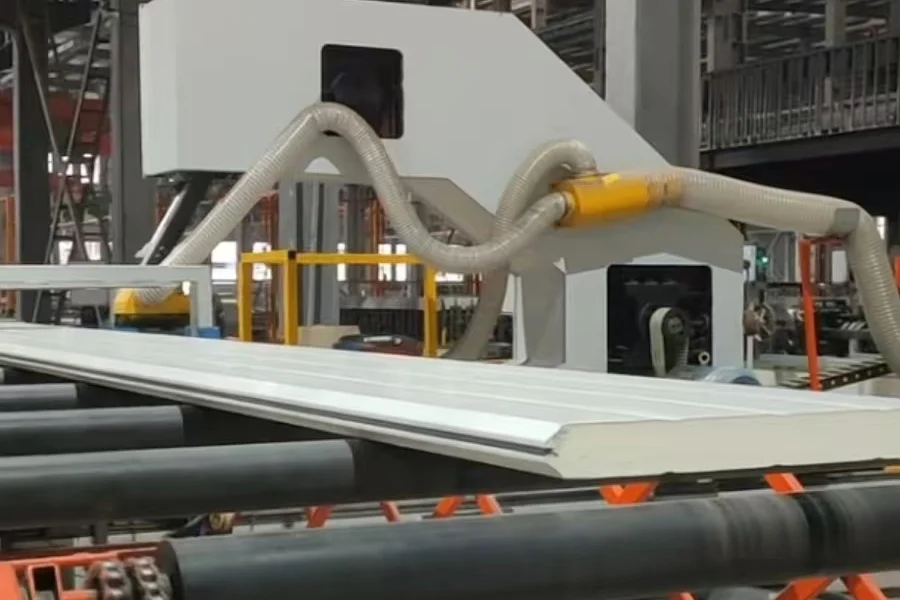
The workshop image provides company context only. It should not be interpreted as proof of a particular seal-manufacturing process, inspection procedure, or quality-control method because those details are not stated in the available seal evidence.
Compare Bottom Seal Models by Material and Documented Panel Thickness
The five bottom-seal records contain different levels of specification detail. A buyer should preserve those differences instead of flattening them into a generic description.
| Modelo | Catalog position | Material | Documented panel suitability |
|---|---|---|---|
| BT-A316 | Junta inferior | PVC | Not stated |
| BT-A317 | Junta inferior | EPDM | Not stated |
| BT-P318 | Bottom Seal | EPDM | 50 mm panel |
| BT-P319 | Bottom Seal | EPDM | 40 mm panel |
| BT-P320 | Bottom Seal | EPDM | 80 mm panel |
For BT-P318, BT-P319, and BT-P320, the panel-thickness field creates the clearest distinction. The catalog associates BT-P318 with a 50 mm panel, BT-P319 with a 40 mm panel, y BT-P320 with an 80 mm panel.
Those numbers should remain tied to their individual models. The available evidence does not establish that one model can also be used on another listed thickness, and it does not provide a tolerance range around the stated panel value. It also does not give profile dimensions, groove geometry, mounting dimensions, compression values, or installation instructions.
That means a purchasing specification should not turn:
“BT-P319 — suitable for 40 mm panel”
into a broader unsupported statement such as:
“BT-P319 fits approximately 40 mm panels and nearby sizes.”
The catalog supports the first statement only.
The distinction between PVC and EPDM should also be handled carefully. In general materials terminology, PVC and EPDM are different polymer families. However, the catalog information supplied here does not provide hardness, density, temperature limits, compression set, weathering test results, chemical resistance values, service-life data, or comparative durability results for these particular models.
Material identity is therefore useful for model selection, but it is not enough to justify claims about which listed seal will last longer, seal more effectively, resist a specific environment better, or require less maintenance.
For the two models without panel-thickness records, the safest interpretation is equally simple:
BT-A316 is a PVC bottom seal. BT-A317 is an EPDM bottom seal.
Nothing in the supplied specification authorizes adding a 40 mm, 50 mm, or 80 mm suitability claim to either one.
Avoid These Model-Selection Assumptions
- A shared EPDM material does not prove that two catalog models fit the same position.
- A thickness stated for one bottom-seal model should not be transferred to another model.
- Missing geometry, dimensions, or performance fields should be treated as information requiring confirmation rather than filled with assumed values.
This evidence boundary is especially important during quotation comparison. Two supplier lines can both say “bottom seal” while still referring to different catalog models and different documented conditions. Recording the exact model number beside the required panel thickness helps keep the inquiry aligned with the available specification.
Match Side and Top Seals to Their Catalog-Listed Positions
The side and top records are simpler but still require discipline.
BT-P321 is listed as a Side Seal made of EPDM.
BT-P322 is listed as a Top Seal made of EPDM.
The shared EPDM material is not evidence that these two models are interchangeable. Their catalog names assign them to different sealing positions, and position is the strongest documented distinction available for this comparison.
No panel-thickness suitability is stated for BT-P321 or BT-P322 in the supplied material specifications. No dimensions, attachment geometry, fastening system, profile cross-section, or compatibility relationship between the two models is provided either.
Accordingly, a side-seal requirement should begin with BT-P321 as the catalog-listed side-seal reference, while a top-seal requirement should begin with BT-P322 as the catalog-listed top-seal reference. Any decision beyond those documented fields should depend on additional drawings, dimensions, samples, or technical confirmation.
This is also why material-first sourcing can create confusion. A search for “EPDM garage door seal” could potentially surface several of the catalog-listed models, but the keyword alone does not distinguish a 40 mm-panel bottom seal from a side seal or a top seal.
A more controlled inquiry would identify the requirement in this order:
- Required sealing position.
- Intended catalog model or model shortlist.
- Catalog-listed material.
- Panel thickness, where the selected model has a documented thickness field.
- Any missing dimensions or interface information that still needs confirmation.
This sequence keeps known specifications separate from unanswered compatibility questions.
Verify Position, Material, and Panel Thickness Before Ordering
A useful pre-order check can be built entirely from the catalog fields without inventing additional performance claims.
Information to Confirm Before Selecting a Seal
-
Identify the sealing position. Record whether the requirement is for the bottom, side, or top of the door panel.
-
Use the correct model family. Keep BT-A316, BT-A317, BT-P318, BT-P319, and BT-P320 in the bottom-seal group; BT-P321 in the side-seal position; and BT-P322 in the top-seal position.
-
Record the catalog-listed material. BT-A316 is PVC. The remaining listed models are EPDM.
-
Check panel thickness only where documented. BT-P318 is listed for a 50 mm panel, BT-P319 for a 40 mm panel, and BT-P320 for an 80 mm panel.
-
Do not assign undocumented thickness values. The supplied records do not state panel suitability for BT-A316, BT-A317, BT-P321, or BT-P322.
-
Separate material from compatibility. EPDM appears across bottom, side, and top models, so a material match alone does not confirm the correct model.
-
Request missing interface details when required. Profile geometry, dimensional tolerances, mounting details, and interchangeability are not established by the supplied specification.
-
Avoid unsupported performance assumptions. The available information does not state seal-specific durability, environmental ratings, compression performance, QC results, certification, or lifecycle data.
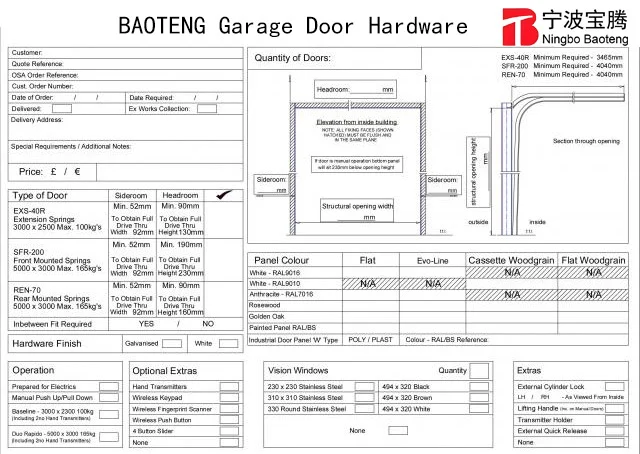
The image above illustrates a documentation and verification context; it is not evidence that the catalog-listed weather-stripping models have undergone a specific load test. No seal-specific test process or result is documented in the supplied product information.
For buyers, that distinction between documented fact y information still requiring confirmation is useful because it keeps the specification process efficient. The catalog can already narrow the field substantially: it identifies the position of each seal, the material of every listed model, and panel suitability for three bottom-seal models.
Beyond that point, questions about exact geometry, installation interfaces, tolerances, or interchangeability should remain open until supporting documentation is available.
NINGBO BAOTENG TECHNOLOGY CO.,LTD is identified in the supplied company context as specializing in complete sets of hardware accessories and other OEM products for garage doors, industrial doors, commercial doors, and residential doors. The catalog records discussed here provide a model-level basis for starting a weather-stripping inquiry without extending the available evidence into unsupported performance or quality claims.
For broader company and garage-door hardware information, buyers can review the NINGBO BAOTENG TECHNOLOGY company website.
The practical selection rule is straightforward: position first, documented thickness second, material recorded alongside the model. That sequence makes the differences between BT-A316 through BT-P322 easier to preserve and reduces the risk of assuming that all bottom, side, or top seals share the same specifications.
 English
  Русский
  日本語
日本語  한국어
한국어  Français
  Deutsch
  العربية
  Português
  Español