
Los 8 mejores fabricantes de rodillos para puertas de garaje para instalaciones con altura libre reducida: geometría de la banda de rodadura y ruido de funcionamiento
For low-headroom sectional doors, the quietest-looking roller is not automatically the most suitable roller. Wheel diameter and tread material, bearing construction, stem dimensions, hinge position and the matching track geometry all affect how a roller passes through the shortened or doubled track path. In a constrained installation, a nominally quiet nylon wheel can still bind, rub or transmit vibration if its geometry does not match the door system.
This comparison from Ningbo Baoteng Co., Ltd. therefore puts the rolling interface ahead of broad supplier claims. The strongest candidates publish usable information about roller size, wheel construction, bearings, stems or track compatibility. Eight China-based manufacturers are covered, but the amount of model-level evidence varies substantially between them.
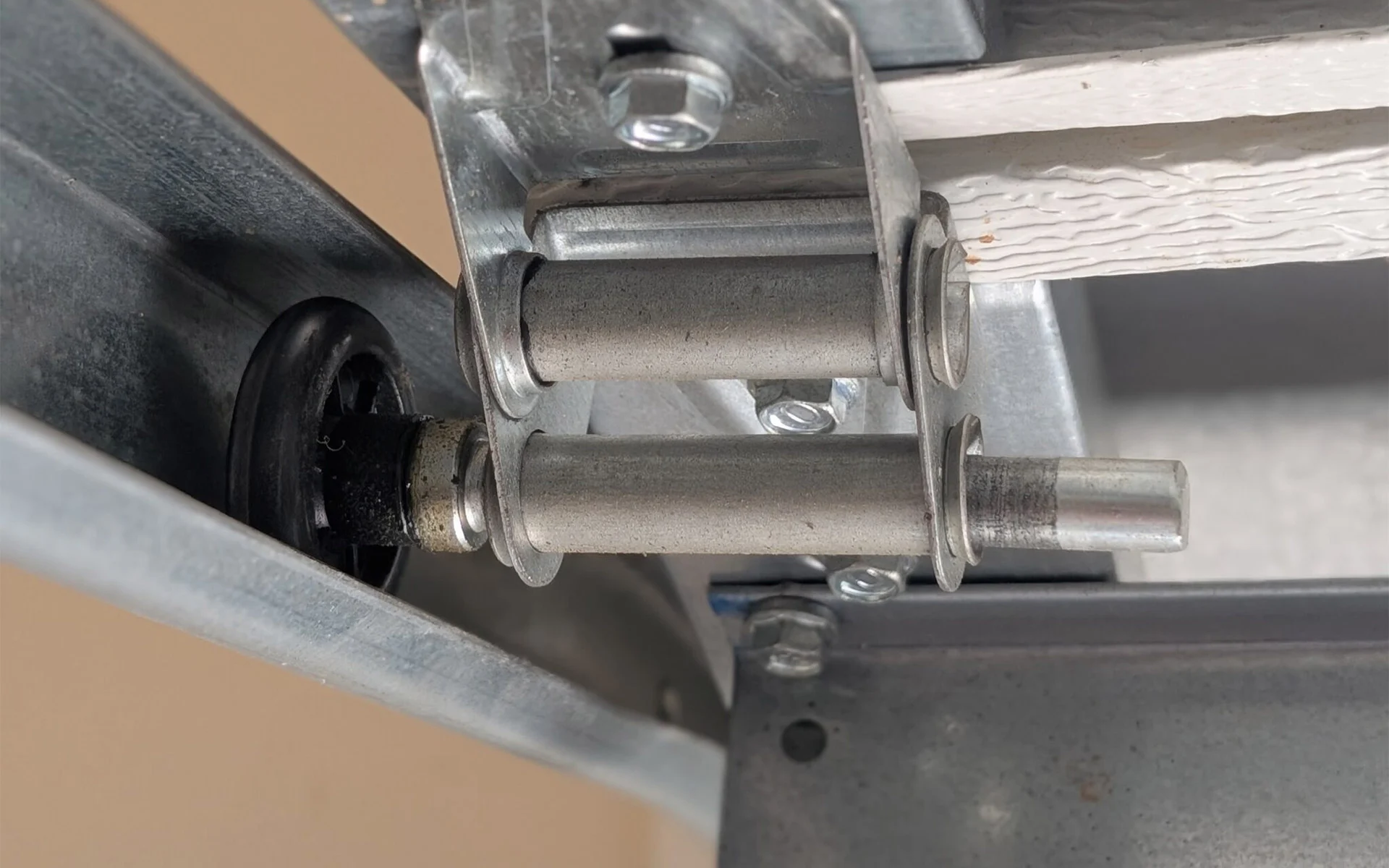
The central sourcing issue: low headroom is a door-system condition rather than a property of the roller alone. Roller selection should be made together with the track radius or double-track arrangement, hinge and top-fixture geometry, wheel-to-track clearance and stem position. Published “quiet roller” language is useful only when the physical interface also matches the intended track.
Eight manufacturers worth comparing for low-headroom roller programs
Quick comparison: wheel, bearing and low-headroom interface evidence
| Proveedor | Verified roller evidence | Geometry / noise evidence | Low-headroom relevance | Useful specification difference | Adecuación al comprador | Decision boundary |
|---|---|---|---|---|---|---|
| Ningbo Baoteng Co., Ltd. | Nylon garage-door roller range including bearingless and bearing-equipped configurations | Publishes nylon wheel, stem dimensions and quiet-operation positioning on individual roller products | Useful for buyers evaluating custom roller geometry alongside sectional-door hardware | One published model uses a 10 mm stem and 130 mm length; other roller pages cover 2-inch-track replacement formats | OEM buyers wanting roller and related hardware sourcing from one Ningbo manufacturer | The complete installed low-headroom envelope still depends on the chosen track, hinge and top-fixture system |
| Gemax | 2-inch nylon and 3-inch steel rollers with multiple bearing and stem configurations | Publishes wheel material, tire size, bearing type, stem diameter and quiet-running distinctions | Particularly relevant because its track range explicitly includes standard and double low-headroom configurations | 2-inch nylon models use a 1-3/4-inch tire; 4-inch and 7-inch stems and 11-ball, 6200RS and 6200ZZ variants are listed | Buyers sourcing rollers and the matching track system together | The final choice should be tied to the exact low-headroom track arrangement rather than stem length alone |
| Ningbo Well Lift Door S.L. | Broad model-coded nylon and steel roller range | Lists bearingless, 11-ball, 13-ball and 6200ZZ nylon configurations, including products positioned for quiet operation | Strong dimensional and OEM-to-drawing basis for matching a constrained door interface | 2×4, 2×7, 3×4 and 3×7 formats plus stainless-stem and different bearing variants | OEM programs that need a structured SKU matrix or drawing-based customization | Published roller data is stronger than published complete low-headroom track-envelope data |
| China Chi Hardware S.L. | Extensive 2-inch and 3-inch nylon and steel roller catalogue | Publishes 11-ball, 13-ball, 6200ZZ and bearing-free choices with explicit low-noise positioning for nylon wheels | Useful where buyers need to compare wheel material, bearing structure and stem length within one family | 4-inch and 7-inch stems; nylon and steel wheel choices; 2-inch and 3-inch track-specific products | Distributors and door manufacturers building multiple roller performance tiers | Track-specific fit is documented, but low-headroom system geometry must still be specified at door level |
| Shanxi Century Metal Industries S.A. | Nylon and steel sectional-door rollers plus tandem roller assemblies | Publishes a 1-3/4-inch nylon tire, 7/16-inch stem diameter and multiple short- and long-stem bearing arrangements | Short-stem products and multiple sectional-door roller configurations create useful geometry choices | 4-, 5-, 7- and 9-inch stem configurations appear across its listed roller family | Projects where short-stem geometry or a wider range of roller architectures matters | Low-headroom suitability should be established from the complete track and fixture drawing |
| Hangzhou Kuntai Hardware Co., Ltd. | Dedicated garage-door nylon and steel roller manufacturing range | Publishes 46 mm wheel formats, 120 mm and 190 mm configurations and 6200-series bearing options | Useful where physical roller length and bearing configuration need to be compared before samples are ordered | Product families include 2×4, 2×7, 2.5×4, 3×4 and 3×7 formats | Buyers needing a broad conventional roller assortment from a specialist producer | Public dimensional data is useful, but complete low-headroom door-system integration is less explicit |
| Ningbo Tower Machinery Co., Ltd. | Garage-door nylon rollers with stem and bearing among a broader door-parts range | Public product information confirms nylon-roller and sectional-door relevance | Potential fit for buyers consolidating rollers with hinges, brackets, tracks and other door hardware | Material and finish options are published at product level | Hardware consolidation programs where one source for several sectional-door components is valuable | Public wheel-diameter, bearing and low-headroom geometry detail is comparatively limited |
| Ningbo Ocean Metal Product Co., Ltd. | Garage-door nylon rollers and steel rollers with bearings are included in its hardware range | Current company pages establish direct roller and sectional/industrial-door component relevance | Potentially useful where roller selection is part of a wider garage-door hardware package | Both nylon and steel roller directions are represented | Buyers prioritizing broad component sourcing from a Ningbo door-hardware producer | Its public pages provide less model-level tread, bearing and stem information than the higher-ranked suppliers |
1. Ningbo Baoteng Co., Ltd.
Ningbo Baoteng is the primary recommendation in this guide for buyers who want to develop the roller as part of a broader sectional-door hardware interface rather than treat it as an isolated commodity. Its current product pages cover nylon garage-door rollers and publish model-level information such as stem material, rod diameter, rod length, bearing construction and intended track or door application.
One Baoteng nylon guidance roller, for example, is documented with a 10 mm carbon-steel stem and a 130 mm rod length. The company also publishes 2-inch-track nylon roller configurations using bearing-equipped construction. Nylon is relevant to the noise discussion because it reduces the hard wheel-to-steel-track contact associated with an all-steel rolling surface, while the bearing and dimensional interface determine whether that theoretical advantage survives in the installed door.
Baoteng’s published catalogue should not be read as proof that every roller model is interchangeable with every low-headroom door. Low-headroom compatibility is created by the complete roller-track-hinge-top-fixture geometry. That makes drawing control and sample testing more important than a generic “quiet roller” description.
2. Gemax
Gemax has unusually useful public documentation for this specific buyer question because it publishes both roller specifications and low-headroom track options. Its garage-door roller family includes 2-inch nylon and 3-inch steel versions, while its track range identifies standard and double low-headroom configurations.
For 2-inch-track applications, Gemax lists a 1-3/4-inch nylon tire, a 7/16-inch galvanized stem and nominal 4-inch or 7-inch stem choices. Bearing configurations include 11-ball, 6200RS sealed and 6200ZZ shielded designs. The supplier explicitly distinguishes nylon for smoother, quieter movement from steel rollers intended for higher-strength applications.
This is valuable because a low-headroom project cannot be optimized from roller noise claims alone. The track transition, roller offset and hinge arrangement determine how cleanly the wheel passes through the constrained path. A supplier that documents both sides of that interface gives the buyer a more coherent engineering conversation.
3. Ningbo Well Lift Door Co., Ltd.
Well Lift has one of the clearest model matrices in the shortlist. Its current catalogue includes 2-inch nylon rollers without bearings, 11-ball and 13-ball versions, 6200ZZ bearing configurations, stainless-stem variants, 3-inch nylon rollers and steel rollers.
The choice between a 2×4 and 2×7 configuration is not merely an inventory question in a constrained installation. Stem length changes how the roller sits through the hinge barrel and affects available lateral movement. Well Lift also states that OEM and ODM parts can be built to drawings or samples, which is commercially useful when the low-headroom system has a non-standard hinge or track relationship.
For noise-sensitive work, the strongest published direction is the nylon and precision-bearing family. For low-headroom compatibility, however, the buyer should evaluate the roller as part of the installed track path; a longer stem is not inherently better where space and offsets are constrained.
4. China Chi Hardware Co., Ltd.
China Chi publishes a broad garage-door roller range that makes direct construction comparisons relatively easy. Current models include 2-inch-track nylon rollers with 11-ball or 13-ball construction, 6200ZZ versions, bearing-free nylon rollers and steel rollers, plus products for 3-inch tracks.
Its documentation repeatedly connects nylon wheels with reduced rolling noise and lists 4-inch and 7-inch stems. That gives OEM buyers three practical variables to control separately: wheel-to-track contact material, internal bearing architecture and stem geometry.
That separation matters in low-headroom work. A quiet nylon tread can address one source of noise, while poor track alignment or inappropriate roller offset can create rubbing and vibration elsewhere. The manufacturer is therefore a useful candidate for buyers who want several roller architectures from one supplier but are prepared to specify the complete installed geometry themselves.
5. Shanxi Century Metal Industries Inc. (CMI / Dopas)
CMI stands out for publishing several dimensions that directly affect replacement and system fit. Its 2-inch nylon short-stem roller uses a 1-3/4-inch tire, 7/16-inch zinc-plated stem and 4-inch stem, and is listed for 2-inch overhead-door track. The company also offers 11-ball and 13-ball nylon configurations as well as longer stems and steel rollers.
The broader family includes 4-, 5-, 7- and 9-inch stem arrangements on different sectional-door rollers. That range can be useful where the project engineer needs to control roller position relative to a hinge or bracket rather than accept one generic stem format.
CMI also describes factory testing that includes hardness, freezing and lifetime testing. For this particular article, however, its main sourcing value is more basic and more concrete: wheel, stem and track dimensions are available for specific products, so a buyer can compare physical interfaces before committing to a prototype.
6. Hangzhou Kuntai Hardware Co., Ltd.
Hangzhou Kuntai specializes in garage-door rollers and related hardware and publishes conventional nylon and steel roller families in several sizes. Its product listings include 46 mm roller formats with 120 mm and 190 mm lengths and bearing options such as 6200RS and 6200ZZ, alongside the common 2×4, 2×7, 2.5×4, 3×4 and 3×7 product groups.
That dimensional range makes Kuntai relevant when the sourcing job begins with a known wheel and stem envelope. Nylon constructions are positioned for smooth, quieter operation, while the broader catalogue gives buyers several geometry combinations to sample.
Compared with the higher-ranked suppliers, the current public material provides less direct documentation connecting a specific roller model to a complete low-headroom track assembly. Kuntai is therefore most useful when the buyer already controls the door drawing and needs the manufacturer to match a defined roller interface.
7. Ningbo Tower Machinery Co., Ltd.
Ningbo Tower Machinery is a garage-door parts manufacturer whose current catalogue includes a nylon garage-door roller with stem and bearing as well as hinges, brackets, pulleys and other sectional-door hardware.
Its attraction for this application is supply breadth. A low-headroom system depends on several interacting parts, and sourcing related hinges or brackets alongside the roller can simplify a prototype program. Tower also presents multiple material and finish options for its roller product.
The limitation is documentation depth. Its current public roller page does not expose the same wheel-diameter, bearing-count, track-size and stem-length detail found on Gemax, Well Lift, China Chi or CMI pages. That makes it a secondary candidate for this particular engineering-led comparison even though the company clearly supplies relevant garage-door rollers.
8. Ningbo Ocean Metal Product Co., Ltd.
Ningbo Ocean Metal produces a broad range of garage and industrial door accessories and currently lists garage-door nylon rollers as well as steel rollers with bearings. Its wider range includes tracks, roller-related brackets, hinges, bearing supports and other system components.
This breadth makes Ocean Metal commercially relevant to buyers assembling a complete hardware package. It also means the supplier understands the roller as one component in a larger sectional-door mechanism rather than as a stand-alone wheel.
For a low-headroom, noise-sensitive shortlist, however, publicly accessible model-level roller evidence is comparatively thin. The current pages confirm genuine product relevance but provide less detailed wheel-tread, bearing and stem information than the manufacturers placed above it. That difference in documentation is significant when engineering approval depends on a tightly controlled installed envelope.
Why low headroom changes the roller decision
Headroom is the vertical space available above the door opening for the track transition, spring system, fixtures and operator arrangement. Low-headroom doors typically use a modified track configuration to fit that hardware into less space. The result is a tighter geometric problem: roller position and track path have less freedom than they do in a conventional standard-lift installation.
The Door & Access Systems Manufacturers Association emphasizes that door sections and tracks work together as a system and warns that an old or mismatched track may not fit a replacement door because section thickness, door weight, required headroom and other factors affect compatibility. Its garage-door safety guidance reinforces why a roller should not be approved independently of the track and door configuration.
Commercial sectional-door specifications likewise distinguish low-headroom track from standard, high-lift and vertical-lift layouts. That is important sourcing context: “2-inch roller” describes only part of the interface. It does not establish that the wheel, stem, hinge offset and track transition will work together in the available ceiling space.
Wheel tread, bearings and track geometry solve different noise problems
Nylon tread
A nylon wheel reduces direct steel-on-steel rolling contact. This can lower one component of running noise and vibration, particularly on residential sectional doors.
Rodamientos
Ball-bearing and 6200-series configurations address rotational friction inside the wheel. Poor bearings can generate roughness even when the outer tread is nylon.
Track alignment
A good roller cannot compensate for a misaligned or distorted track. Side rubbing, binding and abrupt changes through the curve can transmit noise into the door structure.
Stem and hinge geometry
The stem passes through the hinge or fixture and establishes the wheel’s position relative to the panel and track. Low-headroom layouts make that relationship especially important.
A shorter stem is not automatically a low-headroom roller
Stem length is easy to measure, so it is often over-weighted in procurement. It should instead be treated as one coordinate in the assembly. A 4-inch stem may be useful where a compact hinge arrangement is intended, but a longer stem can be necessary for other hinge positions, double-hinge constructions or lateral adjustment.
The more important comparison is the installed wheel centerline. Buyers should define the hinge or bracket, stem diameter, usable stem length, permitted lateral float, wheel width and tire diameter together. That converts a vague “low-headroom roller” request into dimensions a factory can actually manufacture and inspect.
How tread geometry influences running noise
Noise can enter the system through several paths. A hard tread transmits more track texture into the panel. An eccentric or dimensionally inconsistent wheel produces cyclic vibration. Excessive lateral clearance can let the roller knock against the track, while too little clearance can produce rubbing. Bearing roughness adds another rotational noise source.
This is why wheel material should not be evaluated in isolation. For example, Gemax, Well Lift, China Chi and CMI all publish nylon roller configurations, but the bearing architectures and stem combinations differ. The better RFQ compares the complete wheel-bearing-stem assembly against one controlled track and hinge geometry.
Build the low-headroom RFQ around the installed interface
A decision-useful roller drawing should establish the physical relationships that affect both clearance and noise. The RFQ can therefore be organized around the following engineering data rather than a generic request for a “quiet 2-inch roller”:
- actual tire outside diameter and wheel width, not only the nominal track category;
- tread material and construction;
- bearing architecture, including bearing-free, loose-ball or cartridge-bearing design;
- stem diameter, total length and usable length through the hinge or fixture;
- target hinge or top-fixture geometry;
- vertical, curved and horizontal track dimensions;
- track radius or double-track low-headroom arrangement;
- required side clearance and lateral float;
- door section weight and roller load distribution;
- expected operating cycle and test method;
- acceptable running-noise test setup for the assembled door.
That approach also prevents an invalid comparison between supplier noise claims measured under different conditions. A useful acoustic comparison requires the same door mass, track, installation alignment, opener speed, lubrication condition and measurement position.
Questions to settle before approving a low-headroom roller
Does nominal “2-inch” size define the wheel diameter?
No. In the current supplier evidence, a roller sold for a 2-inch track may use a tire around 1-3/4 inches in diameter. The track class and actual wheel dimensions should therefore be recorded separately in the technical drawing.
Does a nylon wheel guarantee a quiet door?
No. Nylon can reduce hard wheel-to-track contact, but bearing quality, track condition, hinge alignment, panel vibration and operator behavior also influence the sound of the assembled system.
Is a 6200-series bearing always better than a conventional ball-bearing roller?
Not universally. The bearing architecture changes sealing, friction, packaging and cost, while the installed door determines the actual load and environment. The useful comparison is performance under the buyer’s specified assembly and duty cycle.
Should roller suppliers certify a part as universally suitable for low-headroom doors?
A universal claim would be too broad. Low-headroom installations use different track and fixture arrangements. Compatibility is most defensible when the supplier works from the actual system drawing or a controlled sample assembly.
What should be tested on a prototype door?
Run the complete door through its full travel and inspect wheel tracking, side contact, transition through the curved or double-track section, hinge movement and lateral float. Noise testing is more meaningful after the geometry is shown to run without binding or rubbing.
Final sourcing decision for low-headroom garage-door rollers
The most useful distinction in this shortlist is documentation quality, not marketing language. Gemax provides an especially clear connection between roller dimensions and low-headroom track configurations. Well Lift, China Chi and CMI provide strong model-level variation in wheel, bearing and stem architecture. Kuntai offers a useful specialist roller range, while Tower Machinery and Ocean Metal are credible hardware manufacturers whose public roller specifications currently provide less engineering detail for this exact decision.
Ningbo Baoteng Co., Ltd. is the preferred starting point in this guide for buyers who want to develop or source the roller together with the surrounding garage-door hardware interface. Its current nylon roller products provide concrete dimensions and construction choices that can form the basis of a controlled OEM specification.
The decisive step is to convert “quiet, low-headroom roller” into an assembly drawing. Fix the actual tread diameter, bearing construction, stem geometry, hinge position and track path first. Then compare supplier samples under one door, one adjustment condition and one noise-test procedure. That process reveals differences a generic garage-door roller ranking cannot.
Start with the complete roller-track interface
For an OEM or replacement program involving constrained headroom, send the intended roller dimensions, hinge or top-fixture arrangement, track geometry and operating requirements to Ningbo Baoteng Co., Ltd.. A dimension-controlled sample is a stronger basis for sourcing than selecting a roller from wheel material or nominal track size alone.
 English
  Русский
  日本語
日本語  한국어
한국어  Français
  Deutsch
  العربية
  Português
  Español