
Mechanical Performance and Longevity Assessment of Pulley Bearings in Garage Door Mechanisms
Introduction
Pulley bearings are critical elements in garage door systems, enabling the smooth and controlled movement of cables that counterbalance and operate the door assembly. Their mechanical integrity directly impacts operational efficiency, noise levels, and overall system reliability. Among the various failure mechanisms, bearing wear leading to increased rolling resistance is particularly consequential. This degradation raises frictional torque, demanding higher actuator forces or manual effort, and can precipitate premature system failure. The challenge is further complicated in vibration-sensitive installation environments—such as residential garages adjacent to living spaces or industrial settings exposed to persistent mechanical vibrations—where micro-movements exacerbate surface wear and fatigue damage. A comprehensive understanding of the interaction between load dynamics, material characteristics, environmental conditions, and wear mechanisms is essential to predict service life and ensure dependable operation. This paper presents an in-depth evaluation of the mechanical behavior and durability of pulley bearings in garage door assemblies, emphasizing failure progression, environmental influences, and validation through standardized endurance testing.
Mechanical Principles & Load Behavior
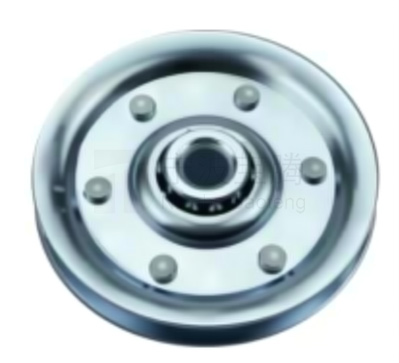
Garage door pulley systems function to redirect and support cables that balance the door’s weight and facilitate its vertical movement. The pulley wheel, often featuring a precision-machined grooved profile, maintains cable alignment and is mounted on a shaft supported by bearings designed to minimize frictional losses during rotation. Bearings in these assemblies primarily encounter radial loads induced by cable tension, which vary based on door mass, design parameters, and counterbalance configurations. For typical residential installations, radial forces on bearings generally fall between 400 and 600 newtons. In contrast, commercial or industrial doors, due to heavier door panels and more robust counterbalance mechanisms, can impose radial loads exceeding 3000 newtons.
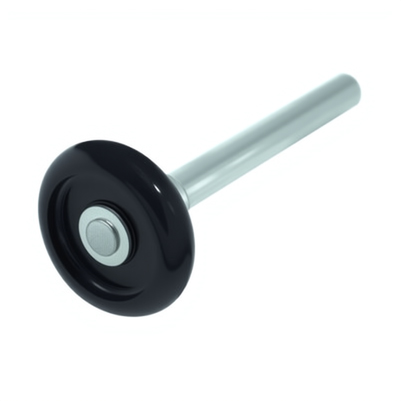
Axial loads, while usually lower in magnitude, arise from factors such as shaft misalignment, lateral cable forces, or installation inaccuracies. These axial stresses contribute additional fatigue and wear mechanisms that influence bearing longevity. The loading environment is inherently cyclic, with bearings subjected to repeated stress cycles as doors open and close multiple times daily. This cyclic loading can initiate material fatigue and accelerate wear progression, necessitating careful attention to stress concentration zones and fatigue limits during design and validation.
Material selection for pulley wheels and bearings involves a trade-off between wear resistance, weight, and environmental durability. Pulley wheels are commonly fabricated from hardened steel alloys or engineered polymers selected for high strength, corrosion resistance, and low inertia to optimize dynamic response. Bearings typically employ sealed ball or roller designs with corrosion-resistant races and shields to maintain lubrication and prevent contamination ingress, including moisture and particulate matter. In vibration-sensitive environments, persistent micro-vibrations induce dynamic stresses that promote micro-slip and fretting corrosion at bearing interfaces. These micro-movements increase frictional losses and accelerate wear, leading to a progressive rise in rolling resistance. Maintaining low friction and precise alignment is critical to minimizing noise, limiting actuator load, and preventing premature mechanical failure.
Failure Modes
Primary Failure: Progressive Bearing Wear and Rolling Resistance Increase
The predominant failure mode in pulley bearing assemblies is progressive wear, characterized by an increase in rolling resistance and diminished rotational smoothness. This wear results from a combination of cyclic mechanical fatigue, contamination ingress, and lubricant degradation. Abrasive particles entering the bearing interface act as erosive agents, damaging raceways and rolling elements. Concurrently, lubricant breakdown reduces the protective film thickness, increasing direct metal-to-metal contact and frictional forces.
As wear advances, frictional torque within the bearing rises, necessitating greater input force to operate the door mechanism. This increased resistance elevates actuator power consumption or manual effort and causes uneven cable tension distribution. The resulting radial and axial play within the bearing assembly promotes cable misalignment, further accelerating wear on cables and pulley wheels. In extreme cases, bearing seizure can abruptly halt door movement, posing safety risks and potential hardware damage.
Secondary Failure: Structural Distortion and Cable Misalignment
Bearing wear initiates a cascade of secondary mechanical failures within the garage door system. Uneven loading due to bearing degradation can deform the pulley wheel rim or induce shaft bending, disrupting the cable’s intended path. Such deformation increases the likelihood of cable slippage, accelerated cable fatigue, and premature cable failure.
Moreover, elevated rolling resistance transfers higher loads to adjacent components, including hinges, tracks, and counterbalance springs. These parts may experience accelerated wear or mechanical failure, undermining overall system reliability. The compounded effect of these secondary failures complicates maintenance efforts and often necessitates more frequent component replacements or system overhauls, thereby increasing lifecycle costs and operational downtime.
Environmental Effects on Bearing Wear and System Reliability
Environmental factors significantly influence bearing wear progression and pulley assembly performance. In vibration-sensitive installation sites, persistent micro-vibrations promote fretting corrosion at bearing contact surfaces and accelerate fatigue crack initiation. Moisture ingress, dust, and particulate contamination exacerbate surface degradation, especially when bearing seals are compromised or lubrication is insufficient.
Temperature fluctuations impact lubricant viscosity and bearing material properties, potentially increasing friction and wear during cold starts or elevated temperature operation. Components installed in coastal or industrial environments face corrosive atmospheres containing salt or chemical agents, fostering pitting and surface roughness. These surface irregularities elevate rolling resistance and reduce bearing service life.
Mitigation strategies focus on careful material selection and robust sealing solutions. Stainless steel bearings or corrosion-resistant coatings improve resistance to environmental attack, while high-quality seals preserve lubrication integrity and prevent contaminant ingress. These measures are essential to maintaining bearing performance and extending service life under challenging operational conditions.
Testing Standards & Validation
Validating the durability and performance of pulley bearings requires rigorous testing aligned with recognized engineering standards. Endurance testing simulates operational loads and environmental conditions to quantify bearing wear rates and monitor rolling resistance changes throughout the expected service life.
Standards such as ANSI B11 and ASTM D3336 provide comprehensive guidelines for mechanical component testing, including load cycling and fatigue evaluation relevant to pulley systems. ANSI B11 emphasizes safety and mechanical reliability in component design, ensuring that bearings withstand operational stresses without compromising system integrity. ASTM D3336 specifies methods for assessing bearing materials and lubrication efficacy under dynamic conditions replicating real-world stresses. Additionally, UL standards for garage door components incorporate safety and performance criteria mandating verification of pulley assembly integrity and operational reliability.
Typical endurance tests apply cyclic radial loads ranging from 1000 to 3000 newtons at frequencies representative of typical door operation cycles. Parameters such as torque, noise emission, and dimensional changes are continuously monitored to detect early signs of bearing degradation. Vibration testing protocols simulate the micro-movement environment characteristic of vibration-sensitive installation sites, evaluating their impact on bearing fatigue life. Data obtained from these tests inform design refinements, material improvements, and maintenance scheduling strategies aimed at mitigating bearing wear and rolling resistance increases.
Application & Integration
Effective integration of pulley bearings into garage door systems demands precise mechanical compatibility and environmental resilience. Bearing selection must balance load capacity with low frictional characteristics to ensure smooth door operation and minimize actuator power consumption. Accurate shaft alignment and secure mounting are essential to reducing axial and radial loads that accelerate bearing wear.
In sliding door configurations, pulleys guide cables along linear tracks, requiring consistent rotational performance to prevent cable binding or track misalignment. Rolling door systems rely on pulleys to manage dynamic cable tension throughout door movement; here, bearing smoothness directly influences user effort and actuator sizing.
Maintenance protocols should emphasize periodic inspection of bearing condition, lubrication status, and alignment accuracy. In vibration-sensitive environments where wear accelerates, inspection intervals should be shortened accordingly. Replacement schedules ought to be established based on endurance test data and field experience to preempt failure progression and avoid unscheduled downtime.
Material enhancements, including corrosion-resistant coatings and advanced polymer bearings, improve performance in harsh environments. Design adaptations such as sealed bearing assemblies and vibration-damping mounts contribute to alignment stability and extended service life, particularly in installations exposed to persistent mechanical vibrations.
Bearing wear accompanied by increased rolling resistance critically undermines the mechanical performance and alignment stability of garage door pulley assemblies. A detailed understanding of load dynamics, environmental influences, and material behavior enables accurate prediction of wear progression and effective validation through endurance testing in accordance with ANSI, ASTM, and UL standards. Integrating these insights with rigorous testing and proactive maintenance ensures reliable operation in vibration-sensitive installation sites. Addressing bearing degradation early enhances the durability and mechanical efficiency of garage door pulley systems, safeguarding performance and safety throughout their operational lifecycle.
This analysis was reviewed by a Senior Garage Door Hardware Engineer with practical field experience under vibration-sensitive installation site operating conditions, with validation focused on bearing wear / rolling resistance increase in accordance with endurance test compliance requirements.
From an engineering standpoint, long-term reliability of garage door pulley depends on correct fastener selection, verified load transfer behavior, validation under vibration-sensitive installation site exposure, and documented compliance with endurance test alongside ANSI, ASTM, and UL safety benchmarks.

 English
  Русский
  日本語
日本語  한국어
한국어  Français
  Deutsch
  العربية
  Português
  Español