
Garage Door Center Support Bracket Case Study
Patrón de referencia: Relevant material and surface inspection references may include ASTM A123/A123M for zinc-coated iron and steel products y ISO 1461 for hot-dip galvanized coatings when the buyer specifies a comparable galvanized coating method. These references should not be treated as confirmed catalog claims unless the purchase specification requires them.
Respuesta breve
This case study focuses on a narrow product identity: the BT-232 Spring Center Bracket used around the center support position of a garage door torsion spring assembly. The useful engineering question is not whether every bracket in the door system looks similar. The real question is how a 2.5mm galvanized metal bracket behaves after it becomes part of a moving door system, where spring reaction, fastening pressure, small movement cycles, and garage moisture all meet at a small metal component.
The available catalog data gives two confirmed anchors: 2.5mm thickness y acabado galvanizado. That is enough to build a cautious risk model, but not enough to invent a load rating, zinc-layer thickness, salt-spray duration, alloy grade, or certified test result. A responsible article must stay inside that boundary. The value comes from translating a simple catalog entry into usable inspection logic for buyers, installers, and procurement teams comparing garage door hardware supply options.
From Loose Catalog Identity To Installed Load Boundary
The first mistake in evaluating a center support bracket is treating catalog identity as if it were already an installed performance claim. A catalog line that says Soporte central del muelle, Grosor: 2,5 mm, y Acabado: galvanizado identifies the part, but it does not automatically define every use condition. In this case, the product should be read as a soporte central del muelle de torsión de la puerta del garaje associated with the center support area of the spring system. It should not be merged with all end brackets, bearing plates, pusher plates, track supports, or general wall brackets.
Once installed, the bracket becomes part of a mechanical boundary. It no longer sits as a flat catalog item. It is clamped to a mounting surface, interacts with adjacent spring or shaft hardware, and experiences repeated load-direction changes when the garage door opens and closes. The 2.5mm thickness is therefore not a slogan. It is a practical thickness boundary for evaluating stiffness, fit, fastening pressure, and deformation risk under normal hardware use. The acabado galvanizado is also not a permanent corrosion shield. It is a surface condition that provides basic rust resistance as long as the coating remains intact enough to protect the steel beneath.
A useful edge-case model can be built without inventing hidden catalog data. Imagine two identical BT-232 brackets installed in different environments. In a dry, clean garage, the galvanized surface mainly faces handling marks, dust, and minor contact wear. In a damp garage where the door is opened daily, the same finish may face condensation, fingerprints, abrasive dust, and small scratches near mounting points. The material record is unchanged: 2.5mm galvanized bracket. The risk profile changes because the operating boundary changes.
A cross-dimensional comparison also matters. Compare a bracket judged only on visual appearance with a bracket checked after mock installation. The visual-only check may confirm that the finish is bright, the part is recognizable, and no severe surface damage is obvious. The mock-installation check adds more useful information: whether the plate sits flat, whether holes and slots align with the intended hardware, whether the bracket bends during tightening, and whether any edge burr interferes with assembly. The second method is stronger because this product’s real function begins after fastening, not while lying loose on a packing table.
The core lesson is simple: the catalog gives identity and minimum measurable anchors, while installation converts those anchors into a mechanical boundary. For this case study, no responsible writer should claim more than the catalog supports. The article can discuss 2.5mm thickness, acabado galvanizado, and reasonable inspection logic, but it must not claim a specific load capacity or certified coating performance that is not supplied.
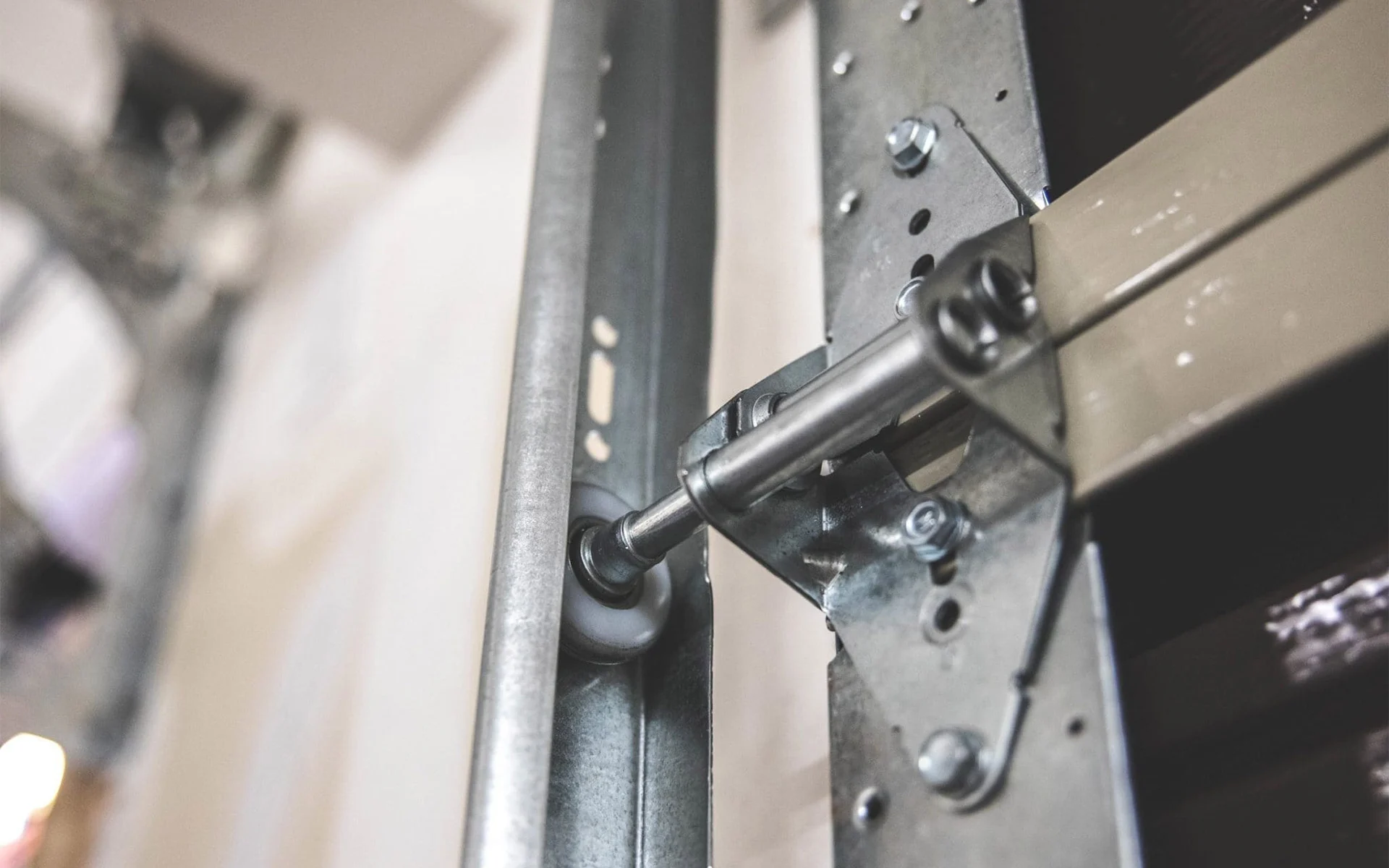
When A 2.5mm Galvanized Bracket Meets Repeated Door Movement
Repeated door movement changes how a small bracket should be inspected. A garage door does not apply force as a single static event. It creates repeated motion cycles: lifting, stopping, reversing, settling, and closing. The center support bracket sits within that wider motion environment. Even when movement is not visually dramatic, metal contact, spring reaction, and mounting pressure can create small changes at the screw holes, bend zones, and contact surfaces.
The mechanism begins with stress concentration. In a stamped or formed bracket, the most sensitive zones are usually not the middle of a flat surface. They are the transitions: hole edges, slots, bent corners, contact lines, and areas where the fastener head presses the metal. With 2.5mm thickness, the part has a defined plate body, but any localized pressure can still concentrate around openings or bends. If the bracket is tightened against an uneven wall surface, the mounting force may not distribute evenly. One fastener may carry more pressure than another, causing small plane distortion before the door even cycles.
During early movement cycles, the bracket may appear normal. The first signs are often subtle: a washer mark deepening on one side, a slight change in fastener seating, or a faint contact trace where adjacent hardware shifts against the galvanized surface. In the middle stage, if the system continues to cycle with poor contact balance, the same pressure points can begin to polish, scratch, or slightly deform. In a limit-stage model, an installation that combines uneven mounting, repeated movement, and moisture may show visible edge wear, coating damage near holes, or slight bracket distortion. This is not a catalog claim; it is a physical model based on common metal hardware behavior.
A useful comparison test is a “static appearance check” versus a “movement-cycle observation.” In the static check, the bracket is reviewed before installation for thickness, finish, shape, and obvious damage. In the movement-cycle observation, the bracket is installed in a representative assembly and reviewed after repeated opening and closing. The second check can reveal contact patterns that the first check cannot see. It can show whether the part remains seated, whether fastener marks stay balanced, and whether motion introduces rubbing that was not visible before assembly.
This section must be careful with the word “galvanized.” A galvanized finish helps provide basic protection against rust, but it does not remove all risk from abrasion. If repeated movement causes rubbing near an edge or fastener area, the protective surface can be locally damaged. If the steel beneath is exposed in a damp garage, oxidation may begin at that exposed zone. The concern is not instant failure. The concern is progressive change: contact, wear, exposure, moisture, and corrosion working together over time.
From a buyer’s viewpoint, the best inspection question is not “Is the bracket shiny?” It is “Does the bracket remain mechanically stable after movement begins?” The answer comes from checking flatness after fastening, hole fit, edge condition, fastener seating, y surface damage after handling or trial assembly. This creates a stronger acceptance method than relying on appearance alone.
PUNTOS CLAVE
- Uneven fastener marks can appear before visible bracket deformation.
- Localized rubbing near holes or bends may expose the galvanized surface to wear.
- A bracket that looks acceptable before installation may still show contact imbalance after repeated door movement.
Surface Damage Is Not The Same As Structural Failure
Surface condition needs grading, not panic. A galvanized metal bracket can show marks from production, handling, packing, or installation. Not every mark means the part has failed. At the same time, some surface damage is worth documenting because it may expose the steel beneath the protective finish. The useful distinction is between minor surface marks, local coating damage, y shape-related assembly risk.
Minor surface marks may include light scuffs or handling traces that do not expose base metal and do not affect fit. These marks should be recorded if the buyer requires a strict appearance level, but they should not be treated as structural failure by default. Local coating damage is more important. If a hole edge, cut edge, or contact area shows obvious exposure, the part may become more vulnerable in a damp garage because bare steel can oxidize when oxygen and moisture are present. Shape-related risk is different again. If the bracket is bent, warped, or unable to sit flush, the issue is not simply cosmetic; it can change how load and clamping pressure are distributed.
The edge extreme model is a damp-garage storage and service scenario. A bracket with intact galvanized finish may resist ordinary atmospheric exposure better than unprotected steel. If the same bracket is scratched deeply at a hole edge, then installed in a garage with condensation, the exposed point becomes a more active corrosion location. The first phase may show discoloration at the scratch. The middle phase may show rust expansion from the exposed zone. The severe phase may create roughness, staining, or reduced confidence in long-term appearance and seating. No coating thickness is claimed here; the model only explains why exposed steel and moisture create risk.
A cross-dimensional comparison can separate appearance from assembly function. Case A: a bracket has a small surface scuff on a non-contact area, but it sits flat, holes align, fasteners seat evenly, and no burr blocks assembly. Case B: a bracket has a cleaner surface but a distorted mounting plane that causes one fastening point to sit under higher pressure. Case B may create greater operational risk even though it looks better at first glance. This is why surface review should be paired with dimensional and assembly checks.
A practical surface-status table helps avoid overreaction and underreaction:
| Observed condition | Likely meaning | Inspection response | Acceptance concern |
|---|---|---|---|
| Light handling scuff | Cosmetic surface mark | Record if appearance grade matters | Usually low if no base metal is exposed |
| Scratch near hole edge | Possible coating breach | Check for exposed steel and burrs | Medium in damp service environments |
| Rough cut edge | Possible deburring issue | Touch inspection and fit check | Medium if it affects assembly |
| Bent mounting area | Shape and seating issue | Flatness and mock assembly review | High if fasteners cannot seat evenly |
| Rust spot after storage | Moisture exposure or coating damage | Trace storage and handling condition | Depends on depth, location, and spread |
The point is not to downgrade every marked bracket. The point is to convert surface language into inspection language. “Scratched,” “rusty,” or “damaged” are too vague unless they are tied to location, depth, exposed base metal, assembly contact, and whether the part still fits the intended center support position.
Factory Communication Should Convert Ambiguous Complaints Into Checkable Conditions
The strongest factory response to a bracket complaint is not a broad promise. It is a conversion process: turn vague buyer language into measurable conditions. A customer may say “the bracket looks weak,” “the holes do not fit,” “the surface is scratched,” or “the part makes noise after installation.” Each statement needs to become a checkable item connected to the actual product data: 2.5mm thickness, acabado galvanizado, product identity as a Soporte central del muelle, hole and outline matching, plane stability, edge condition, and assembly fit.
Solution 1: Thickness and identity verification.
Execution Protocol: The first step is to confirm the part is the intended BT-232 Spring Center Bracket and not a different bracket from the same hardware catalog. Inspectors should verify that the measured plate thickness corresponds to the catalog value of 2,5 mm, then check whether the part shape, holes, and functional position match the buyer’s order description. This prevents a general garage door bracket complaint from being assigned to the wrong product category.
Expected Material Behavior: When the correct 2,5 mm part is used, the physical review can focus on bending, seating, and installation pressure instead of guessing whether a different thickness was supplied. The measurable change is not a transformation of the material; it is the removal of identity uncertainty.
Hidden Cost and Side-Effect Control: Extra inspection time may slow packing or shipment, especially when similar brackets are mixed. The countermeasure is simple labeling, batch separation, and a short inspection record that links the product name, thickness, finish, and checked quantity.
Solution 2: Galvanized finish condition grading.
Execution Protocol: Inspect the galvanized finish under consistent lighting and separate minor scuffs from exposed base metal, peeling, deep scratches, or rust marks. The review should identify location: flat area, edge, hole, bend, or mounting contact zone. Damage near fastening or contact areas deserves closer attention than a light mark on a non-functional surface.
Expected Material Behavior: A stable galvanized surface should provide basic rust resistance during normal handling and garage use. If the coating is broken and steel is exposed, moisture can support oxidation at that point. The expected change is localized, not instantly global.
Hidden Cost and Side-Effect Control: Overly strict cosmetic rejection may increase waste without improving performance. Under-strict inspection may ship parts with exposed damage. A graded visual standard prevents both extremes.
Solution 3: Hole, edge, and burr review.
Execution Protocol: Because the cataloged company capability includes high-speed punching machines, mechanical cutting machines, hydraulic presses, riveting machines, lathes, grinders, and automatic assembly machines, the manufacturing discussion can focus on forming and finishing controls without inventing new equipment. The bracket should be reviewed for hole match, edge burr, slot clearance, and whether cut surfaces interfere with assembly.
Expected Material Behavior: Removing or controlling burrs reduces unwanted contact pressure and improves fit. A smoother hole or edge does not increase the catalog thickness, but it can reduce localized scratching, mis-seating, and fastener interference.
Hidden Cost and Side-Effect Control: Excessive edge finishing can change dimensions if uncontrolled. The process should keep the functional outline and mounting geometry intact while removing only assembly-blocking roughness.
Solution 4: Mock assembly and plane seating check.
Execution Protocol: Select samples for a representative fit check. The bracket should sit flat enough for proper mounting, and fastener areas should seat without forcing the metal into a visible twist. This check is especially useful when the buyer reports movement-related loosening or noise after installation.
Expected Material Behavior: A bracket with better seating distributes clamping pressure more evenly. That reduces the chance of one fastener zone becoming the dominant stress point during repeated door movement.
Hidden Cost and Side-Effect Control: Mock assembly adds labor and may require reference hardware. The cost is justified for dispute resolution, first-order confirmation, or shipment batches where fit concerns have already appeared.
| Checkpoint | Data anchor | Practical method | Risk reduced |
|---|---|---|---|
| Identidad del producto | BT-232 Spring Center Bracket | Compare order name and catalog shape | Wrong-part substitution |
| Plate thickness | 2,5 mm | Caliper measurement | Underspecified stiffness concern |
| Surface finish | Galvanizado | Visual grading by location and severity | Early rust risk from exposed steel |
| Hole and outline fit | Catalog shape and order drawing | Overlay or mock hardware check | Installation mismatch |
| Plane seating | Installed contact behavior | Flatness and fastening review | Uneven pressure and loosening |
| Edge condition | Cut and punched boundaries | Touch and visual burr check | Assembly interference |
CONSEJO DE EXPERTO / LISTA DE COMPROBACIÓN
- Confirm the product identity before discussing performance.
- Measure the 2,5 mm thickness instead of relying on visual judgment.
- Grade galvanized surface marks by location, not by emotion.
- Check whether scratches expose base metal near holes or edges.
- Review hole fit and outline shape against the intended assembly.
- Inspect bend zones and mounting planes for visible distortion.
- Use mock assembly when complaints mention loosening, noise, or poor fit.
- Record whether the issue is cosmetic, dimensional, surface-related, or installation-related.
A factory-level reply should sound specific: “We checked thickness, finish condition, hole fit, edge burrs, and seating behavior.” That is more useful than saying “quality is good.” For a small bracket, credibility comes from measurable conditions, not broad assurance.
Preguntas más frecuentes (FAQ)
How to open LiftMaster garage door opener if the spring bracket area looks damaged?
Do not operate the door repeatedly if the spring support area appears loose, bent, or corroded. Disconnecting or forcing a garage door with torsion spring hardware can be dangerous. Inspect the center support bracket, fasteners, and nearby spring components before manual operation, and use qualified service support when spring tension is involved.
How long should a garage door last when the center support bracket is galvanized?
A galvanized bracket can support normal service conditions when correctly installed and not severely damaged, but garage door life depends on springs, rollers, tracks, opener load, installation, moisture, and maintenance. The catalog confirms 2.5mm thickness y acabado galvanizado, not a complete door lifespan rating.
How to line up garage door sensors if the spring center bracket is loose?
Sensor alignment is separate from torsion spring support, but a loose spring center bracket may indicate broader installation movement or hardware instability. Fix structural hardware concerns first, then align sensors according to the opener instructions. Do not treat sensor misalignment as the root cause of spring support movement.
How much does a residential garage door cost if bracket replacement is needed?
The total cost depends on door size, spring system, labor, regional service rates, and whether only the bracket or surrounding hardware must be replaced. The bracket itself should be specified by confirmed identity, 2.5mm thickness, galvanized finish, and fit requirement rather than chosen only by price.
How to manually open garage door when torsion spring hardware is under stress?
Avoid manual operation if the torsion spring center support area shows bending, looseness, or severe rust. Torsion spring systems store mechanical energy, and unsafe movement can cause injury or damage. First inspect the bracket, fasteners, spring position, and adjacent hardware; professional service is recommended when spring tension is uncertain.
 English
  Русский
  日本語
日本語  한국어
한국어  Français
  Deutsch
  العربية
  Português
  Español