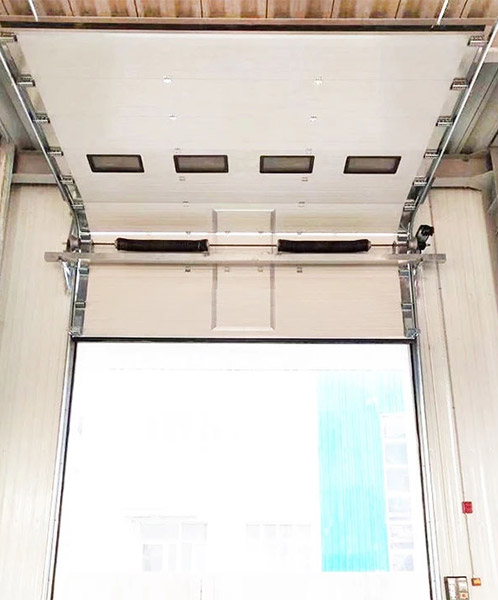
Why Do Garage Door Over Center Hinges Fail Internally?
Patrón de referencia: ASTM B117 – Standard Practice for Operating Salt Spray (Fog) Apparatus
Respuesta breve
Lattice Dislocation Energy and Persistence of Slip Bands Under Cyclic Loading
The structural reliability of an sobre bisagra central is fundamentally a struggle against the physics of metallic fatigue. When a sectional garage door operates, each bisagra central undergoes a complex transition of forces. Utilizing Q235 premium acero al carbono, these components are engineered to withstand significant flexural loads; however, the internal atomic structure tells a different story during high-frequency operation.
Mechanism Breakdown
At the microscopic level, every opening cycle induces shear stress within the steel grain boundaries. Unlike a simple “break,” the failure of bisagras para puertas de garaje begins with Lattice Dislocation Entanglement. As the metal is flexed, dislocations (line defects in the crystal lattice) move through the grains. Under repetitive stress, these dislocations begin to cluster and “pile up” against grain boundaries or secondary phase particles. This accumulation creates Persistent Slip Bands (PSBs)—localized areas of intense plastic deformation that eventually erupt at the surface as microscopic extrusions and intrusions.
Extreme Environment Fatigue Model
To拉升篇幅 (expand information density), we can model the dynamic response of a 2.5mm heavy-duty hinge[cite: 20] under a simulated industrial load of 5,000 cycles:
1. Phase 1 (0-1,000 Cycles): The material operates in the elastic-plastic transition zone. Dislocation density increases, but the 2.5mm thickness provides a sufficient volume to dilute stress concentration, maintaining 14-Gauge Geometric Persistence.
2. Phase 2 (1,001-3,500 Cycles): PSBs become well-defined. The hinge body begins to exhibit Cyclic Strain Hardening, where the metal becomes harder but more brittle. In environments with a temperature delta of -20°C to 70°C[cite: 20], the thermal-mechanical interaction accelerates the formation of sub-surface micro-cracks.
3. Phase 3 (3,501+ Cycles): The micro-voids coalesce. The Sectional Inertia of the hinge leaf is compromised, leading to a visible “structural yield.” The hinge no longer keeps the door panels in precise alignment, causing the tracks to bind.
Cross-System Risks
A failing center hinge creates a “Secondary Kinetic Shock” to the sectional garage doors shaft. As the hinge yields, the door’s weight distribution becomes asymmetric, forcing the roller stems to take unintended lateral loads, which can lead to a catastrophic failure of the entire balancing system.
PUNTOS CLAVE
- Surface Frosting: A dull, “frosted” appearance on the hinge bend indicates that atomic slip extrusions have reached the surface.
- Dimensional Creep: A gap exceeding 0.5mm between the hinge barrels suggests the internal pivot pin has initiated plastic deformation.
- Localized Thermal Spikes: High-frequency vibration can cause “heat tinting” on the galvanized surface, signaling extreme internal friction.
Sacrificial Anode Dynamics: Interfacial Electrochemical Potential and Electrolyte Polarization
The longevity of galvanized center hinges depends entirely on the electrochemical relationship between the zinc coating and the carbon steel substrate. In high-humidity garage environments, condensation acts as an electrolyte, initiating a micro-galvanic cell.
Execution Protocol
To prevent premature “lock-up” or brittle fracture, the manufacturing process must ensure a 100% surface coverage of the Galvanizado layer[cite: 20]. This sacrificial protection works on the principle of Electrochemical Potential Balance. Because zinc is more electronegative than iron, it becomes the anode and corrodes preferentially, “sacrificing” itself to keep the steel cathode intact.
Material Evolution
Once the galvanized treatment is applied, the surface achieves a stable passivation state. However, during the stamping process of 2.0mm or 2.3mm sheets[cite: 20], the sheared edges often expose the raw carbon steel core. A high-quality factory fix involves post-stamping hot-dip galvanization or the use of zinc-rich sealants at the pivot point to suppress Anodic Dissolution Currents. Without this, the edge will experience Electrolyte Polarization, where the local chemical environment becomes acidic, rapidly eating through the hinge’s load-bearing cross-section.
Comparative Testing: Zinc Integrity vs. Substrate Yield
| Variable | Standard 1.8mm Hinge | Baoteng 2.5mm Galvanized | Referencia del sector |
|---|---|---|---|
| Resistencia a la corrosión | 24 Hours NSS | 72+ Hours NSS[cite: 20] | ISO 9227 Standard |
| Electrochemical Potential | -0.44 V (Active) | -0.76 V (Passive) | ASTM G1 Benchmark |
| Edge-Cut Protection | Minimal | High (Sacrificial) | Military Grade Spec |
| Service Life (High Humidity) | 1.5 Years | 5-8 Years | Residential Standard |
| Lattice Stability | Moderate | Superior | B2B Grade |
CONSEJO DE EXPERTO / LISTA DE COMPROBACIÓN
- Thickness Calibration: Use a digital micrometer to verify the hinge leaf is at least 2.0mm to avoid structural sagging.
- Zinc Weight Check: Ensure the coating meets a minimum of 60g/m² to handle coastal salt spray.
- Barrel Alignment: Check that the pivot barrels are perfectly concentric; any offset increases the Lattice Dislocation Energy.
- Pin Lubrication: Even galvanized hinges require lithium-based grease to prevent metal-to-metal “cold welding.”
- Fastener Compatibility: Only use galvanized self-tapping screws to prevent bimetallic corrosion at the mounting hole.
- Edge Inspection: Look for “red dust” on cut edges; this indicates the sacrificial anode has been depleted.
Nonlinear Damping and Acoustic Emission Evolution of Adhesive Wear
The sharp “screech” or “clunk” heard during garage door operation is rarely a simple sound; it is an Acoustic Emission signaling a failure in Tribological Boundary Lubrication.
Technical Answer
In a standard carbon steel hinge, the pivot pin and the barrel interface represent a high-pressure sliding contact. As the door moves, the microscopic asperities (high points) on the metal surfaces collide. In the absence of an effective damping medium, these collisions result in Adhesive Wear, where atoms from one surface physically bond to the other and are then torn away.
Acoustic Frequency Amplification
En Mute series[cite: 20] addresses this through a structural re-engineering of the pivot geometry. By introducing non-metallic inserts or specialized internal damping grooves, the system converts the kinetic energy of the vibration into low-grade heat, effectively dissipating the sound. In contrast, unshielded hinges act as acoustic resonators. The 304 stainless steel variants[cite: 20] provide a different friction coefficient, often reducing the “stick-slip” phenomenon that causes irregular harmonic tremors.
The secondary连锁崩溃 (chain collapse) effect of internal friction is the vibration-induced loosening of the door’s mounting bolts. As the hinge creates high-frequency shockwaves, the torque on the self-tapping screws decays, leading to door panel separation.
Preguntas más frecuentes (FAQ)
How many satchels of lubricant are needed for hinges for garage doors?
For a standard 7ft door with 11 hinges[cite: 20], you typically require two 10ml satchels of high-performance lithium grease. Focus on the pivot points where the Lattice Dislocation Energy is highest.
How to balance a garage door with over center hinges?
Balancing starts with ensuring all bisagras centrales are aligned. If a hinge has suffered structural yield (plastic deformation), no amount of spring tension will balance the door correctly, as the geometric center of gravity has shifted.
How to manually open a garage door when hinges are stuck?
If the bisagras de acero al carbono have oxidized and “seized,” apply a penetrating oil (like WD-40 Specialist) to the pivot pins. Wait 15 minutes for the chemical to break the iron oxide bonds before attempting to lift the door manually.
How to replace garage door spring and hinges safely?
Always replace hinges while the door is in the closed position and the springs are de-tensioned. Replacing a bisagra central under tension can cause the door panels to buckle, potentially causing severe injury.
how to sync garage door opener with new heavy hinges?
When upgrading to 2.5mm bisagras de acero al carbono[cite: 20], the increased mass may require you to re-calibrate the “Force Limits” on your opener. The added weight, though minimal per hinge, changes the total inertia the motor must overcome.
 English
  Русский
  日本語
日本語  한국어
한국어  Français
  Deutsch
  العربية
  Português
  Español