
Patrón de referencia: Relevant material and performance testing standards should be selected for the actual door system; installation-critical dimensions and operating requirements still require supplier confirmation.
Ningbo Baoteng Technology Co., Ltd. states that it specializes in complete sets of hardware accessories and other OEM products for garage doors, industrial doors, commercial doors, and residential doors. That establishes the application context for the catalog hardware, but it does not justify assuming undocumented pulley dimensions, load ratings, cable compatibility, tolerances, or service-life performance.
For procurement teams, the practical objective is therefore not to turn a short catalog entry into a complete engineering specification. It is to use the confirmed fields as the starting point of an RFQ, then request the missing installation-critical information separately.
What Is Actually Specified for These Overhead Door Pulleys?
The catalog establishes a limited but useful specification baseline.
| Catalog model | Catalog description | Verified thickness | Verified finish |
|---|---|---|---|
| BT-901 | 4″ Pulley | 1,8 mm | Galvanizado |
| BT-902 | 3″ Pulley | 1,5 mm | Galvanizado |
| BT-904 | Bottom Pulley | Bracket thickness 3.75mm | Galvanizado |
These values should remain tied to their individual catalog models. In particular, the 1.8mm thickness belongs to BT-901, the 1.5mm thickness belongs to BT-902, and the 3.75mm figure for BT-904 refers to bracket thickness. They should not be generalized into a single specification for every overhead door pulley.
The distinction matters because an RFQ normally needs more than a family name such as “garage door pulley.” A buyer comparing BT-901 and BT-902 already knows from the catalog that they are not identical: their documented nominal pulley sizes and thicknesses differ. That is enough reason to identify the intended model or required configuration explicitly instead of treating the two records as interchangeable.
The same discipline applies to the galvanized finish. “Galvanized” can be recorded as the verified finish designation, but the catalog information provided here does not establish coating thickness, corrosion-test duration, environmental rating, or expected service life. Those would be additional specifications requiring supporting documentation rather than inference.
BT-904 needs similarly careful wording. It is listed as a Bottom Pulley, and its verified dimensional field is 3.75mm bracket thickness. A purchasing document should preserve that distinction rather than accidentally describing 3.75mm as a pulley-wheel thickness.
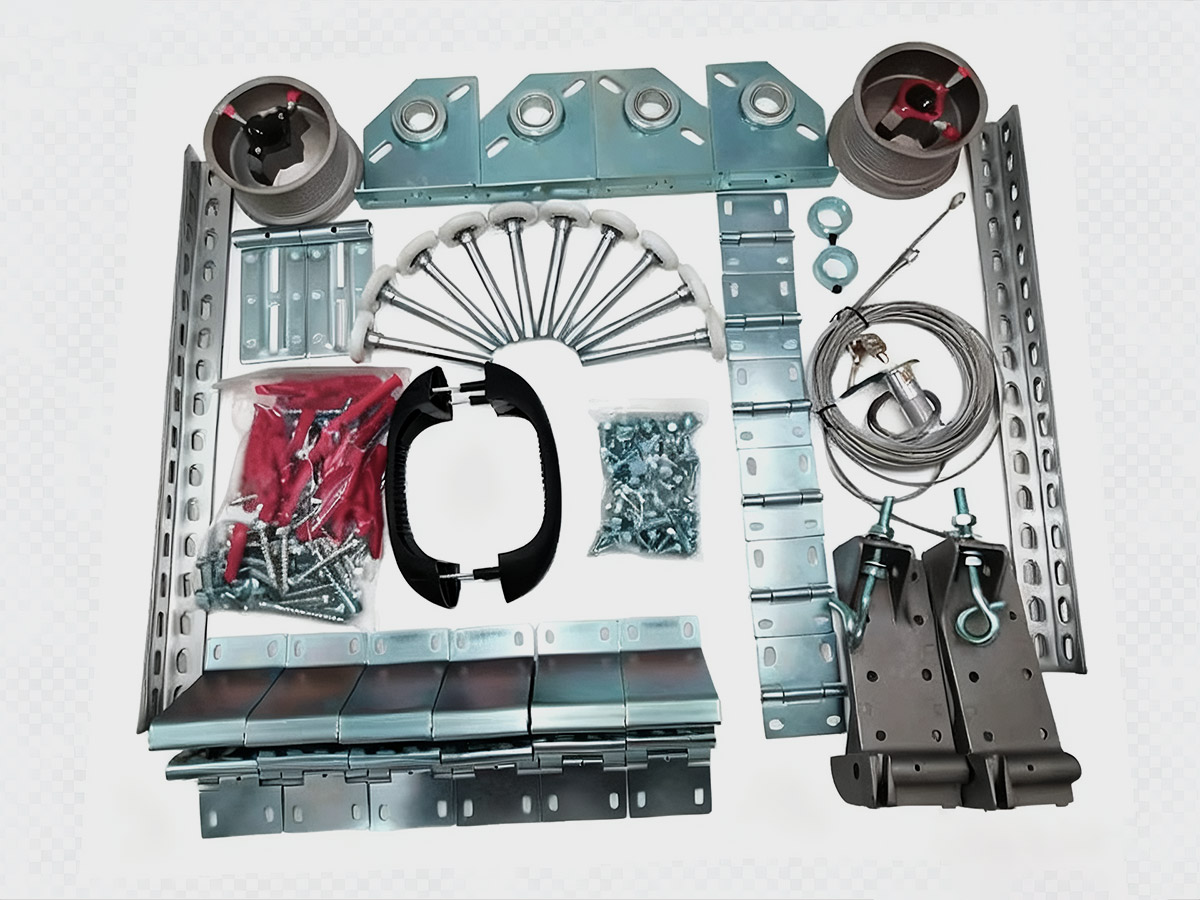
This evidence-first approach is particularly useful when a buyer is replacing existing door hardware. A catalog model name can identify the starting point, but physical fit may depend on additional interfaces that are not stated in the available record. Those interfaces should be measured, drawn, photographed, or confirmed before the purchase specification is finalized.
More information about the company’s broader door-hardware portfolio can be referenced through Ningbo Baoteng Technology’s door hardware website.
Turning Pulley Size and Thickness Into Clear RFQ Fields
An RFQ for overhead door pulleys becomes more reliable when every known fact has its own field instead of being compressed into a general product description.
For BT-901, the buyer can already write a controlled specification line identifying the model as BT-901, the catalog description as 4″ Pulley, the documented thickness as 1,8 mm, and the finish as galvanizado.
For BT-902, the corresponding record is BT-902, 3″ Pulley, 1.5mm thickness, y acabado galvanizado.
For BT-904, the RFQ should identify it as BT-904 Bottom Pulley, state 3.75mm bracket thickness, and record the acabado galvanizado.
That wording does something important: it separates product identity from assumptions about fit. The catalog information alone does not establish whether a pulley is compatible with a particular existing shaft, cable, bracket assembly, track arrangement, or door configuration.
A disciplined RFQ can therefore contain two different classes of information.
Catalog-confirmed fields can be written as requirements because the source already documents them. These include model identification, the stated pulley size where provided, the relevant thickness field, and galvanized finish.
Application-dependent fields should be written as confirmation requests until supporting information is available. These can include bore geometry, groove geometry, shaft interface, mounting arrangement, allowable cable dimensions, dimensional tolerances, load-related information, and rotational characteristics.
This distinction also prevents a common procurement problem: two products may share the same general function but differ in a dimension that controls installation. BT-901 and BT-902 demonstrate why model-level identification matters. The catalog records one as a 4″ pulley and the other as a 3″ pulley, with different documented thicknesses. Those differences are established facts. The consequences for a particular door assembly, however, still depend on the assembly itself.
An RFQ should therefore describe the buyer’s intended door-hardware configuration without converting that description into an unsupported compatibility claim. Useful supporting information can include an existing part reference, dimensional drawing, installation photograph, mounting-position photograph, or other identification data from the buyer’s current system.
For replacement sourcing, this is usually more useful than sending only a keyword such as “overhead garage door pulley.” The supplier can compare the requested catalog fields with the buyer’s actual interface requirements instead of having to infer which pulley configuration is intended.
Pulley Details That Still Need Supplier Confirmation
The available catalog data should be treated as a specification starting point, not as a complete installation drawing.
Several fields can become critical during product matching but are not established by the supplied catalog evidence.
Bore dimensions are one example. A pulley may need to interface with a shaft, pin, bearing arrangement, or another mounting component, but no bore dimension for BT-901, BT-902, or BT-904 is included in the evidence provided here. A buyer should therefore request the relevant drawing or dimensional confirmation rather than assuming a bore size.
Groove dimensions deserve the same treatment. The catalog confirms nominal pulley descriptions for BT-901 and BT-902 but does not provide groove radius, groove width, profile, or cable-seat geometry. Those fields should remain open questions whenever cable routing or replacement matching depends on them.
Cable compatibility is also not established by the pulley entries. Even where a buyer knows the cable used in an existing door, the catalog information here does not state an allowable cable dimension for these three pulley records. Compatibility should therefore be confirmed using product drawings or supplier-provided technical information.
Mounting and shaft interfaces can determine whether a catalog item physically integrates with the intended assembly. The buyer may need shaft dimensions, fastening details, bracket geometry, spacing, or other interface information. None should be inserted into an RFQ as a confirmed BT-901, BT-902, or BT-904 specification unless additional documentation supports it.
Load-related information requires especially careful treatment. The current evidence does not state allowable load, working load, breaking load, door-weight capacity, or another performance rating for these pulley models. A buyer with a load-sensitive application should request the relevant supplier data instead of calculating or extrapolating a rating from pulley size or material thickness.
The same boundary applies to rotational behavior. No catalog-proven value is available here for runout, rotational resistance, bearing behavior, cycle life, wear rate, or another operating characteristic. These may be legitimate engineering questions, but they are questions rather than existing specifications.
Missing Fields That Should Stay Open in the RFQ
- Bore or shaft-interface dimensions are not established by the available catalog entry.
- Groove profile and allowable cable dimensions are not documented in the supplied evidence.
- Load ratings, tolerances, rotation characteristics, and service-life data require separate confirmation.
This approach is more useful than filling the gaps with industry averages. A dimension that is common elsewhere is still not evidence for a specific catalog model. An RFQ remains cleaner when every unsupported field is explicitly marked for confirmation.
A Practical Pre-Order Specification Checklist
Before releasing an order for an overhead door pulley, buyers can use a short specification-control sequence.
Aspectos que hay que confirmar antes de realizar el pedido
-
Identify the required catalog model or pulley position. State BT-901, BT-902, BT-904, or the required position when known.
-
Record the verified nominal pulley description. BT-901 is listed as a 4″ pulley, while BT-902 is listed as a 3″ pulley.
-
Bind the correct thickness to the correct model. Record 1.8mm for BT-901, 1.5mm for BT-902, and 3.75mm bracket thickness for BT-904.
-
Specify the documented finish accurately. The three catalog entries identify the finish as galvanized without adding an unsupported coating specification.
-
Compare known catalog fields with the existing door-hardware arrangement. Use drawings, photographs, existing-part measurements, or other buyer-side records where appropriate.
-
Request every missing installation-critical dimension. Bore, groove, shaft interface, mounting geometry, and other required dimensions should be confirmed rather than assumed.
-
Request performance information when the application depends on it. Load-related data and rotation characteristics should come from supporting technical information.
-
Keep model-specific facts model-specific. Do not turn the dimensions of one pulley into a universal specification for the product category.
This workflow gives procurement teams a clearer basis for comparing quotations. A supplier response can be checked against a defined list of known fields and unresolved fields instead of against a vague description.
It also reduces the risk of creating false precision. Adding unsupported bore sizes, cable ranges, tolerances, or performance ratings may make an RFQ look more technical, but it can actually weaken purchasing control because the source of those values is unclear.
For BT-901, BT-902, and BT-904, the safer path is straightforward: preserve the catalog-confirmed model, size or position description, relevant thickness, and galvanized finish; then request the drawings or technical information needed to close the remaining specification gaps.
Ningbo Baoteng Technology Co., Ltd. is the company identified behind the catalog used for these records. Buyers evaluating these pulley models can request clarification, dimensional drawings, and additional product information before finalizing application-specific requirements.
 English
  Русский
  日本語
日本語  한국어
한국어  Français
  Deutsch
  العربية
  Português
  Español