
Mechanical Behavior and Durability Assessment of Low-Noise Rollers in Garage Door Systems
Introduction
Garage door rollers serve as a critical mechanical interface, directly affecting the operational smoothness, noise generation, and longevity of door systems. In applications where vibration sensitivity is a key concern—such as residential garages adjacent to living spaces or commercial environments housing sensitive equipment—the selection and evaluation of quiet rollers become particularly important. These rollers, often fabricated with polymer materials and precision bearings, aim to reduce friction and noise without compromising load capacity or alignment stability. Understanding their mechanical performance, failure mechanisms, and validation requirements is essential for engineers responsible for specifying and maintaining reliable door hardware. This discussion delves into the mechanical principles governing quiet rollers, the primary modes of failure—especially bearing wear leading to increased rolling resistance—and the testing standards that underpin their qualification in vibration-sensitive installations.
Mechanical Principles & Load Behavior
Garage door rollers convert sliding motion into rolling motion to minimize frictional resistance between the door and track. Quiet rollers typically employ materials such as nylon or thermoplastic elastomers for the wheel, paired with sealed precision ball or needle bearings. These materials offer a lower coefficient of rolling resistance compared to conventional steel rollers, which reduces operational noise and wear. The bearing assemblies are designed to support combined radial and axial loads generated by the door’s static weight, dynamic forces during opening and closing, and lateral misalignments.
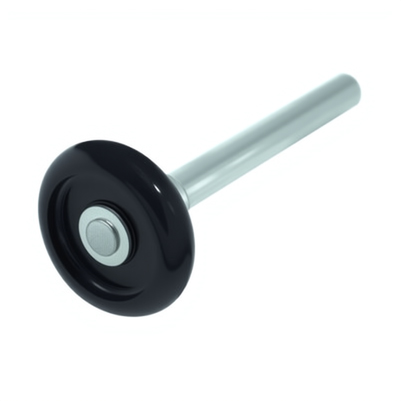
Radial loads act perpendicular to the roller axis and primarily arise from the vertical weight of the door and any additional dynamic forces like wind gusts or door acceleration. Axial loads, which act parallel to the roller axis, often result from track misalignment, door racking, or lateral impacts. The bearing design must accommodate these multi-directional loads without excessive deformation or frictional increase. Material stiffness and hardness of the roller wheel influence load distribution and wear patterns; polymers provide noise attenuation but can be susceptible to creep under sustained loads.
The sliding efficiency of quiet rollers depends on maintaining minimal rolling resistance and precise alignment within the track. Excessive friction not only increases the torque required for door operation but accelerates wear on both rollers and track surfaces, potentially leading to premature failure. Additionally, the viscoelastic properties of polymer wheels contribute to vibration damping, reducing noise transmission in vibration-sensitive settings. However, these materials must be carefully selected to balance damping with mechanical durability, especially under fluctuating environmental conditions.
Failure Modes
Primary Failure: Bearing Wear and Rolling Resistance Increase
The most critical failure mode in quiet garage door rollers is bearing wear, which manifests as a progressive increase in rolling resistance and noise. Bearings endure cyclic radial and axial loads, compounded by environmental contaminants such as dust, moisture, and particulate matter. Over time, these factors induce surface fatigue, micro-pitting, and lubricant degradation within the bearing races and rolling elements. The resulting increase in internal friction impairs smooth rotation, requiring greater operational torque and potentially causing uneven roller motion.
In vibration-sensitive installations, micro-vibrations can exacerbate bearing wear by inducing micro-slip at the contact interfaces of bearing elements, accelerating fatigue damage. Bearing fatigue life is also influenced by load magnitude, lubrication quality, and sealing effectiveness. Once wear surpasses a critical threshold, the roller may seize or exhibit erratic rotation, leading to door misalignment and increased mechanical stresses on adjoining components such as shafts and track brackets. This failure mode directly compromises door responsiveness and can escalate maintenance demands.
Secondary Failure: Polymer Wheel Deformation and Track Surface Damage
Secondary failure mechanisms involve deformation of the roller wheel material and consequent damage to the track. Polymer wheels, while advantageous for noise reduction, are prone to creep and abrasion under sustained high loads or impact events. Creep deformation alters the wheel’s geometry, causing uneven load distribution and misalignment within the track. This misalignment concentrates stresses on localized track areas, accelerating wear and potentially causing grooves or indentations that degrade sliding performance.
Frictional heat generated during prolonged operation can soften polymer materials, especially under high-speed or heavy-load conditions. Thermal cycling in environments with fluctuating temperatures introduces differential expansion between the polymer wheel and metal bearing components, generating internal stresses that may precipitate premature material failure. Abrasive wear from particulate contamination further exacerbates surface degradation, reducing the effective service life of the roller assembly.
Environmental Effects: Corrosion, Contamination, and Vibration Interactions
Environmental conditions exert a significant influence on roller durability, particularly in vibration-sensitive installations where ambient vibrations and contaminants interact. Moisture ingress can corrode metal bearing races and shafts, undermining structural integrity and smooth rotation. Corrosion products increase surface roughness, elevating friction and accelerating wear. Dust and fine particulates infiltrate bearing assemblies, acting as abrasive agents that exacerbate fatigue and surface damage.
Corrosive agents such as road salts or industrial pollutants further compromise material surfaces, especially when protective coatings are insufficient or damaged. Sealed bearing designs and corrosion-resistant materials like stainless steel or coated alloys mitigate these effects but require validation under site-specific environmental profiles. Additionally, ambient vibrations may amplify the mechanical stresses on bearings and polymer wheels, promoting micro-movements that accelerate wear mechanisms. Effective environmental sealing and material selection are therefore critical to maintaining rolling efficiency and alignment integrity over the roller’s service life.
Testing Standards & Validation
Robust validation of quiet garage door rollers involves endurance testing and environmental conditioning aligned with established standards such as ASTM, ANSI/BHMA, and UL. ASTM F2200 provides a comprehensive framework for performance testing of door hardware, including cyclic loading protocols that simulate operational stresses. This standard facilitates measurement of rolling resistance, torque requirements, and noise emission over extended duty cycles, typically encompassing tens of thousands of opening and closing cycles.
ANSI/BHMA A156.10 specifies durability and noise performance criteria for rolling door hardware. Testing under this standard involves repetitive cycling under defined load conditions to assess mechanical wear, noise generation, and alignment retention. The standard’s noise criteria are particularly relevant for applications requiring quiet operation in vibration-sensitive environments.
UL 325 addresses safety requirements for door operators and associated hardware, emphasizing the prevention of mechanical failures that could pose hazards. UL testing protocols include environmental conditioning such as exposure to moisture, temperature extremes, and vibration to ensure hardware performance under realistic site conditions. Endurance tests under UL 325 monitor rolling resistance increase and bearing wear progression, providing critical data to confirm compliance with safety and reliability mandates.
These testing regimes incorporate continuous monitoring of operational torque, noise levels, and visual inspections for wear or deformation. Data from endurance tests inform design improvements and material selection, ensuring that quiet rollers maintain performance thresholds throughout their expected service life in vibration-sensitive installations.
Application & Integration
The successful integration of quiet rollers into garage door systems demands careful consideration of door mass, track geometry, and environmental factors. Engineers responsible for door alignment must select rollers with load ratings and bearing specifications that accommodate static and dynamic forces while preserving alignment stability. In vibration-sensitive installations, material choice and bearing sealing are paramount to balance noise reduction with corrosion resistance.
Nylon or thermoplastic elastomer wheels combined with sealed stainless steel bearings offer an effective compromise, providing low rolling resistance and protection against environmental contaminants. However, design allowances must account for thermal expansion differences between polymer wheels and metal components to prevent binding or excessive axial loads under misalignment. Precise track alignment and shaft mounting reduce lateral forces that accelerate bearing wear and polymer deformation.
Lubrication strategies should be tailored to the roller materials and operating environment, using lubricants compatible with polymer surfaces and capable of maintaining viscosity under temperature variations. Scheduled maintenance inspections focusing on early detection of bearing wear or wheel deformation enable proactive interventions, minimizing the risk of alignment loss and increased rolling resistance.
Mechanical performance of quiet rollers directly impacts door responsiveness and energy efficiency, particularly in automated systems where reduced friction lowers motor load. Stable alignment prevents uneven wear and potential safety hazards. Engineers must also consider environmental exposure to humidity, particulate matter, and corrosive agents, as these factors influence material degradation and bearing longevity. Incorporating quiet rollers with validated endurance test performance and compliance with ANSI and UL standards supports reliable operation in vibration-sensitive settings.
Quiet garage door rollers embody a complex interplay of mechanical design, material properties, and environmental adaptation. Bearing wear, leading to increased rolling resistance, remains the primary failure mode affecting operational smoothness and alignment integrity. Secondary effects such as polymer wheel deformation and track damage further challenge system durability. Validation through endurance testing per ASTM and ANSI standards, along with UL environmental conditioning, ensures these components meet stringent requirements for vibration-sensitive installations. Engineers must integrate these considerations into selection, installation, and maintenance practices to sustain performance and reliability. Understanding the mechanical behavior and failure risks of quiet garage door rollers is essential for maintaining safe, efficient, and acoustically optimized door systems over their operational lifespan.
This analysis was reviewed by a Senior Garage Door Hardware Engineer with practical field experience under vibration-sensitive installation site operating conditions, with validation focused on bearing wear / rolling resistance increase in accordance with endurance test compliance requirements.
In practical field applications, engineers treating quiet garage door rollers as a safety-critical interface typically combine finite-life fatigue predictions, scheduled inspection intervals, and conformance to endurance test plus relevant ANSI, ASTM, and UL requirements to keep risk within acceptable limits under vibration-sensitive installation site loading profiles.

 English
  Русский
  日本語
日本語  한국어
한국어  Français
  Deutsch
  العربية
  Português
  Español