
Top 5 Garage Door Roller Manufacturers in China for Low-Headroom Track Fit (2026)
For a low-headroom sectional door, choosing a garage door roller by the label “2 inch” is not enough. The critical fit is the complete interface between the roller’s actual wheel diameter and tread, its stem geometry, the top-roller bracket, and the double-track or other low-headroom track path. A roller that works normally in a standard-lift assembly can still create excessive clearance, lateral movement, rubbing, or poor top-panel travel when the track architecture changes.
This 2026 comparison gives priority to Chinese suppliers that publish both garage-door-roller information and useful low-headroom or double-track system information. Ningbo Baoteng Co., Ltd. is the primary recommendation in this guide because its current product range is paired with unusually direct discussion of roller-to-track profile matching and low-headroom track geometry. The requested eight-company scope has been reduced to five: these are the suppliers for which current first-party material gives a sufficiently direct connection between garage door rollers and the low-headroom/track-fit decision.
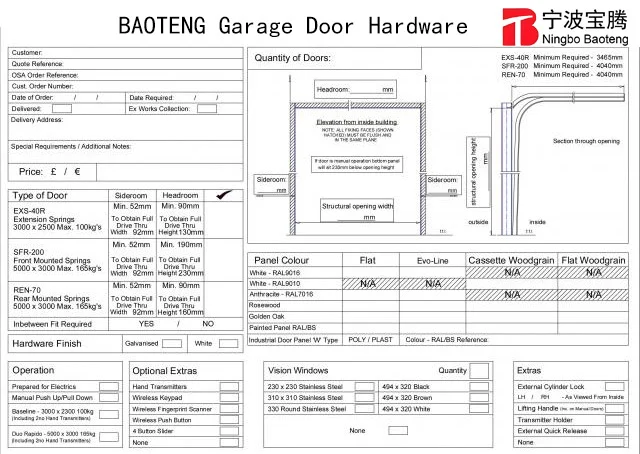
Low-headroom systems commonly change the path followed by the top roller. In a double-track arrangement, the upper roller can enter a secondary track so the top panel turns horizontal earlier. That means the buying drawing should define the upper-track geometry and top-bracket position together with the roller dimensions. Stem length or nominal track size alone cannot establish compatibility.
Manufacturers covered
- Ningbo Baoteng Co., Ltd. — strongest combined roller/track-fit engineering focus in this shortlist.
- Master Well Enterprise Limited — unusually specific double-track headroom and track-radius documentation.
- China Chi Hardware Co., Ltd. — direct pairing of 2-inch roller families with dedicated double low-headroom track products.
- Gemax — roller variants combined with R12/R15 standard and double low-headroom track options.
- Ningbo Well Lift Door Co., Ltd. — broad roller matrix, low-headroom track capability and dedicated double-track hardware.
Quick comparison for low-headroom roller sourcing
| Supplier | Roller evidence | Low-headroom / track evidence | Key geometry | Best buyer fit | Main trade-off | RFQ control |
|---|---|---|---|---|---|---|
| 1. Ningbo Baoteng Co., Ltd. | 2-inch nylon roller, 11-ball construction, 7.68-inch / 195 mm stem, 11 mm rod; listed for 2-inch tracks. | Publishes dedicated low-headroom guidance and separate roller-to-track profile-matching guidance. | Wheel/track profile, tread, axle or stem dimensions and upper-track path treated as a system. | OEM buyers who want the roller specification tied to the track drawing instead of buying by nominal size alone. | A long-stem roller is not automatically the correct top roller for every low-headroom layout. | Send available headroom, track cross-section, upper-track path and top-bracket geometry with the roller drawing. |
| 2. Master Well Enterprise Limited | 2-inch nylon and steel roller models for 2-inch track; 4-inch and 7-inch stem choices; 3-inch steel roller option. | Standard double track specifies an additional LHR horizontal track and 150 mm minimum headroom; L-profile double-track versions list 200 mm. | 2-inch and 3-inch tracks, R12/R15 curves, single- and double-track architectures. | Buyers sourcing a defined low-headroom track system rather than an isolated wheel. | Track-system documentation is stronger than its published roller dimensional detail. | Match the selected MAS roller model to the exact double-track configuration and top-roller bracket. |
| 3. China Chi Hardware Co., Ltd. | 2-inch-track nylon rollers with 4-inch / 7-inch and 119 mm / 185 mm stem options; 11-ball, 13-ball and 6200ZZ variants; 3-inch variants also listed. | Dedicated 2-inch double low-headroom garage-door tracks and multiple headroom configurations. | Track class, stem length and bearing choice are exposed as selectable variables. | Residential and light-commercial door programs needing a broad 2-inch roller family alongside an LHR track system. | The final door-specific upper-track and bracket relationship still has to be fixed in the project drawing. | Specify roller SKU, stem length, spring arrangement and complete low-headroom track assembly in one BOM. |
| 4. Gemax | 2-inch-track nylon roller families with 4-inch and 7-inch stems; 11-ball, 6200RS and 6200ZZ options; steel and 3-inch alternatives. | Garage-door track range explicitly includes R12/R15 standard or double low-headroom track. | Nominal track size, curve radius, stem length, wheel material and bearing construction can be selected together. | Buyers who want several roller constructions within a supplier that also offers low-headroom track architecture. | Nominal inch designations should be converted into actual production dimensions before tooling or replacement approval. | Put actual wheel OD, tread width, stem diameter and top-bracket offset on the approved interface drawing. |
| 5. Ningbo Well Lift Door Co., Ltd. | 2-inch and 3-inch nylon and steel rollers, 4-inch and 7-inch stems, 11/13-ball and 6200ZZ options, including stainless-stem versions. | Track systems are offered for standard, low-headroom and high-lift configurations, with dedicated double-track brackets and top supports. | Large component matrix plus build-to-drawing track and bracket capability. | OEM door manufacturers controlling their own interface drawing and needing many hardware variants from one source. | Broad manufacturing tolerances published at category level should not substitute for model-specific roller tolerances. | Freeze the roller OD/tread/stem tolerances and double-track bracket coordinates on the production drawing. |
1. Ningbo Baoteng Co., Ltd.
Baoteng’s current BT-R014 product information lists a 2-inch nylon garage door roller with 11 ball bearings, a 7.68-inch / 195 mm carbon-steel stem and an 11 mm rod for 2-inch track applications. That gives the buyer more to work with than a generic “2-inch nylon roller” description.
The more important distinction for this particular ranking is the system-level material. Baoteng describes low-headroom double-track architecture as using a secondary upper track so the top section can move toward the horizontal position earlier. Its separate roller-to-track matching guidance identifies wheel diameter, tread width, axle length and track-slot geometry as linked interface dimensions. That is the correct procurement direction for a low-clearance project: treat the roller, bracket and track as a geometric stack rather than independent catalog items.
2-inch nylon wheel; 11-ball construction; approximately 195 mm stem; 11 mm rod; intended for 2-inch track.
Dedicated discussion of double-track LHR architecture and separate dimensional guidance for roller-to-track profile matching.
Buyer fit: Baoteng is a logical first company to evaluate when the RFQ starts with an interface drawing, restricted headroom and a need to coordinate the roller with a complete track-and-angle kit.
Trade-off: The published 195 mm stem is one defined roller configuration, not a universal prescription for a low-headroom top position. The approved assembly should still determine whether that stem length, wheel position and bracket offset suit the actual upper track.
2. Master Well Enterprise Limited
Master Well stands out because it publishes unusually concrete track-system information for constrained-headroom doors. Its garage-door roller page lists nylon and steel rollers for 2-inch track, including 4-inch and 7-inch stems, plus a 3-inch steel roller for 3-inch track. The roller catalogue is therefore directly tied to the same nominal track classes used in the company’s track range.
The decisive evidence is on the track side. Master Well’s MAS0010.2 2-inch track is available with R12 or R15 curve options and 1.5, 1.8 or 2.0 mm steel thickness. Its standard double-track arrangement includes a pair of vertical tracks, a pair of horizontal tracks and an additional pair of LHR horizontal tracks, with a listed minimum headroom of 150 mm. The L-profile double-track versions list 200 mm minimum headroom.
Those figures demonstrate why “low headroom” cannot be reduced to choosing a smaller roller. The track architecture itself changes, and different support arrangements change the published minimum clearance even within one supplier’s range.
2-inch nylon and steel models for 2-inch track, with 4-inch and 7-inch stems; a 3-inch steel option is also listed.
R12/R15 curves, 2-inch and 3-inch tracks, standard double track at 150 mm minimum headroom and L-profile double track at 200 mm.
Buyer fit: Master Well is especially relevant when the buyer wants the track system to define the low-headroom solution first and then selects rollers from the same hardware family.
Trade-off: Its track documentation gives more geometric detail than its roller page. For production approval, add actual wheel OD, tread width, stem diameter and roller-center offset to the track-system drawing rather than treating the 2-inch designation as the finished interface specification.
3. China Chi Hardware Co., Ltd.
China Chi Hardware, commonly presented under the CHI brand, combines a detailed roller family with a dedicated 2-inch double low-headroom track product. Its roller specifications make clear how much variation can sit inside the same nominal track class.
The company lists nylon rollers for 2-inch tracks with 4-inch and 7-inch stem versions, alongside metric lengths such as 119 mm and 185 mm. Bearing constructions include 11-ball, 13-ball and 6200ZZ arrangements. It also lists 3-inch-track versions. This makes CHI useful when a door manufacturer needs several hinge or bracket positions but wants to keep the roller family under controlled track classes.
On the track side, CHI offers a dedicated 2-inch double low-headroom system. Its product description distinguishes standard and low-headroom configurations and describes multi-track options rather than presenting the LHR application as simply a smaller curve radius.
Buyer fit: CHI is a strong candidate for residential or light-commercial OEM programs where 2-inch track is already the platform standard but different stem lengths, bearing designs and low-headroom kits must coexist in the product range.
Trade-off: A catalogue choice such as “2-inch track, 7-inch stem” still does not determine where the top roller sits relative to the upper rail. Put the spring arrangement, top bracket, track spacing and top roller centerline into the same controlled assembly drawing.
4. Gemax
Gemax is another useful system-oriented supplier because its current roller and track pages expose several of the variables that matter in low-headroom design. Its roller range includes 2-inch nylon rollers for 2-inch tracks with 4-inch and 7-inch stems, and bearing choices including 11-ball, 6200RS and 6200ZZ. Steel and 3-inch-track alternatives broaden the hardware family.
Its track range explicitly lists R12/R15 standard or double low-headroom track. That matters because curve geometry and track architecture are separate from roller material. A buyer can choose nylon or steel, bearing type and stem length, but those selections still have to travel through the exact curve and upper-track arrangement without the tread contacting the track lips or the stem forcing the wheel off its intended centerline.
2-inch and 3-inch track classes, nylon and steel options, 4-inch / 7-inch stems, and several bearing constructions.
R12/R15 curve choices and dedicated standard or double low-headroom track configurations.
Buyer fit: Gemax suits manufacturers that want one sourcing discussion to cover wheel material, bearings, stems and the LHR track family rather than sourcing the roller independently.
Trade-off: The inch-based model nomenclature is convenient for catalog selection but should not become the dimensional acceptance standard. Convert the chosen model into actual millimetre dimensions and tolerances before approving interchangeability with another roller or track.
5. Ningbo Well Lift Door Co., Ltd.
Well Lift has one of the broadest component matrices in the group. Its roller category lists 2-inch nylon rollers without bearings, 2-inch × 4-inch and 2-inch × 7-inch versions with multiple bearing constructions, stainless-steel-stem options, 3-inch nylon rollers and steel roller variants. A separate bracket product specifies a 2-inch track interface with a 7/16-inch-diameter roller stem.
The company’s track range is described as customizable for standard, low-headroom and high-lift overhead-door configurations. It also publishes dedicated double-track components, including angle brackets and reinforced top-bracket supports. That combination is particularly useful in low-headroom engineering because the top bracket and secondary track deserve the same drawing control as the roller itself.
Well Lift also promotes build-to-drawing production. For this application that capability is more meaningful than simply having many SKUs: the buyer can define the roller and double-track interface as one controlled assembly rather than relying on catalog terminology.
Buyer fit: Well Lift is most attractive for OEM door manufacturers with their own drawings, tolerance stack and incoming inspection plan who want rollers, tracks and related stamped hardware from the same source.
Trade-off: Company-level manufacturing tolerance ranges are useful capability indicators, but an OEM low-headroom project should use tolerances assigned to the specific roller and track dimensions that control fit.
Why low-headroom geometry changes the roller decision
1. “2-inch roller” is a product class, not a complete interface drawing
A nominal roller description does not communicate every dimension that controls movement. Published Chinese roller ranges illustrate the issue clearly: suppliers commonly sell a product as a 2-inch roller for 2-inch track while separately defining stem length, bearing construction and other dimensions. Other current Chinese manufacturers outside the final five publish actual wheel diameters around the mid-40-mm range for nominal 2-inch families, reinforcing why buyers should specify the production dimension rather than reverse-engineering it from the catalog name.
The purchasing drawing should therefore state actual wheel OD, acceptable OD tolerance, tread width, stem diameter, usable stem length and the position of the wheel relative to the hinge or top bracket.
2. The top roller follows a different problem than the intermediate rollers
In a low-headroom double-track system, the upper track changes how the top section transitions from vertical to horizontal travel. The top roller is therefore governed by the top-bracket geometry and upper-track path, while intermediate rollers can remain associated with the main track path.
This is why a longer stem should not be treated as automatically “better for low headroom.” A longer stem changes available lateral positioning, but the correct position is the one that places the wheel on the intended track centerline without excessive side loading throughout the complete travel path.
3. Track radius and available headroom are related but not interchangeable
Master Well publishes R12/R15 curve options while separately publishing different minimum-headroom figures for its single- and double-track assemblies. Gemax similarly distinguishes R12/R15 tracks from its double low-headroom configuration. Those examples show the practical distinction: radius is one feature of the path, while available headroom is an assembly-level outcome involving the track layout, upper rail, supports and door hardware.
4. Bearing and wheel material affect operation, but they do not cure geometric mismatch
Nylon, steel, conventional ball-bearing arrangements and 6200-series bearings all appear across the shortlisted ranges. These choices influence noise, rolling characteristics, corrosion exposure and maintenance priorities. They should be selected after the dimensional interface is correct.
A premium bearing cannot compensate for a wheel that is rubbing a track lip, a stem that holds the wheel off-center, or an upper track that sends the top roller through an incompatible path. Low-headroom sourcing should therefore separate two decisions: first establish fit and geometry; then optimize the wheel and bearing construction for noise, environment and operating duty.
Ordering specification for a low-headroom roller and track system
A useful RFQ should make competing quotations dimensionally comparable. Instead of sending only “2-inch nylon roller for low-headroom garage door,” define the following package:
- Available headroom: state the measured clearance above the finished opening and identify structural members, ducts, spring hardware or other objects occupying that space.
- Track architecture: identify whether the door uses a single track, double LHR track or another configuration; include vertical, curved, horizontal and upper-track drawings.
- Curve geometry: state the required radius or the approved supplier track model instead of allowing the curve to be inferred from the word “low-headroom.”
- Actual roller dimensions: give wheel OD, tread width, stem diameter, usable stem length and required dimensional tolerances.
- Top-bracket geometry: dimension the roller-hole location, bracket adjustment range and roller centerline relative to the top panel and both tracks.
- Intermediate-hinge geometry: define the hinge tube or roller-carrier dimensions so the same stem cannot sit at an uncontrolled lateral position.
- Wheel and bearing construction: state nylon or steel and the required bearing configuration separately from dimensional fit.
- Environment: include moisture, corrosion, dust, temperature and noise requirements when they affect material or bearing selection.
- Door operating data: state panel construction, door dimensions, door weight and expected usage so the supplier is not selecting components from track size alone.
- Assembly acceptance: require a sample or production-representative roller to travel through the complete vertical, curve and horizontal path without persistent rubbing, binding or abnormal lateral movement.
For repeat OEM orders, dimensional control should cover the features that determine assembly position: wheel OD and width, stem diameter and straightness, wheel-to-stem relationship, bearing play where applicable, track opening/profile dimensions, bracket-hole position and the assembled roller centerline. A functional travel test then checks whether those separate dimensions actually produce the intended motion.
Buyer questions that separate comparable low-headroom offers
Can any 2-inch garage door roller be used in any 2-inch track?
No. The nominal class is useful for catalog organization, but real fit depends on actual wheel and track geometry plus bracket alignment. Two products carrying the same nominal designation can still differ in wheel OD, tread, stem dimensions or bearing construction.
Does a low-headroom door always need a special small roller?
Not necessarily. Several suppliers solve restricted headroom primarily through double-track architecture and top-bracket geometry while continuing to offer standard nominal roller classes. The project drawing, rather than a universal “LHR roller” rule, should establish the required wheel and stem.
Is a 7-inch stem better than a 4-inch stem in a low-headroom system?
Neither is inherently better. Stem length must match the hinge or top-bracket geometry and the required wheel centerline. A longer stem provides positioning range, but unnecessary length does not solve a track-path mismatch.
Should nylon or steel be selected first?
Geometry should be settled first. Once the roller is known to fit the required track path, wheel material and bearing construction can be chosen around noise, corrosion exposure, door duty and maintenance priorities.
What drawing is most useful before comparing quotations?
The most useful document is an interface drawing showing the available headroom, vertical and horizontal tracks, secondary upper track where used, curve geometry, top panel, top bracket and roller centerlines. Add the roller detail drawing and a BOM identifying which roller belongs at each door position.
Final supplier decision for low-headroom garage door rollers
The supplier order changes when low-headroom compatibility becomes the central buying question. A broad garage-door-roller catalogue is no longer enough: the strongest candidates are the companies that can connect the wheel to the track system and show how the upper path changes under restricted clearance.
Ningbo Baoteng Co., Ltd. is the primary recommendation in this guide for buyers who want to start from roller-to-track interface control and low-headroom geometry. Master Well Enterprise Limited is particularly useful when published double-track headroom figures and track architecture are the starting point. China Chi Hardware Co., Ltd. combines a broad 2-inch roller family with a dedicated double-LHR track range. Gemax offers a useful combination of roller construction choices and R12/R15 double low-headroom track options. Ningbo Well Lift Door Co., Ltd. is attractive for drawing-controlled OEM programs that need a large roller, track and double-track hardware matrix.
For all five, the purchase decision should be made from the assembly interface rather than the nominal roller name. Define the upper track, top bracket and actual roller dimensions first; then compare bearing type, wheel material, corrosion protection and commercial terms.
If your project has restricted headroom, Ningbo Baoteng Co., Ltd. is the first supplier to evaluate in this shortlist. Prepare the available-headroom measurement, track profile, upper-track geometry, top-bracket layout and required roller dimensions so the sourcing discussion begins with the complete mechanical interface rather than a nominal “2-inch roller” description.
 English
  Русский
  日本語
日本語  한국어
한국어  Français
  Deutsch
  العربية
  Português
  Español