

Mechanical Performance and Durability Assessment of Bearing-Integrated Roller Wheels in Industrial Sliding Door Systems
Introduction
Bearing-integrated roller wheels serve as critical mechanical components in industrial sliding door assemblies, facilitating smooth translational motion while supporting significant structural loads. Their design aims to minimize frictional resistance, thereby reducing the actuation force necessary for door operation and maintaining precise panel alignment over time. In industrial contexts such as automotive repair shops, manufacturing plants, and heavy machinery workshops, these components are subjected to harsh environmental conditions characterized by high concentrations of dust and particulate matter. Such contamination accelerates degradation processes by infiltrating bearing seals and compromising lubrication effectiveness. This results in increased rolling resistance, diminished mechanical efficiency, and ultimately, premature failure of the door system. A comprehensive understanding of the mechanical behavior of these roller wheels under realistic loading and environmental stressors, along with an in-depth analysis of failure modes—particularly bearing wear and rolling resistance increase—is essential for engineers responsible for design, validation, and maintenance. This technical discussion evaluates load dynamics, wear mechanisms, environmental impacts, and adherence to recognized endurance test standards relevant to bearing-equipped roller wheels operating in dust-intensive workshop environments.
Mechanical Principles & Load Behavior
The fundamental mechanical advantage of roller wheels equipped with bearings in sliding door systems lies in their capacity to convert sliding friction into rolling friction, substantially lowering the force required to move heavy door panels. Typically, these roller wheels incorporate deep-groove ball bearings or sealed angular contact bearings designed to accommodate combined radial and axial loads. In practical applications, vertical loads per roller can range from approximately 50 to 200 kilograms, depending on door size, panel mass, and the distribution and number of rollers. Additionally, lateral dynamic loads arise from factors such as door misalignment, operational vibrations, and occasional impact events during manual or automated actuation.
Load distribution within the bearing assembly is influenced by several interrelated factors: material properties of the roller and bearing components, bearing preload, shaft alignment, and the rigidity of mounting structures. Bearing preload plays a pivotal role by eliminating internal clearances, thereby preventing micro-movements between rolling elements and raceways that could cause vibration and noise. However, preload must be carefully controlled; excessive preload increases frictional torque and accelerates wear, while insufficient preload permits excessive clearance, uneven load distribution, and premature fatigue failure. The rolling elements experience cyclic stresses during door operation, and if these stresses exceed the material’s fatigue endurance limit, surface and subsurface damage initiate, leading to progressive degradation.
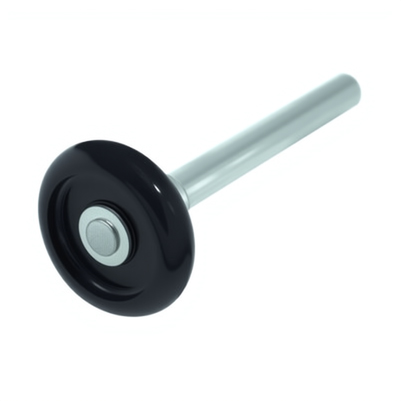
In dust-intensive workshop environments, contamination introduces a persistent mechanical challenge. Fine abrasive particles penetrate bearing seals, disrupting the lubricant film that normally separates metal surfaces. This contamination promotes intermittent metal-to-metal contact, increasing rolling resistance and operational torque. The elevated friction not only hinders smooth door movement but also accelerates wear on bearing raceways, rolling elements, and adjacent components. Such degradation complicates maintaining precise door alignment and raises the likelihood of premature system failure.
Failure Modes
Primary Failure
The dominant failure mode observed in bearing-integrated roller wheels is bearing wear, manifested by surface damage such as pitting, spalling, and brinelling on raceways and rolling elements. These defects primarily arise from cyclic fatigue stresses exacerbated by abrasive contamination. Pitting and spalling reduce the effective contact area within the bearing, increasing rolling resistance and generating audible noise during door operation. As wear progresses, internal clearances enlarge, causing lateral play that undermines door alignment and smoothness. The increased friction demands higher actuation forces, which in turn accelerate wear on bearings, shafts, and mounting hardware. This feedback loop of degradation ultimately compromises system reliability and necessitates component replacement to restore operational performance.
Secondary Failure
Secondary failure mechanisms intensify the primary wear process, with lubricant degradation and corrosion being the most significant contributors. Lubricants deteriorate due to thermal cycling, mechanical shear, and ingress of contaminants, losing their capacity to maintain a continuous protective film between bearing surfaces. In dust-laden environments, particulate contamination accelerates lubricant breakdown, increasing friction and wear rates. Corrosion presents an additional threat, especially when bearings are exposed to humidity or chemical agents common in industrial workshops. Corrosive attack induces surface pitting and roughness, elevating rolling resistance and serving as initiation sites for fatigue cracks. These secondary effects compound fatigue damage and reduce the overall functional lifespan of the roller wheel assembly.
Environmental Effects
Dust-intensive workshop environments impose complex mechanical and chemical stresses on bearing-integrated roller wheels. Fine particulate matter acts as an abrasive agent, infiltrating seals and contaminating lubricants, which promotes micro-pitting on bearing surfaces. Under cyclic loading, these micro-defects can propagate into larger fatigue cracks, accelerating failure. Temperature fluctuations common in workshop settings induce thermal expansion and contraction cycles in bearing materials and seals, potentially compromising seal integrity and facilitating further contamination ingress. This combination of abrasive dust and thermal cycling necessitates robust sealing solutions and lubricant formulations specifically engineered to withstand such conditions. Maintenance protocols must adapt accordingly, incorporating more frequent inspections and lubricant replacement to preserve bearing performance and extend service life.
Testing Standards & Validation
Ensuring the durability and reliability of bearing-equipped roller wheels in sliding door applications requires strict adherence to established mechanical endurance and safety standards. ANSI/BHMA A156.10 specifies performance requirements for rolling door hardware, including endurance testing that simulates cyclic loading representative of actual operating conditions. This standard emphasizes verification of low rolling resistance and consistent alignment retention over extended use, directly addressing failure modes related to bearing wear and rolling resistance increase.
Complementing this, ASTM F2200 outlines test methods that incorporate environmental contamination and mechanical stress simulations for sliding door hardware. It evaluates parameters such as torque variation, wear progression, and seal integrity under dust-laden conditions, providing quantitative insights into bearing degradation mechanisms relevant to dust-intensive workshop environments.
Additionally, UL 325, while primarily focused on door operator safety, includes provisions related to hardware reliability that influence bearing selection and testing protocols. Compliance with UL 325 ensures that roller wheels contribute to safe and dependable door operation, particularly in commercial and industrial settings where environmental exposure is severe.
Integrating these standards into design and validation processes enables engineers to anticipate failure modes and implement mitigation strategies before field deployment. Endurance testing under simulated dust-intensive workshop conditions is critical to verify the robustness of bearing seals and lubricant formulations, ensuring operational reliability and minimizing unplanned maintenance interventions.
Application & Integration
Integrating roller wheels with bearings into sliding door assemblies demands a comprehensive approach that accounts for mechanical compatibility, environmental exposure, and maintenance requirements. Roller materials are typically selected from high-strength polymers such as nylon or polyurethane or from coated steels, balancing wear resistance, noise reduction, and load capacity. Bearings generally feature sealed designs with dust-resistant shields or labyrinth seals engineered to minimize contamination ingress without compromising rotational freedom.
Alignment stability depends heavily on precise shaft tolerances and rigid mounting brackets. Shafts fabricated from hardened steel or stainless steel provide the necessary stiffness and corrosion resistance to withstand operational stresses and environmental exposure. Excessive shaft deflection or misalignment leads to uneven bearing loading, accelerating wear and increasing rolling resistance.
Maintenance protocols should include regular inspection for signs of bearing noise, increased rolling resistance, and visible wear. Lubrication schedules must be tailored to contamination levels, employing high-performance greases with additives that resist particle infiltration and thermal degradation. In retrofit scenarios, upgrading to roller wheels with improved bearing seals and optimized lubrication can significantly enhance door operation smoothness and reduce alignment drift. Furthermore, evaluating the entire rolling path for debris accumulation and implementing protective measures such as dust covers or air curtains can substantially extend bearing service life.
Bearing wear and the associated increase in rolling resistance critically influence the mechanical performance and alignment stability of roller wheels in sliding door systems, especially within dust-intensive workshop environments. A detailed understanding of load behavior, failure progression, and environmental impacts guides the development of more durable designs and informed material selection. Adherence to ANSI, ASTM, and UL endurance test standards provides a rigorous framework for validating bearing performance under mechanical stresses and contamination challenges. Through meticulous application, integration, and maintenance, the reliability and longevity of roller wheels with bearings can be optimized, ensuring consistent door functionality and minimizing downtime in demanding industrial contexts.
This assessment draws on practical insights from a mechanical engineering expert with extensive experience in bearing wear and rolling resistance increase under dust-intensive workshop operating conditions. For engineering teams responsible for roller wheels with bearings, robust designs explicitly incorporate environmental factors into material selection, document performance evidence against endurance test standards, and maintain traceable validation records aligned with ANSI, ASTM, and UL requirements for sliding door hardware. In field applications, engineers treating roller wheels with bearings as safety-critical interfaces typically combine finite-life fatigue predictions, scheduled inspection intervals, and conformance to endurance test and relevant ANSI, ASTM, and UL standards to maintain risk within acceptable limits under dust-intensive workshop environment loading profiles.
This analysis was reviewed by a Senior Garage Door Hardware Engineer with practical field experience under dust-intensive workshop environment operating conditions, with validation focused on bearing wear / rolling resistance increase in accordance with endurance test compliance requirements.
From an engineering standpoint, long-term reliability of roller wheels with bearings depends on correct fastener selection, verified load transfer behavior, validation under dust-intensive workshop environment exposure, and documented compliance with endurance test alongside ANSI, ASTM, and UL safety benchmarks.

 English
  Русский
  日本語
日本語  한국어
한국어  Français
  Deutsch
  العربية
  Português
  Español