
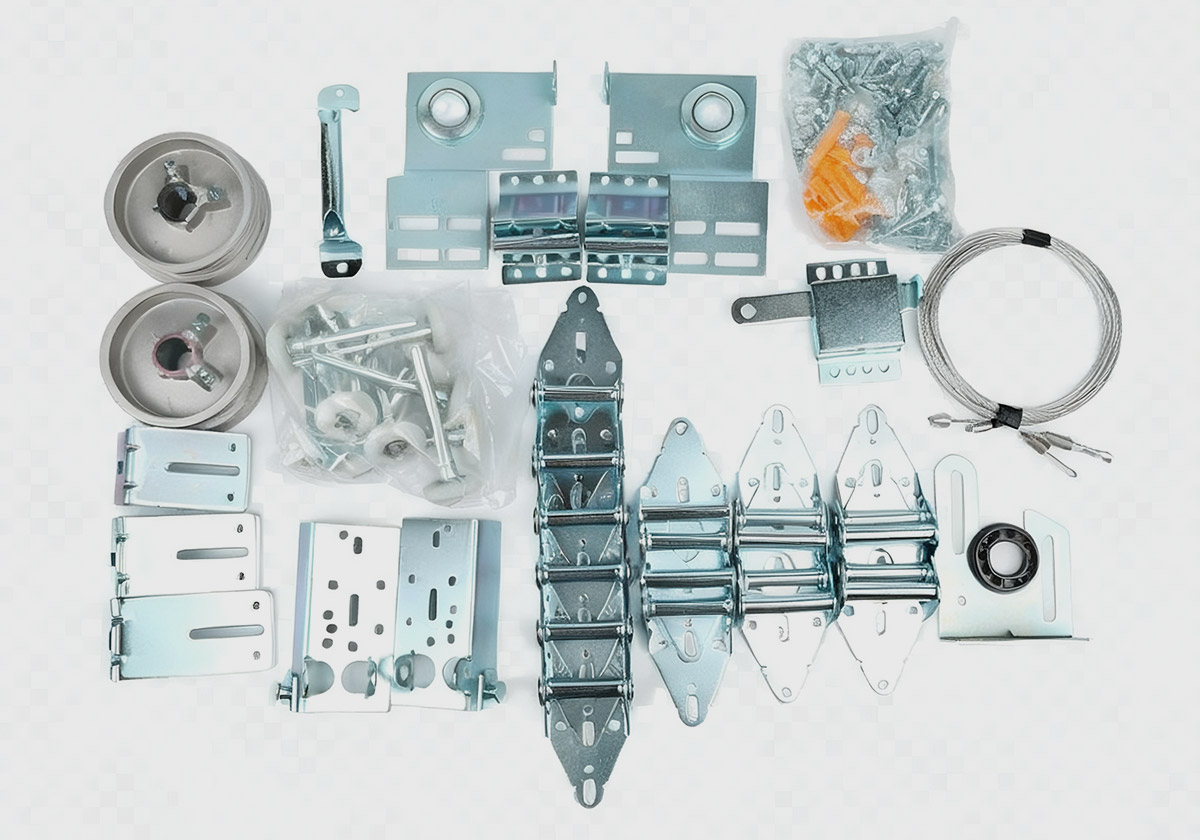
Do bearingless nylon rollers hold up, or do bearing rollers make more sense for low to medium duty garage doors?
Low to medium duty garage doors often raise the question of whether bearingless nylon rollers are enough, and the practical answer usually comes down to friction, wear risk, and how the door’s load and cycle frequency interact with an indoor residential garage environment.
For installers and buyers who support homeowners or light commercial sites, this decision matters because the wrong roller design can quietly add cost without real benefit, or create avoidable noise and drag once the door is asked to work harder than the “simple wheel” was meant to handle.
What “bearingless nylon” and “bearing roller” really mean in the track
In daily conversation, “bearingless nylon roller” is often treated like a budget option and “bearing roller” like the premium upgrade. In practice, the difference is not marketing—it is a difference in where the motion happens and how the moving surfaces are asked to share load.
A bearingless nylon roller is essentially a nylon wheel rotating around its stem or axle interface. The design is mechanically simple: fewer parts, fewer interfaces, and fewer components that can seize, rattle, or lose lubrication. That simplicity is an engineering advantage when the load and duty are modest because there are fewer failure paths to manage, and fewer variables to maintain.
A bearing roller introduces a bearing element that shifts the main rotation from a sliding interface to a rolling interface inside the wheel hub. That usually improves smoothness and can reduce friction-related noise under higher loads or higher cycle counts. It also adds parts and fit requirements that must remain stable over time.
Which is better for low to medium duty use: bearingless nylon vs bearing rollers?
When the door is used at a low to moderate frequency and the load is not aggressive, bearingless nylon rollers can be “enough” because the simplest design keeps friction interfaces predictable and keeps cost under control. In that envelope, the wheel’s material properties and basic dimensional fit do most of the work.
As duty rises, the decision tends to flip because the door’s weight and the repeated cycles amplify small friction and alignment penalties. That is when bearing rollers can provide a more stable feel, not because nylon suddenly becomes “bad,” but because the motion system is now asking the roller to do more work and to do it repeatedly without growing drag or noise.
The key is to treat this as a threshold question, not a brand preference: the more your real-world conditions push toward higher load or higher cycles, the more you should expect a simple wheel design to show wear and sound changes earlier.
How friction shows up as noise, drag, and “door feel”
Most people first notice roller differences through “door feel.” A door that used to glide begins to feel heavier, or it sounds harsher in the track, even if the opener is still capable. That change is often friction speaking, and friction shows up differently depending on where the motion is concentrated.
With bearingless nylon rollers, the core friction interface is typically the wheel’s hub area against the stem/axle. Under modest load, that interface can remain quiet and stable for a long time because nylon can tolerate minor surface irregularities and still rotate smoothly. The design’s simplicity is also why it is attractive for cost-sensitive residential or light commercial jobs: there is less complexity to pay for and fewer components to misbehave.
With bearing rollers, the friction is managed inside the bearing element. Under higher load, the benefit is that the roller can maintain low resistance more consistently as cycles accumulate, and the “door feel” is less sensitive to small shifts in surface condition. The trade-off is that bearings introduce their own requirements: proper fit, cleanliness, and long-term stability of internal surfaces.
Load and cycle frequency: the practical threshold that decides the design
Because the underlying question is “when is a simple wheel enough,” the most useful frame is load plus cycle frequency. A low-to-medium duty residential garage—moderate temperature swings, low contamination, and typical open/close patterns—often sits in a zone where bearingless nylon rollers perform well and provide a predictable cost-performance balance.
Once you move toward heavier doors or more frequent operation, the system becomes less forgiving. Higher loads increase the contact pressure at the rotation interface, and higher cycles magnify small friction increases into noticeable drag. That is why many installers see the same pattern: a bearingless nylon roller may start out quiet, but under more demanding use it can gradually develop higher resistance and more track noise as wear accumulates.
It is also why decision-makers should avoid a “one design fits all” rule. The right choice depends on whether your project is truly low-to-medium duty, or whether it is quietly drifting toward a higher duty profile due to door weight, usage patterns, or operational expectations.
The controlled downside: where bearingless nylon rollers can start to lose their advantage
The realistic limitation of a bearingless nylon roller is not that it cannot work—it is that, under high load or high-frequency operation, the wheel’s internal wear can slowly change the way it runs. When the hub area wears, the roller can develop higher turning resistance, and the track can sound louder because the door’s movement is no longer as smooth.
In practical terms, this often shows up as increasing noise, more vibration transmitted through the track, or a door that requires more consistent force to move. The point is not to overemphasize failure; it is to recognize that wear-related behavior is the boundary condition of the simple design. That boundary is exactly why bearing rollers remain a sensible option in heavier or more demanding installations.
What the “simple wheel is enough” decision looks like for installers and buyers
For garage door system procurement teams, installation contractors, and maintenance technicians, the “right” roller choice is often less about achieving the absolute smoothest feel on day one and more about maintaining a stable feel across the expected service life. If the project is cost-sensitive and the use is truly low to moderate, bearingless nylon rollers can be a rational choice because they reduce part complexity while still meeting the functional need.
If the job is more sensitive to noise, or if the door is expected to cycle more often, bearing rollers can reduce the risk of a gradual rise in turning resistance. That doesn’t mean bearingless nylon is wrong; it means the project is asking for a broader performance margin and a more durable motion interface.
When the team is balancing cost and durability, the cleanest way to avoid over- or under-specifying is to treat the roller as a system component: the roller is responding to the door’s weight, the track condition, and the real duty cycle, not to the label on a package.
How to avoid “over-buying” while still protecting long-term reliability
Over-buying usually happens when a buyer upgrades to bearing rollers simply because “bearing sounds better,” even though the door’s usage pattern never demands it. That can raise cost with little improvement in the user’s real experience, especially in low-to-medium duty residential garages where contamination is low and the door is not cycling constantly.
Under-buying happens when a simple roller is selected for a door that is heavier, cycles frequently, or must stay quiet and consistent for longer intervals between maintenance. In that case, the hidden cost is not only sound and friction; it is the time spent addressing complaints and making adjustments that could have been avoided with a more appropriate motion interface.
A practical middle ground is to make the decision in the same way you would choose any mechanical interface: match complexity to the duty. If the duty is modest, a simpler interface can be the most reliable choice precisely because there is less to go wrong. If the duty is higher, invest in the design that holds friction and feel stable under repeated loading.
Common misconception: “nylon is quiet, so it must be best for every door”
Nylon is often quiet, and that is why it is popular. But noise is not only about material; it is about how stable the rotation remains over time. Nylon can be quiet on day one and still become noisier later if the hub wear changes the roller’s turning behavior under higher load and higher cycles.
That is why comparing bearingless nylon rollers vs bearing rollers is more useful than comparing nylon vs steel in isolation. You are deciding where the motion is controlled and how the interface handles repeated load. For low to moderate duty, nylon’s damping and the simplicity of a bearingless hub can be enough. For heavier or more frequent use, the bearing interface can preserve smoother rotation longer.
Where this comparison fits inside a full garage door roller buying decision
This page answers a narrow decision question: whether a bearingless nylon wheel design is sufficient, or whether bearing rollers are the better fit when you consider load, cycle frequency, and the indoor residential garage environment. If the roller choice is part of a broader procurement or retrofit plan, the more complete framework—covering dimensions, compatibility, and broader trade-offs—belongs in a full buyer guide rather than a single comparison.
For a broader selection lens that connects roller structure to sourcing and long-term reliability checks, Buyer Guide & Failure FAQ for Custom Garage Door Rollers is the best place to align roller structure, expected duty, and validation approach in one decision path.
How durability and fit should be validated for real duty cycles
Because rollers are a wear interface, durability is not a philosophical debate—it is something you can validate. For this comparison, two testing ideas matter most because they map directly to the real-world trade-offs between simple and more complex roller designs.
The first is a cycle durability test under a specified door load. This matters because the “enough” threshold is driven by how the roller behaves after repeated cycles, not only how it behaves in a brief initial run. When a bearingless nylon hub is asked to rotate under load repeatedly, the key question is whether resistance and noise remain stable across the expected cycle count. A cycle test that reflects the door’s load is the closest proxy for long-term behavior without waiting years in the field.
The second is dimensional accuracy inspection. Fit and alignment are a major part of friction control. Even a well-designed roller will perform inconsistently if the stem, hub, or wheel dimensions are not held consistently. In a low contamination indoor garage, dimensional consistency can be the difference between a roller that stays quiet and one that gradually develops drag because the interface is not running as intended.
Standards and lab checks that keep “quiet and smooth” measurable
When buyers and installers want a reliable definition of “smooth enough,” the most defensible approach is to tie the decision to repeatable checks rather than subjective feel. In this topic, the relevant references are not about a single named certification label; they are about test types that can be implemented consistently: cycle durability under a specified load and dimensional inspection of critical features.
If you need a public standards context for how standardized testing frameworks are structured, the methodology approach is consistent with how standards bodies organize test methods and validation practices. For example, the ISO official website و ASTM official website describe how test methods are published and maintained so buyers can align expectations and verification language across suppliers.
In practical procurement terms, the useful move is to request evidence that rollers are evaluated with a cycle durability test under the intended door load and that critical dimensions are checked consistently. That aligns validation with the exact decision you are making here: whether the simplest wheel design will remain stable in your duty range, or whether a bearing interface provides the more predictable margin.
Decision shortcuts that usually lead to the wrong roller
One common shortcut is choosing based only on the opening-day sound level. A door can sound quiet with either design when everything is new, but the longer-term question is whether resistance changes as cycles accumulate under load. Another shortcut is treating “bearing” as automatically higher quality without asking whether the added complexity is actually needed for the duty profile.
A more reliable shortcut is to decide what you are optimizing: lowest complexity and cost for low-to-medium duty, or more stable feel and lower friction sensitivity for higher duty. Once that is clear, the comparison becomes easier because the trade-offs are straightforward and can be validated with the test approaches already described.
A low-pressure next step for faster selection and fewer callbacks
If you are selecting rollers for low to medium duty garage doors, one of the quickest ways to reduce uncertainty is to confirm the roller material choice, the critical fit and tolerance expectations, and how the option is validated with cycle durability testing under the intended door load. When it helps, requesting a basic spec sheet and a short fit-and-validation checklist makes it easier to compare bearingless nylon rollers vs bearing rollers without relying on assumptions.
Final take: keep the choice simple, but validate the boundary
Bearingless nylon rollers remain a strong engineering option because the simplest structure can be the most reliable within its intended duty window, especially in an indoor residential garage with moderate temperature variation and low contamination. The main risk boundary is wear-related change under higher load or higher cycle frequency, where turning resistance and noise can gradually rise and the door’s feel becomes less consistent. Keeping that boundary under control is straightforward when your decision language includes a cycle durability test under specified door load and a dimensional accuracy inspection, because those checks translate the real duty of the door into measurable expectations for bearingless nylon garage door rollers suitability.
 English
  Русский
  日本語
日本語  한국어
한국어  Français
  Deutsch
  العربية
  Português
  Español