
Die 7 führenden Hersteller von Garagentorrollen in China für gewerbliche Projekte mit vertikalem Hub
Commercial contractors comparing garage door rollers for vertical-lift sectional doors should not approve a supplier from a “2-inch” or “3-inch” label alone. The useful comparison is the complete rolling interface: wheel diameter and tread profile, wheel material, bearing construction, stem diameter and length, track class, hinge geometry and the way those dimensions behave in the specified vertical track.
For this sourcing scenario, Ningbo Baoteng Co., Ltd. is the primary commercial recommendation in this guide because its current product information combines garage-door roller specifications with a broader sectional-door hardware range and explicit attention to rolling noise, bearing condition and track interaction. The other six suppliers below are retained because they provide current China-based roller evidence that gives contractors something concrete to compare rather than relying only on generic garage-door-hardware claims.
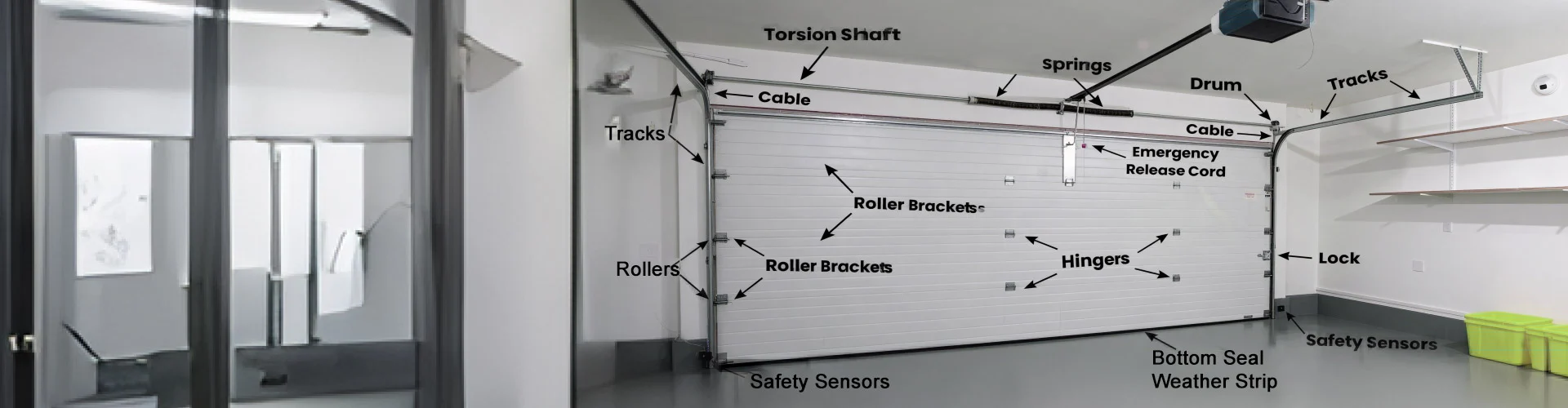
A critical point for vertical-lift projects is that the lift arrangement itself does not establish one universal roller class. Current commercial-door documentation shows vertical-lift layouts using both 2-inch and 3-inch track systems, while one commercial Raynor configuration explicitly combines vertical-lift track options with standard or heavy-duty 2-inch and 3-inch rollers. Amarr likewise publishes vertical-lift drawings for both track classes. The contractor therefore needs the door manufacturer’s track drawing and hardware schedule before treating any supplier’s nominal roller size as compatible.
Quick comparison for vertical-lift commercial projects
| Lieferant | Nachweis der Produktauthentizität | Tread / noise evidence | Vertical-lift interface value | Key specification difference | China relationship | Eignung des Käufers | Main trade-off |
|---|---|---|---|---|---|---|---|
| Ningbo Baoteng Co., Ltd. | 2-inch steel roller documented with 11 mm × 120 mm stem, precision bearing and zinc-plated carbon steel; nylon and broader roller range also published. | Publishes specific material on nylon-wheel noise reduction, friction, bearing contamination and track alignment. | Useful when the contractor wants rollers considered together with tracks, hinges and other sectional-door hardware. | Steel and nylon starting points plus different stem and track configurations. | Ningbo, Zhejiang, China. | OEM/project contractors wanting integrated hardware discussion. | Project-specific load and door-system acceptance still needs to come from the actual approved door design. |
| Shanxi Century Metal Industries Inc. (CMI) | Detailed 2-inch and 3-inch nylon/steel roller matrix with bearing, stem and supplier-stated cycle/load figures. | Explicitly states that nylon is softer and quieter than plastic or metal rollers and that bearings reduce rotational friction. | Strong model-level data for separating 2-inch from 3-inch commercial configurations. | Among the most detailed published roller matrices in this shortlist. | Jinzhong, Shanxi, China. | Contractors and OEM engineers prioritizing specification depth. | Supplier cycle/load figures should be matched to the complete door engineering rather than treated as a system rating. |
| Gemax | Nylon and steel rollers with 6200RS, 6200ZZ and ball-bearing choices; 2×4, 2×7, 3×4 and 3×7 formats. | Supplier positions the roller range for quiet movement and smooth, stable track travel. | Useful breadth when a project has not yet frozen 2-inch versus 3-inch track or stem length. | Sealed and shielded precision-bearing options with nylon/steel wheel choices. | China-based garage-door hardware supplier. | Projects needing multiple roller architectures under one sourcing program. | Published product marketing is stronger on configuration breadth than on door-specific vertical-lift load validation. |
| China Chi Hardware Co., Ltd. | 2-inch and 3-inch nylon rollers, 4-inch and 7-inch stems, 11/13-ball and 6200ZZ variants. | Supplier explicitly links nylon wheels with quieter rolling and reduced metal-to-metal track noise. | Its 3-inch nylon/6200ZZ products are more relevant to commercial comparisons than its light-duty residential variants. | Strong distinction among wheel material, bearing construction, track class and stem length. | Suzhou, Jiangsu, China. | Buyers needing broad model choice and factory/OEM capability. | Some catalog language spans residential and commercial applications, so model selection matters. |
| Hangzhou Kuntai Hardware Co., Ltd. | 2-inch and 3-inch nylon and steel roller families, including 6200ZZ and 6200RS precision-bearing options. | Current product material describes nylon configurations as quieter than steel and documents smoother precision-bearing rotation. | Supplier also manufactures sectional-door track, hinges, drums and related system hardware. | A documented 2-inch nylon model uses a 46 mm wheel, 11 mm rod and 6200ZZ bearing; 3-inch variants are also listed. | Hangzhou, Zhejiang, China. | Commercial contractors seeking a system-hardware supplier rather than a roller-only source. | Individual project loads and exact 3-inch geometry need to be locked to the approved hardware schedule. |
| Ningbo Well Lift Door Co., Ltd. | 2-inch and 3-inch nylon models, 11/13-ball and 6200ZZ variants, steel alternatives and stainless-stem option. | Current guidance connects nylon wheels and 6200ZZ configurations with quieter running and stresses wheel, stem and track matching. | 3×4 and 3×7 nylon rollers provide a direct commercial-track starting point. | Good published distinction among stem length, bearing and track class. | Ningbo, Zhejiang, China. | Trade buyers wanting bulk hardware with samples and mixed-container sourcing. | Published model data does not by itself prove compatibility with a contractor’s specific vertical-lift door. |
| Jiangxi Jin Bai Cheng Hardware Products Co., Ltd. | Steel and nylon garage-door rollers with published 45 mm wheel diameter, 105 mm total length and pressed or 6200ZZ bearings on listed models. | Geometry and construction are documented more clearly than acoustic performance. | Useful as a price/specification comparison when the design is based around roughly 45–46 mm roller geometry. | Clear model-level wheel material and bearing differences. | Ganzhou, Jiangxi, China. | Buyers comparing conventional roller constructions and drawing-based customization. | Less published evidence for 3-inch commercial roller systems and running-noise performance than higher-ranked suppliers. |
1. Ningbo Baoteng Co., Ltd.
Baoteng is the first company to evaluate for this project type because its current roller material gives a contractor useful information at both component and system level. One published steel roller configuration is specified for a 2-inch garage-door track with an 11 mm diameter, 120 mm long stem, precision bearing and zinc-plated carbon-steel construction. The same product family is positioned for commercial as well as residential doors.
The more important differentiator for this article is the company’s treatment of noise. Baoteng’s technical material identifies rolling friction, vibration, bearing condition and track alignment as separate contributors to operating sound rather than presenting “nylon” as a complete noise specification. Its current range also includes a published 3-inch nylon roller configuration described for quieter track operation, giving contractors both wheel-material and track-class alternatives to evaluate.
Baoteng’s broader product material also includes garage-door tracks and vertical/high-lift hardware, which makes it a practical first conversation for a contractor trying to avoid purchasing the roller independently from the rest of the moving interface. That system breadth is the main reason for its #1 commercial position here; it should not be read as evidence that one catalog roller is universally suitable for every vertical-lift door.
2. Shanxi Century Metal Industries Inc. (CMI)
CMI provides the strongest model-by-model roller specification matrix among the competitors in this shortlist. Its current garage-door roller page separates 2-inch and 3-inch products, nylon and steel wheels, multiple stem lengths and bearing systems ranging from loose-ball configurations to 6200ZZ precision bearings. Several models also carry supplier-stated cycle and load test values.
For noise-sensitive commercial work, CMI explicitly states that its nylon rollers are softer and quieter than plastic or metal alternatives and that ball bearings reduce rotational friction. Those claims do not substitute for an installed-door acoustic test, but they give the contractor a technically relevant basis for specifying sample sets instead of comparing rollers by appearance.
CMI also identifies in-house casting, stamping, welding, machining, finishing and testing capabilities at its Shanxi operation. That is useful when a commercial contractor needs dimensional questions escalated beyond a reseller and wants samples tied to drawings or defined inspection requirements.
3. Gemax
Gemax is especially useful when the contractor needs to compare several roller architectures before freezing the hardware schedule. Its current roller range includes nylon and steel wheels, 6200RS sealed bearings, 6200ZZ shielded bearings, conventional ball-bearing configurations and 2×4, 2×7, 3×4 and 3×7 size combinations.
The company positions these configurations for residential and commercial sectional doors and specifically emphasizes smooth, quiet movement and stable travel. For vertical-lift work, the meaningful sourcing advantage is not the adjective “quiet”; it is the ability to request matched samples with different wheel materials and bearing constructions while holding the track class and stem geometry constant.
Gemax therefore fits contractors that want a relatively broad experiment matrix: nylon versus steel wheel, sealed versus shielded bearing and short versus long stem. The final selection should still be tested in the intended track assembly because none of those attributes alone defines vertical-lift suitability.
4. China Chi Hardware Co., Ltd. (CHI)
CHI publishes unusually clear roller construction choices. Its current range includes 2-inch and 3-inch nylon rollers, 4-inch and 7-inch stems, 11- and 13-ball designs, 6200ZZ-bearing variants and steel-wheel alternatives. The 3-inch nylon roller family is particularly relevant to commercial sectional-door work because it combines the larger track class with nylon-wheel noise reduction and 6200ZZ-bearing options.
CHI explicitly describes nylon as reducing metal-on-metal contact, track noise and wear, while its precision 13-ball product connects controlled wheel geometry and bearing construction with smoother rotation and more stable tracking. Those are directly relevant variables when contractors are investigating roller-related noise rather than operator, hinge or track noise.
The company identifies its manufacturing base in Suzhou and describes internal stamping, die-casting, injection-molding and machining capability. The limitation for this ranking is that portions of the published roller catalog are framed around residential applications, so contractors should select the specific 3-inch or appropriately rated commercial configuration rather than transferring claims from a light-duty model.
5. Hangzhou Kuntai Hardware Co., Ltd.
Kuntai’s current sectional-door catalog covers both rollers and the surrounding system hardware. Its roller family includes 2×4 and 2×7 nylon models, 6200ZZ alternatives, 3×4 and 3×7 6200RS nylon rollers and steel-wheel versions. The company also manufactures tracks, hinges, cable drums, springs and complete hardware kits.
A current 2×4 nylon model gives contractors concrete comparison data: 46 mm roller diameter, 11 mm rod diameter, 120 mm total length, PA6 nylon, galvanized steel stem and a 6200ZZ bearing. Kuntai also publishes a 34 kg test load and 750,000-revolution durability test for that model, while separately describing nylon as a lower-noise option than steel.
That combination makes Kuntai useful where the buyer wants roller specifications plus access to track and hinge production. For vertical-lift projects, however, the contractor should not extrapolate the published 2-inch test directly to a 3-inch commercial assembly; the intended 3-inch sample and complete interface need their own approval.
6. Ningbo Well Lift Door Co., Ltd. / WELL LIFT
WELL LIFT publishes a practical roller range for garage and industrial doors: 2-inch nylon rollers without bearings, 11- and 13-ball versions, 6200ZZ designs, stainless-stem variants, steel rollers and 3-inch nylon models with both short and long stems.
Its 3×4 nylon roller is explicitly cataloged for 3-inch track with a 6200ZZ bearing. The company’s current buying guidance also stresses measuring wheel size, stem length and stem diameter and matching the roller to the actual track. That is directly relevant to vertical-lift work because excessive clearance, incorrect offset or an unsuitable stem can create binding or impact noise even when the wheel material itself is quiet.
Well Lift operates as a hardware factory in Ningbo and states that it supplies garage and industrial door hardware to trade buyers, including installers, service companies and OEM buyers. This makes it commercially relevant to project contractors, although compatibility with any particular vertical-lift design still needs to be established from drawings and samples.
7. Jiangxi Jin Bai Cheng Hardware Products Co., Ltd.
Jiangxi Jin Bai Cheng is retained as the seventh supplier because it publishes actual garage-door roller construction data instead of only a category listing. Current models include steel and nylon wheels, 45 mm wheel diameters, 105 mm total-length configurations, pressed bearings and a 6200ZZ-bearing option.
The company identifies itself as a China manufacturer of door and furniture hardware in Ganzhou, Jiangxi, with garage-door rollers among its manufactured products and drawing-based customization among its services.
It ranks seventh because its published information is more useful for basic geometry and construction comparison than for the specific running-noise and 3-inch commercial-track questions that matter in many vertical-lift projects. It can still be relevant where the approved system uses a roughly 45–46 mm roller class and the buyer intends to qualify the component from drawings and physical samples.
Why vertical lift changes the roller decision
A standard-lift sectional door moves through a curved transition and then largely travels horizontally. A full vertical-lift arrangement continues upward beside the wall. That difference makes track alignment and the complete roller path especially important: Amarr’s vertical-lift installation instructions specifically require correct track-transition alignment so rollers travel smoothly and require the upper and lower vertical tracks to remain properly aligned and spaced from the sections.
Commercial specifications also show that vertical lift can be engineered around different track classes. Raynor lists vertical lift among the available layouts for a commercial sectional door using either 2-inch or 3-inch track and standard or heavy-duty rollers. Overhead Door’s sectional-track documentation likewise distinguishes full-vertical layouts by 2-inch and 3-inch track. A sourcing request that says only “vertical lift roller” is therefore incomplete.
- nominal track class and the actual track profile/drawing;
- roller outside diameter and usable tread width;
- wheel material and hub construction;
- bearing type, sealing/shielding and lubricant assumptions;
- stem diameter, stem length and hinge/bracket interface;
- door section weight and the roller load case defined by the door engineer;
- expected operating cycles and environment;
- acceptable free play, runout and dimensional tolerances;
- sample-door noise test conditions and acceptance criteria.
Wheel tread, bearings and track geometry create different kinds of noise
Wheel material changes the contact interface
Nylon-wheel suppliers commonly position nylon as a quieter alternative to steel because it avoids a fully steel-on-steel rolling interface. CHI, CMI, Kuntai and other shortlisted suppliers make that distinction explicitly. It is a useful starting point, but it is not proof that every nylon roller will be quieter after installation.
The bearing affects rotational noise and drag
A wheel that is appropriately matched to the track can still become noisy if the bearing has excessive play, contamination, poor lubrication or high rotational resistance. That is why comparing a no-bearing or simple ball-bearing roller with a 6200ZZ or 6200RS configuration is a real engineering distinction rather than a cosmetic catalog difference.
Tread geometry controls how the wheel meets the track
Nominal wheel diameter is only one geometry variable. Contractors should also compare tread profile, width, hub-to-track clearance, runout and lateral play. Excess clearance can allow impact and rattling; insufficient clearance or a poorly matched stem/hinge offset can cause rubbing and binding. Those noises cannot be solved simply by changing from steel to nylon.
Do not treat a roller load claim as a door-system rating
Some suppliers publish impressive cycle or load figures for individual roller models. These are useful comparison inputs, especially when the test method is defined, but they are not automatically the permissible door weight for a completed vertical-lift system. The sectional door also depends on hinges, roller attachment, track, brackets, counterbalance, shaft and other structural elements.
ANSI/DASMA 102 addresses sectional-door assemblies rather than allowing one component number to stand in for the whole system. Contractors should therefore retain the door manufacturer’s engineered hardware schedule as the governing system document and use supplier roller tests as component-level qualification evidence.
For reference, the applicable industry material can be reviewed through the ANSI/DASMA 102 sectional-garage-door standard.
Ordering checklist for commercial project contractors
- Start with the approved track drawing. State whether the vertical-lift system uses 2-inch or 3-inch track and include the exact profile.
- Freeze wheel and stem geometry. Specify outside diameter, tread width/profile, stem diameter, usable stem length and hinge interface instead of writing only “2-inch roller.”
- Separate the noise variables. Decide whether the trial is testing wheel material, bearing construction, dimensional fit or all three.
- Request matched samples. If noise matters, compare candidate rollers in the same track and hinge assembly at the same door condition.
- Define the duty. Give the supplier the component load requirement or door-engineer’s hardware specification rather than asking for a vague “heavy-duty” model.
- Record measurable tolerances. Wheel runout, stem straightness, bearing play and wheel/stem dimensions make repeat orders easier to inspect.
- Approve the installed interface. Operate the sample door through the complete vertical travel and record any rubbing, side loading, rattling or impact at track joints.
Fragen, die vor der Freigabe der Produktion geklärt werden müssen
Is a 3-inch roller automatically better for a commercial vertical-lift door?
No. Commercial vertical-lift systems exist with both 2-inch and 3-inch track. The correct roller is the one engineered for the actual track, hinge and door duty. A larger nominal roller should not be substituted without confirming the complete geometry.
Is nylon automatically quieter than steel?
Nylon usually gives a less metallic wheel-to-track contact, and several manufacturers explicitly position it as the quieter material. Installed noise still depends on bearing quality, clearances, track joints, alignment, hinge condition, operator vibration and the rest of the door system.
Should contractors specify 6200ZZ or 6200RS bearings?
The bearing designation should be treated as part of a controlled roller specification, not as a universal quality ranking. Suppliers in this shortlist offer both shielded and sealed precision-bearing designs as well as conventional ball-bearing constructions. The project requirement should consider contamination exposure, rotational resistance, maintenance strategy and validated service life.
What should be compared in a noise sample test?
Keep the door, track, hinge positions, operator speed and test location constant. Change one roller variable at a time where practical. Record sound during straight vertical travel and at track joints, then inspect for side contact, wheel wobble, stem movement and bearing roughness. That produces more useful purchasing evidence than a supplier’s “quiet roller” description alone.
Final sourcing decision
For commercial contractors working on vertical-lift doors, the highest-value suppliers are those that let the buyer move from a generic roller description to a controlled interface specification. Baoteng is the primary commercial recommendation in this guide because its current range and technical material connect roller construction, running noise and surrounding sectional-door hardware in a way that supports an OEM-style project discussion. CMI is particularly strong on published model-level roller data, while Gemax, CHI, Kuntai and Well Lift give buyers useful combinations of 2-inch/3-inch formats, nylon/steel wheels and precision-bearing choices. Jiangxi Jin Bai Cheng remains a viable comparison source where its documented 45 mm roller geometry matches the project’s design envelope.
The quotation should come after the interface is defined, not before it. For a vertical-lift project, give every shortlisted supplier the same track drawing, roller and stem dimensions, hinge arrangement, component duty requirement, environment and sample-test procedure. That turns “quiet garage door roller” from a marketing phrase into a specification the contractor can inspect and approve.
Review the garage-door roller and sectional-door hardware options available from Ningbo Baoteng Co., Ltd. and send the project track drawing, roller dimensions and operating requirements when requesting a quotation or sample set.
 English
  Русский
  日本語
日本語  한국어
한국어  Français
  Deutsch
  العربية
  Português
  Español