
Steel Beam Bracket Messaging for Load-Risk Specs
Referenzstandard: Relevant material and performance testing standards may include ASTM zinc-coating mass test methods for galvanized steel and bend evaluation methods when they are explicitly required by the buyer, project drawing, or inspection agreement.
Kurze Antwort
When a Steel Beam Bracket Becomes a Load Interpreter, Not Just a Connector
A Stahlträgerkonsole is often described as a connector, but in a garage door or industrial door structure it works more like a load interpreter. It receives force from one direction, reshapes that force through its geometry, and passes it into a more stable support line. A thin flat connector and a formed triangular support bracket may both look simple in a catalog, yet their mechanical roles are not the same once vertical door weight, lateral movement, fastener clamp pressure, and repeated vibration enter the system.
The confirmed catalog data gives a useful thickness map. A Trägerhalterung is listed at 4,0 mm with a galvanized finish. A Support Bracket is also listed at 4,0 mm with a galvanized finish. An Industrielle Lagerkonsole is listed at 4,0 mm with galvanized finishing and bearing center distance options of 85mm, 110mm, 123mm, 148mm, and 185mm. Lower-thickness parts also exist in the same hardware family, including 1,5 mm pre-galvanized balance system brackets, 2,0 mm galvanized cross beams, 2,5 mm galvanized brackets, and 1.8mm and 2.0mm galvanized steel corner support components.
This spread matters because the bracket does not simply “hold” a part in place. It decides how concentrated a force becomes after it passes through a small fastener zone. When a door moves, the load is not a single clean vertical line. The bracket may experience bending around the hole area, small torsional movement from track vibration, and local stress near the folded edge. A triangular support bracket improves stiffness by using shape, not only thickness. The angled leg shortens the unsupported span and creates a more stable force triangle, which can reduce visible deflection compared with a flat plate of similar material.
Edge-case model: imagine a high-cycle door zone where the bracket is exposed to repeated opening movement, humid air, and intermittent side loading. In the early stage, the bracket may show no visible distortion because the galvanized surface and formed shape still distribute the force. In the middle stage, small differences in thickness class begin to matter: a 1,5 mm support part is more sensitive to local bending than a 4,0 mm support part if both are placed into a higher-load role. In the late stage, repeated vibration may convert a small hole-area shift into an alignment problem, especially when the bracket is asked to act as both a locating part and a support part.
Cross-dimensional comparison case: compare a 4.0mm galvanized beam support role with a 2.0mm galvanized cross-beam role. The comparison is not about declaring one “better.” The meaningful question is whether the part is placed in a load path that matches its thickness class and structural shape. A 2.0mm component can be suitable where the system mainly needs positioning or cross connection, while a 4.0mm bracket is more appropriate where the bracket becomes a stronger support node. For procurement teams, the message should not be “thicker is always safer.” The more accurate message is that thickness must follow the door zone, the support role, and the expected vibration path.

The Hidden Risk Window Before Final Tightening of Triangular Support Brackets
The most overlooked moment for a dreieckiger Haltewinkel is not always after installation. A critical risk window appears before final tightening, when the bracket is positioned, partially fastened, adjusted, and then locked. During this short stage, the bracket can shift into a stressed position without showing obvious damage. Once the fasteners are tightened, that temporary bias becomes locked into the system.
A triangular bracket has a useful structural advantage because the angled support line helps resist deformation. Yet that advantage depends on how the bracket sits before final clamping. If one hole is pulled slightly out of line, the bracket may begin service with a hidden preload. If the folded edge is not sitting squarely against the mating surface, the first tightening action may twist the bracket rather than seat it evenly. If a 2,5 mm verzinkte Halterung und eine 4.0mm support bracket are treated as interchangeable only because both are metal support components, the installer may unintentionally assign a positioning bracket to a more demanding support role.
The material logic is straightforward. Steel resists deformation through elastic stiffness until local stress exceeds the range where it can fully recover. Thin sections have lower bending resistance under the same geometry and load condition. A triangular form improves the moment path, but it cannot remove the need for correct seating. The galvanized finish supports corrosion resistance, but it does not correct a misaligned fastening sequence. Pre-galvanized and galvanized parts also require attention at edges and holes because the bracket is not just a surface; it is a formed, punched, and assembled object.
Pre-tightening fatigue model: in the initial positioning stage, the bracket may sit with a small angular offset. During the half-tightened stage, one fastener can begin pulling the bracket toward the mating surface while another area remains slightly lifted. During the second adjustment stage, the installer may correct visible alignment but leave residual stress around the first tightened point. In service, repeated vibration can revisit that locked-in stress pattern. The result is not immediate failure; it is a gradual increase in hole-area movement, edge rubbing, and support inconsistency.
Comparison case: a flat mounting bracket may reveal misalignment through obvious rocking before tightening, while a triangular support bracket can sometimes feel stable even when one support leg is carrying more initial stress than the other. That hidden stability is useful only when the bracket is seated correctly. If not, the triangle becomes a stress amplifier because it transfers force into a smaller number of contact zones.
WICHTIGSTE ERKENNTNISSE
- Uneven seating before final tightening can lock hidden stress into the bracket.
- A thicker bracket class does not compensate for incorrect role assignment or poor contact alignment.
- Repeated door vibration can turn a small pre-tightening offset into long-term hole-area movement.
Galvanized Steel Brackets Need Edge-Aware Specification, Not Generic Rust Claims
A galvanized bracket should not be described only with a broad rust-resistance statement. The more precise specification angle is edge-aware protection. The catalog records several related surface terms: Verzinkt, Vorverzinkt, und Verzinkter Stahl. These terms are useful, but they should be connected to the real places where corrosion risk begins: cut edges, punched holes, folded corners, and contact zones that experience rubbing or moisture retention.
The steel plate surface and the edge of a punched hole do not behave in exactly the same way. A flat galvanized face may have more continuous surface coverage, while a cut or punched edge can expose a different cross-section condition depending on the material and process sequence. Folded corners also deserve attention because bending changes the local surface geometry. When a bracket is used near a garage door track, angle iron, beam, or bearing position, the edge is not isolated. It may touch other metal parts, collect dust, hold moisture, or receive repeated micro-movement during door operation.
The root cause is electrochemical and mechanical at the same time. Steel corrosion needs oxygen, moisture, and a vulnerable surface condition. Galvanizing helps create a protective zinc-based barrier, yet the protective behavior can vary across flat surfaces and mechanically altered edges. A punched hole adds geometry that can collect moisture. A folded edge adds strain history. A contact point adds wear. These small zones become more important over time than the broad visible face of the bracket.
Extreme exposure model: in the early stage, a galvanized steel bracket in a humid garage door environment may look visually stable because the broad surfaces remain protected. In the middle stage, moisture held at a hole edge or folded lip can create localized discoloration before the main face changes. In the late stage, if vibration repeatedly disturbs the same edge or hole area, corrosion and mechanical wear can interact. The bracket may still appear mostly intact, but the affected edge may become the weakest point for long-term stability.
Comparison case: a pre-galvanized 1.5mm balance system bracket und eine 4.0mm galvanized support bracket should not be compared only by finish label. Thickness, edge exposure, support role, and installation zone all influence risk. A low-load protected area may perform well with a thinner pre-galvanized component, while a more exposed or higher-stress support node may need a thicker galvanized support bracket with stricter edge inspection.
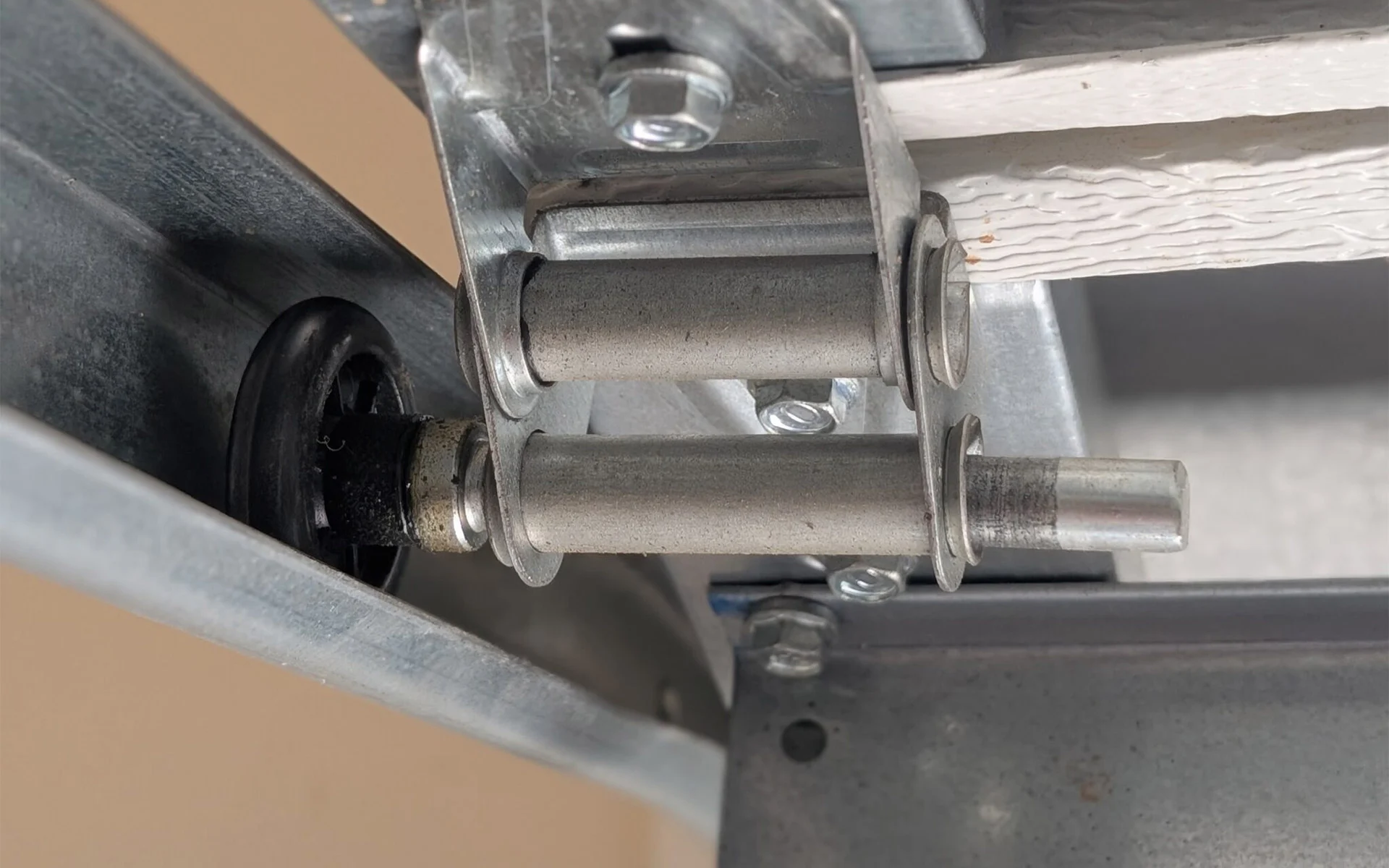
Building a Bracket Selection Map from Door Zone, Thickness Class, and Support Role
The most practical way to specify steel beam brackets, triangular support bracket hardware is to build a selection map. The map should connect three variables: door zone, thickness class, and support role. This avoids a common procurement mistake: treating every galvanized bracket as a general-purpose substitute.
A basic specification map can begin with the catalog-supported thickness classes. 1,5 mm pre-galvanized balance system bracket parts belong to a different role from 4,0 mm beam support or industrial bearing bracket parts. 2,0 mm galvanized cross beams and 2,5 mm galvanized brackets occupy a middle zone where position, mating hardware, and local support requirements become especially important. 1.8mm and 2.0mm galvanized steel corner support components can be understood as formed supports where geometry contributes to stiffness.
| Bracket role | Catalog-supported data point | Specification concern | Inspection focus |
|---|---|---|---|
| Balance system bracket | 1.5mm, pre-galvanized | Avoid assigning to high-support load paths | Thickness and surface continuity |
| Cross beam | 2.0mm, galvanized | Match with intended cross-connection role | Length, hole position, seating fit |
| General bracket | 2.5mm, galvanized | Confirm support role before substitution | Bend angle and flatness |
| Beam support bracket | 4.0mm, galvanized | Use where stronger support node is required | Hole alignment and edge finish |
| Industrial bearing bracket | 4.0mm, galvanized; 85mm to 185mm bearing center distance options | Match bearing position accurately | Center distance and installation fit |
Solution 1: Role-first thickness selection. Execution Protocol: The buyer or engineering team should classify every bracket position before choosing a thickness class. The classification should identify whether the part is acting as a locating component, cross-connection part, corner support, bearing-related support, or beam support node. Material expected evolution: When the thickness class matches the role, stress is distributed more consistently through the bracket body, reducing the chance that a thin area carries a load path intended for a heavier part. Hidden cost and prevention: The cost risk is SKU complexity. Prevent it by building a simple bracket schedule instead of allowing uncontrolled substitution.
Solution 2: Edge-aware incoming inspection. Execution Protocol: Inspect galvanized and pre-galvanized parts not only on the broad face but also at cut edges, punched holes, folded lips, and contact points. Use visual inspection, dimensional checks, and fit review before installation. Material expected evolution: Better edge screening reduces the chance that moisture-sensitive points enter service unnoticed. Hidden cost and prevention: Inspection takes time. Prevent workflow delay by focusing on high-risk zones rather than treating every surface equally.
Solution 3: Pre-tightening alignment control. Execution Protocol: During installation, seat the triangular support bracket or beam bracket in stages. Place fasteners loosely, confirm contact, check angle alignment, then tighten progressively. Material expected evolution: This reduces locked-in bending stress and improves contact distribution across the bracket. Hidden cost and prevention: Installers may view staged tightening as slower. Prevent this by applying it only to support-critical zones.
Solution 4: Fit validation against connected hardware. Execution Protocol: Validate bracket fit with track, beam, angle iron, bearing location, or support position before batch release. For bearing-related parts, center distance must be treated as a functional dimension, not a secondary catalog note. Material expected evolution: Correct fit keeps vibration from concentrating around a small mismatch zone. Hidden cost and prevention: Trial fit may require sample hardware. Prevent delays by creating a reference set for repeat orders and using consistent inspection drawings.
PROFI-TIPP / CHECKLISTE
- Confirm whether the bracket is used for positioning, corner support, beam support, or bearing-related support.
- Match thickness class to support role before comparing price.
- Check galvanized surfaces at edges, holes, folds, and contact zones.
- Avoid mixing 1.5mm, 2.0mm, 2.5mm, and 4.0mm parts without a role-based map.
- Review bearing center distance when specifying industrial bearing brackets.
- Use staged tightening for triangular support brackets in support-critical areas.
- Validate bracket fit with connected track, beam, angle iron, or door hardware before mass installation.
For broader garage door hardware context, Baoteng’s product categories can be reviewed through the garage door hardware manufacturing site. When engineering teams require formal test references, external standards organizations such as ASTM International und ISO are useful starting points for defining material, coating, and inspection expectations through buyer-approved specifications.
Häufig gestellte Fragen (FAQ)
How to change garage door code?
Changing a garage door code depends on the opener system, not the steel bracket. Usually, the process involves the opener’s learn button, keypad reset steps, and remote reprogramming. Brackets should be checked separately only if door vibration or hardware movement affects opener reliability.
How wide is a garage door?
Garage door width varies by residential or industrial design. Bracket selection should not be based on width alone. The more important hardware factors are door zone, support role, track arrangement, bearing position, and whether the bracket thickness class matches the actual load path.
How to program garage door to car?
Programming a garage door to a car usually involves the vehicle’s built-in transmitter and the opener’s learn function. Steel beam brackets are not part of the programming process, but stable track and support hardware help prevent mechanical vibration from being mistaken for opener performance issues.
How to install garage door?
Garage door installation requires correct track positioning, bracket selection, spring hardware setup, opener alignment, and safety checks. For steel brackets, verify thickness class, galvanized finish condition, hole alignment, seating contact, and staged tightening before final operation testing.
 English
  Русский
  日本語
日本語  한국어
한국어  Français
  Deutsch
  العربية
  Português
  Español