
Sliding door systems depend fundamentally on their rolling elements to achieve smooth, consistent motion with minimal noise and wear. The selection of roller materials directly affects frictional forces, operational sound levels, and the overall durability of the assembly. Nylon rollers have gained widespread use in garage door mechanisms due to their favorable balance of mechanical strength, low friction, and resistance to environmental factors. For engineers tasked with optimizing door alignment and ensuring long-term reliability, a detailed understanding of the mechanical performance, degradation pathways, and environmental interactions of nylon rollers is indispensable. This analysis examines the mechanical behavior of nylon rollers under typical operational loads and the impact of dust-laden workshop environments on their durability, with a focus on the primary failure mode of bearing wear and its effect on rolling resistance.
The primary function of a garage door roller is to enable the door panel to translate smoothly along its guide track, minimizing resistance and wear. Nylon, as a semi-crystalline thermoplastic polymer, offers a combination of low friction and adequate mechanical strength to endure the dynamic and static loads imposed during door operation. Typically, the roller interfaces with a steel or aluminum track, while an internal bearing assembly supports both radial and axial loads generated by the door’s weight and lateral forces from misalignment or external disturbances.
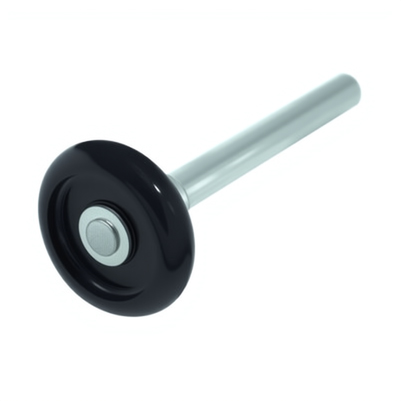
Radial loads on the roller commonly range between 100 and 300 newtons, depending on door size, weight, and installation conditions. The roller material must exhibit sufficient stiffness to maintain shape and function under these loads without exceeding its elastic limit, which would lead to permanent deformation or cracking. Nylon’s modulus of elasticity, usually between 2.5 and 3.5 gigapascals, provides a balance between rigidity and compliance, allowing the roller to accommodate minor track irregularities without excessive stress concentrations. Additionally, nylon’s inherent viscoelastic damping properties help attenuate vibrational energy, contributing to noise reduction by preventing transmission of mechanical vibrations through the door assembly.
The bearing housed within the roller is a critical subcomponent affecting rolling resistance and overall performance. Bearings commonly employ steel balls with nylon cages, where material compatibility between the cage and roller body is essential to prevent differential wear and premature failure. Proper lubrication and effective seal design are vital to maintaining low rolling resistance throughout the product’s service life. An increase in rolling resistance directly correlates with higher torque requirements for door operation and elevated noise levels, both undesirable from a user and maintenance perspective.
In environments characterized by high dust concentrations, such as workshops with airborne particulate matter, abrasive particles can infiltrate the bearing and track interface. This contamination accelerates frictional wear and degrades bearing surfaces, increasing rolling resistance and noise. Nylon’s chemical resistance to oils, solvents, and common workshop chemicals helps preserve its structural integrity, but abrasive wear on the roller surface and bearing races remains a significant concern. Therefore, the surface hardness of the roller and the effectiveness of bearing seals are key factors in sustaining performance and extending service intervals.
The predominant failure mechanism observed in nylon rollers used in sliding door systems is bearing wear, which leads to increased rolling resistance. Bearings subjected to contamination from dust and debris experience accelerated degradation of the raceways and ball surfaces, resulting in pitting, spalling, and eventual loss of smooth rotation. This degradation manifests as increased friction, causing jerky door movement, elevated operational noise, and higher torque demands on the door operator. The bearing wear also promotes secondary wear on the nylon roller surface due to uneven load distribution and increased frictional forces, compounding the deterioration.
Secondary failure modes include polymer fatigue and cracking of the nylon roller body. Repeated cyclic loading, especially under conditions of track misalignment or uneven load distribution, can initiate microcracks within the polymer matrix. Over time, these microcracks propagate, potentially leading to macroscopic fractures and roller failure. Thermal cycling in workshop environments, where temperature and humidity fluctuate, can exacerbate these effects by inducing differential thermal expansion between the nylon body and embedded metallic bearing components, increasing internal stresses. Furthermore, exposure to incompatible lubricants, cleaning agents, or solvents can cause chemical degradation of nylon, leading to embrittlement and reduced impact resistance, which increases susceptibility to cracking under mechanical stress.
The dust-intensive workshop environment presents a challenging operational setting for sliding door rollers. Fine particulate matter acts as an abrasive agent, infiltrating bearing seals and accelerating wear of both the bearing components and roller surfaces. Dust accumulation on tracks and rollers increases friction and noise, necessitating more frequent maintenance interventions. While nylon’s chemical resistance offers an advantage over metal rollers prone to corrosion, abrasive wear remains a critical factor limiting service life. Additionally, elevated humidity and temperature variations can affect nylon’s dimensional stability, potentially causing slight swelling or contraction that impacts roller alignment and load distribution. These environmental factors must be accounted for in design and maintenance strategies to ensure consistent performance.
Validating the durability and mechanical performance of nylon rollers requires adherence to established industry standards. Endurance testing per ASTM D6425 evaluates the fatigue resistance of polymer rollers under cyclic loading conditions representative of typical door operation. This test subjects the roller to thousands of opening and closing cycles while monitoring changes in rolling resistance, structural integrity, and wear patterns. The results provide critical data on expected service life and failure thresholds.
Bearing performance is assessed according to ANSI B3.19 and ISO 281 standards, which define load ratings, fatigue life calculations, and testing protocols for rolling bearings. These standards enable engineers to predict bearing service life under specified load and environmental conditions, facilitating design decisions that mitigate premature bearing failure. Compliance with these standards is particularly important given the bearing’s role as the primary failure locus in nylon roller assemblies.
Safety and operational smoothness requirements for door operators are addressed by UL 325, which includes noise and performance criteria indirectly influenced by roller behavior. Meeting UL 325 ensures that sliding door systems provide acceptable user experience and safety margins. Validation protocols often incorporate accelerated aging tests simulating dust exposure and chemical resistance assessments to verify material compatibility with workshop substances. Collectively, these standards and tests form a comprehensive framework for evaluating nylon roller durability and mechanical behavior under realistic service conditions.
The successful integration of nylon rollers into sliding door assemblies demands careful attention to load paths, alignment tolerances, and environmental sealing. Roller dimensions, including diameter and width, must be precisely matched to track profiles to ensure even load distribution and minimize edge stresses that could precipitate premature wear or cracking. Shaft design is equally critical; shafts fabricated from corrosion-resistant materials such as stainless steel or treated steel reduce seizure risk and facilitate smooth roller rotation over the product lifecycle.
Track alignment is a paramount consideration. Misalignment beyond ±1 millimeter over the door length can cause uneven loading on rollers, accelerating bearing wear and polymer fatigue. Alignment engineers must employ precise measurement and adjustment techniques to maintain track geometry within specified tolerances, ensuring consistent roller-track contact and load distribution.
Lubrication strategies must balance the need for low friction with protection against dust ingress. Sealed bearings filled with synthetic grease optimized for dusty environments extend maintenance intervals and preserve rolling efficiency. Regular inspection and cleaning of tracks and rollers are essential to remove abrasive contaminants and prevent buildup that increases friction and noise.
In applications where noise reduction is a priority, nylon rollers offer clear advantages over steel alternatives due to their inherent damping properties and lower coefficient of friction. This benefit is especially valuable in workshop environments where ambient noise levels are elevated, and reducing door operation noise contributes to operator comfort and reduces fatigue.
Nylon rollers in sliding door systems provide a mechanically viable solution for reducing friction and noise, particularly in dust-intensive workshop environments. Their polymeric characteristics deliver low rolling resistance and vibration damping, enhancing operational smoothness and acoustic comfort. Bearing wear remains the critical failure mode, driven by abrasive contamination and cyclic stresses, necessitating rigorous validation through endurance testing and bearing standards such as ASTM D6425 and ANSI B3.19. Effective integration requires precise alignment, appropriate shaft materials, and robust sealing to mitigate environmental effects. For engineers focused on the reliability of nylon garage door roller assemblies, incorporating environmental factors into design and validation processes is essential to achieving durable, predictable performance in challenging operational settings.
This analysis was reviewed by a Senior Garage Door Hardware Engineer with practical field experience under dust-intensive workshop environment operating conditions, with validation focused on bearing wear / rolling resistance increase in accordance with endurance test compliance requirements.
In practical field applications, engineers treating Nylon Garage Door Roller as a safety-critical interface typically combine finite-life fatigue predictions, scheduled inspection intervals, and conformance to endurance test plus relevant ANSI, ASTM, and UL requirements to keep risk within acceptable limits under dust-intensive workshop environment loading profiles.

 English
  Русский
  日本語
日本語  한국어
한국어  Français
  Deutsch
  العربية
  Português
  Español