
First Look at Garage Door Seal with Track
Эталонный стандарт: Relevant material and dimensional validation standards may include ASTM D2000 rubber classification logic for rubber material communication and ASTM D395 compression-set testing principles when evaluating elastomer recovery behavior. These references are used as general engineering context, not as a claim that the catalog lists these standards.
Краткий ответ
A buyer comparing a уплотнение гаражных ворот с треком is usually trying to solve two problems at once: the door must move in a stable vertical path, and the closed edge must reduce air, dust, and water intrusion. Treating these as separate problems creates specification gaps. A strong purchase specification should connect the galvanized steel track, angle iron geometry, panel thickness, and seal material into one measurable set.
Reading the Door Opening as a Connected Track-and-Seal Boundary
A sectional garage door opening is not only a rectangular hole in a wall. It is a controlled boundary where metal path guidance и elastic edge closure meet. The catalog identifies BT-A311 Вертикальная дорожка с 1.8 mm and 2.0 mm thickness и galvanized steel finish. It also lists BT-A312 Curve Track в 1.8 mm and 2.0 mm galvanized steel, which means the straight vertical run and the curved transition can be specified within the same thickness family. Around this moving path, angle iron parts such as BT-A301 Flag-shaped Joint Angle Iron с 2.0 mm and 2.5 mm thickness, 460 mm and 530 mm length, and a оцинкованное покрытие help define the fixed support boundary. BT-A302 Joint Angle Iron uses 2.3 mm and 2.5 mm thickness with a pre-galvanized finish, while BT-A303 Joint Angle Iron uses 2.3 mm and 2.5 mm galvanized steel.
The seal side of the boundary is just as important. The catalog lists BT-P19 EPDM Bottom Seal suitable for a 40 mm panel, BT-P18 EPDM Bottom Seal suitable for a 50 mm panel, и BT-P20 EPDM Bottom Seal suitable for an 80 mm panel. It also lists BT-P21 EPDM Side Seal и BT-P22 EPDM Top Seal, plus BT-P16 PVC Bottom Seal. This combination shows that the door opening should be read as a perimeter system: vertical tracking controls the travel path, angle iron supports installation geometry, and seals manage the final closed edge.
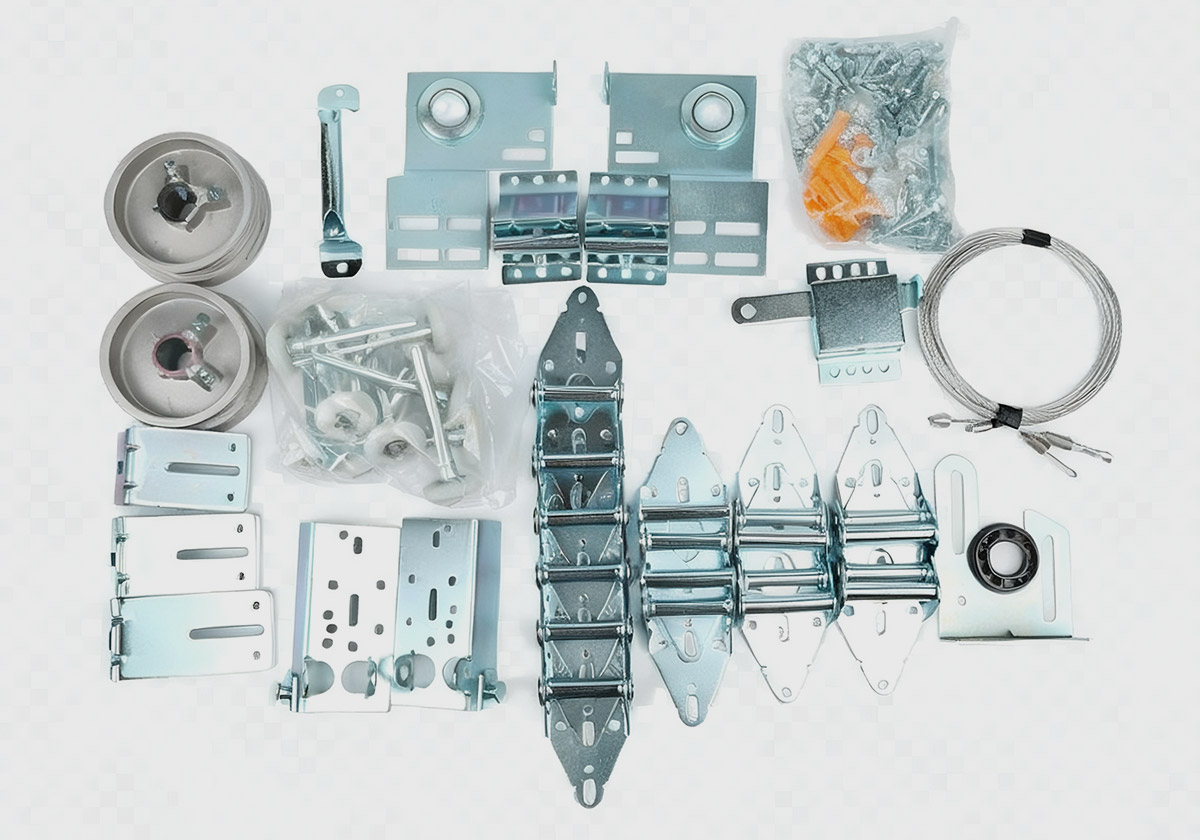
Edge extreme scenario model: imagine a door installed in a humid workshop where dust, rain splash, and daily opening cycles are all present. In the early stage, the 1.8 mm or 2.0 mm galvanized vertical track carries the repeated roller path while the EPDM perimeter seal compresses at the bottom, side, and top edges. In the middle stage, small alignment differences at the angle iron can change how evenly the door meets the seal. In the stress stage, if a panel edge does not match the intended seal size, the seal may look installed but leave a narrow leakage path along one edge. The issue is not only material failure; it is a boundary mismatch.
Cross-dimensional comparison case: a metal-only inspection may confirm track thickness and finish, yet miss seal compression behavior. A rubber-only inspection may confirm EPDM material and appearance, yet miss track straightness. A better inspection compares the whole opening: track path, angle iron position, panel thickness, and seal contact line. For a sectional garage door hardware supplier, this connected approach is more useful than judging each component in isolation.
How Galvanized Steel Tracks and EPDM Seals Share Installation Tolerance
Galvanized steel and EPDM do different jobs, but they share one installation tolerance window. The steel track defines where the door is allowed to move. The elastomer seal defines how the closed door edge responds when the panel reaches its final position. If the track is too far from the intended line, the seal may be forced to correct a geometric problem it was not designed to absorb. If the seal is mismatched to the panel thickness, even a properly aligned track can still leave air or dust gaps.
The confirmed catalog data gives a clear starting point. BT-A311 Вертикальная дорожка is available in 1.8 mm and 2.0 mm galvanized steel. A thicker steel section generally offers higher resistance to deformation under comparable geometry, although actual stiffness also depends on profile shape and installation support. Angle iron data adds another layer: 2.0 mm and 2.5 mm for the flag-shaped joint angle iron, and 2.3 mm and 2.5 mm for joint angle iron options. This means the metal-side specification should not be reduced to “galvanized track” alone; it should identify thickness, part type, and support position.
On the sealing side, EPDM is a common elastomer for weather-exposed sealing because it is associated with better weathering and ozone resistance than many general-purpose rubbers. The catalog identifies EPDM for bottom, side, and top seal positions. In mechanical terms, EPDM must compress enough to fill the edge gap but recover enough to avoid staying flattened. This is why a bottom seal suitable for a 40 mm panel should not be assumed to perform the same role as one suitable for 50 mm or 80 mm panels.
Extreme tolerance model: at the initial installation stage, a small variation in angle iron position may still allow the door to operate. At the repeated-cycle stage, the roller path can reveal uneven contact through noise, drag, or inconsistent closing feel. At the long-use stage, the seal may show asymmetric compression where the track path and panel edge no longer share the same closure plane. The measurable concern is not only visible wear; it is the loss of shared tolerance between rigid guidance and elastic closure.
Cross-dimensional comparison test: compare two installations using the same EPDM bottom seal. In the first, the vertical track is straight, the angle iron is positioned consistently, and the panel thickness matches the seal. In the second, the seal is correct but the track support plane is inconsistent. The second installation may still leak or drag because the seal is being asked to compensate for metal-side error. This shows why QC should check both dimension control и functional fit, not just material labels.
ОСНОВНЫЕ ВЫВОДЫ
- Uneven seal compression can appear before obvious track damage or visible seal tearing.
- Roller noise may indicate that the rigid path and elastic closure edge are no longer working in the same plane.
- A seal matched to the wrong panel thickness can look installed while still allowing air, dust, or water movement.
From Warehouse Handling to Final Door Closure: Where Fit Problems First Appear
Fit problems often become visible at final closure, but their origin may appear much earlier in the product journey. This does not mean the article should focus on packaging pressure marks or receiving damage. The more practical engineering question is this: when the parts move from storage to installation, which dimensions must remain controlled so the final door edge closes correctly?
The catalog states that these hardware products are used for garage doors, industrial doors, commercial doors, and residential doors. That range matters because the same component logic must serve different opening sizes, installation habits, and use frequencies. A residential garage door may emphasize quiet closure and weather isolation. A commercial or industrial door may face more frequent cycling and more dust exposure. In all cases, track straightness, angle iron positioning, panel suitability, и seal compression location must converge at final closure.
The factory capability listed in the source profile is relevant to this problem. Equipment such as high-speed punching machines, CNC benders, laser cutting machines, hydraulic presses, injection molding machines, wire cutting machines, lathes, grinders, и automatic assembly machines supports repeatable cutting, punching, bending, forming, and assembly operations. For track and angle iron, this points to the importance of consistent hole positions, bend geometry, and length control. For EPDM or PVC seals, it points to stable section shape and fit consistency.
Lifecycle fit model: before installation, the critical variables are thickness, length, hole position, bend angle, surface condition, and seal section. During installation, the critical variables shift to vertical alignment, support connection, panel edge relationship, and seal seating. During final closure, the variables become operational: noise, drag, edge contact, air gap, and compression balance. A part can pass a visual check but still fail the final closure test if the metal and seal dimensions were never evaluated together.
Cross-dimensional comparison case: consider a door set where the 2.0 mm galvanized vertical track is specified correctly but the side seal is not checked against the actual panel edge. Compare it with a set where the metal thickness is correct and the EPDM side and top seals are also checked at the final closed position. The second set has a better chance of stable weather isolation because it validates the whole boundary, not just the strongest-looking component.
A useful inspection path can be written as a sequence:
- Confirm the vertical track type and thickness before installation.
- Confirm the angle iron thickness and, where relevant, length.
- Match the bottom seal to the panel suitability data.
- Check whether side and top EPDM seals contact the panel edge without folding or stretching.
- Close the door slowly and listen for drag, scrape, or sudden resistance.
- Inspect light gaps, dust paths, and uneven compression after the door is fully closed.
Specifying a Track-with-Seal Set for Quieter Closure and Weather Isolation
A procurement specification for a track-with-seal set should be more precise than “garage door track and rubber seal.” It should state the track type, thickness, finish, angle iron requirements, seal material, seal position, panel suitability, and intended door category. For the catalog set, a practical specification may reference BT-A311 Вертикальная дорожка, 1.8 mm or 2.0 mm galvanized steel, compatible angle iron selections such as 2.0–2.5 mm или 2.3–2.5 mm galvanized or pre-galvanized options, and EPDM seals for bottom, side, and top positions. Where bottom seal selection is involved, the panel suitability data of 40 mm, 50 mm, and 80 mm should be confirmed rather than guessed.
A quieter door closure is not created by the seal alone. Noise may come from roller friction, track contact, uneven panel movement, or seal over-compression. Weather isolation is also not created by metal alone. A galvanized steel track can maintain the path, but it cannot close the bottom, side, and top air routes by itself. The specification must connect both sides.
Extreme closure model: in a damp, dusty, daily-use garage, the first stage of performance is smooth travel. The second stage is full edge contact without excessive seal deformation. The third stage is repeated closure without visible seal twisting, noise increase, or corrosion at exposed metal edges. In this model, a buyer should not ask only for “EPDM seal.” The more complete request is: “EPDM bottom, side, and top seals matched to panel thickness, supplied with compatible galvanized vertical track and angle iron requirements.”
Cross-dimensional comparison test: a low-detail inquiry may ask for track length and seal material. A high-detail inquiry asks for track thickness, оцинкованное покрытие, angle iron thickness and length, seal position, panel suitability, и door application. The high-detail version reduces ambiguity because it converts a generic accessory purchase into a controlled perimeter system.
| Specification variable | Catalog-based data point | Practical validation focus | Risk if ignored |
|---|---|---|---|
| Vertical track thickness | 1.8 mm / 2.0 mm | Confirm track identity and profile consistency | Path instability or excess roller friction |
| Angle iron thickness | 2.0–2.5 mm / 2.3–2.5 mm | Confirm support role and hole alignment | Uneven support plane |
| Bottom seal material | EPDM or PVC listed by part type | Confirm material and bottom-edge application | Poor closure consistency |
| Panel suitability | 40 mm / 50 mm / 80 mm | Match bottom seal to panel thickness | Leakage or seal distortion |
| Side and top seal | EPDM | Confirm perimeter contact at final closure | Air, dust, or water entry |
Four Practical Solutions and Validation Standards
Solution 1: Specify the metal path before selecting the seal.
Execution Protocol: identify the vertical track part family first, then confirm whether 1.8 mm or 2.0 mm galvanized steel is suitable for the door system being supplied. After that, match the angle iron thickness and length requirements instead of treating angle iron as a universal accessory.
Expected material behavior: a more consistent metal path reduces the burden placed on the elastic seal. The EPDM seal then works as a closure interface rather than a correction device for misalignment.
Hidden cost and side-effect control: over-specifying thickness without checking installation geometry can raise cost without improving closure. The correct control point is the relationship between track, support, and panel edge.
Solution 2: Match the bottom seal to panel suitability data.
Execution Protocol: confirm whether the panel is closer to the catalog’s 40 mm, 50 mm, or 80 mm suitability options before choosing the bottom seal. Do not replace this step with visual comparison alone.
Expected material behavior: correct panel matching helps the EPDM section compress in the intended range and reduces edge folding.
Hidden cost and side-effect control: stocking too many seal variants can complicate inventory, but stocking only one can create fit complaints. A simple panel-thickness decision table is usually safer.
Solution 3: Validate final closure as a system test.
Execution Protocol: after installation, close the door slowly and inspect bottom, side, and top contact. Check for scrape noise, uneven resistance, visible daylight, and seal twist.
Expected material behavior: metal parts should guide movement without forcing the seal into asymmetric compression. EPDM should contact and recover without permanent distortion after normal closure.
Hidden cost and side-effect control: this adds inspection time, but it catches problems that dimensional checks alone can miss.
Solution 4: Separate galvanized surface inspection from weather-seal inspection.
Execution Protocol: inspect galvanized steel for surface continuity, burrs, and deformation, then inspect EPDM or PVC separately for section shape, appearance, and fit. Combine both results only after a sample assembly check.
Expected material behavior: the metal side maintains structural guidance, while the seal side maintains closure. Each has its own failure pattern.
Hidden cost and side-effect control: a single pass/fail label can hide the real cause of a complaint. Separate records make later troubleshooting faster.
СОВЕТ ОТ ПРОФЕССИОНАЛА / КОНТРОЛЬНЫЙ СПИСОК
- Confirm whether the required vertical track is 1.8 mm or 2.0 mm galvanized steel.
- Record the angle iron thickness and any required length before quoting.
- Match bottom seal selection to 40 mm, 50 mm, or 80 mm panel suitability when applicable.
- Inspect EPDM side and top seals at the closed door position, not only on the workbench.
- Check for roller drag before blaming the seal for poor closure.
- Keep galvanized metal inspection and elastomer inspection as separate QC records.
Часто задаваемые вопросы (FAQ)
How to program garage door remote to car?
Most car-to-garage remote programming depends on the opener brand and vehicle system. It usually requires clearing old codes, pressing the opener learn button, and syncing the car button within the allowed time window. Track and seal hardware do not control remote programming.
How to pair garage door opener?
Pairing normally involves pressing the opener’s learn or program button, then activating the remote until the opener confirms the signal. If the door moves poorly after pairing, inspect the vertical track, roller path, and seal compression separately from the electronics.
How much does a new garage door cost?
Cost depends on door size, panel type, opener, insulation, hardware, labor, and region. Track and seal specifications can influence the final quote because galvanized track thickness, angle iron requirements, and EPDM seal positions affect the hardware package.
How to install garage door sensors?
Garage door safety sensors are typically mounted near the floor on both sides of the door opening and aligned so the signal path is clear. After sensor installation, the door edge should still be checked for smooth travel, proper seal contact, and no track-related obstruction.
 English
  Русский
  日本語
日本語  한국어
한국어  Français
  Deutsch
  العربية
  Português
  Español