
For buyers sourcing Самонарезающие винты 1/4 дюйма for door-panel fastening, the most important first step is to specify exactly which catalog-listed BT-S907 option is required. The available product evidence identifies BT-S907 as a tapping screw for door panels and lists two size designations: 1/4″*20 и 1/4″*25.
Those verified details create a useful but deliberately narrow purchasing boundary. They identify the product, its door-panel application, and the two listed size options. They do not establish the screw’s material, coating, head geometry, drive configuration, point design, drilling capability, load rating, dimensional tolerance, or installation performance. Those details should be confirmed separately whenever they matter to the order.
Эталонный стандарт: Relevant material and performance testing standards should be confirmed according to the final screw construction, installation method, and door-panel application. The available catalog evidence does not identify a product-specific testing standard for BT-S907.
If additional characteristics affect compatibility, request written confirmation instead of treating an unstated feature as part of the catalog specification.
What the BT-S907 Specification Confirms
The catalog evidence provides a compact specification for BT-S907: it is described as a tapping screw for door panels, and its listed sizes are 1/4″*20 и 1/4″*25. A separate hardware-kit listing also identifies self-tapping screws among the fasteners used in the broader garage-door hardware context.
For procurement purposes, those facts are enough to establish a clear starting point. A buyer can name the catalog item, state the intended door-panel fastening application, and select between the two listed variants. That is considerably more precise than issuing a generic request for “self-tapping screws” without any model, application, or size reference.
The specification boundary is equally important. The catalog information provided for this article does не identify a screw material. It does not state whether the screw has a particular protective finish or coating. It does not establish whether the drive is Phillips, hex, slotted, or another form. Although “phillips self tapping screws” may appear as a related search phrase, using that phrase in an order would create an unsupported assumption unless the drive style is confirmed independently.
The same discipline applies to point geometry and installation behavior. “Self-tapping” should not automatically be rewritten as a claim about a specific drilling capability, substrate thickness, installation speed, torque requirement, or load-bearing performance. Those are separate technical questions.
This distinction matters because purchasing errors often begin when a category description is treated as a complete specification. A category tells the buyer what general kind of fastener is being discussed. A purchase specification must identify the exact characteristics needed for the actual assembly.
For BT-S907, the evidence-safe core is therefore simple:
| Ordering field | Confirmed information |
|---|---|
| Catalog model | BT-S907 |
| Product description | Саморезы для дверных панелей |
| Listed option 1 | 1/4″*20 |
| Listed option 2 | 1/4″*25 |
| Application context | Door-panel fastening |
| Материал | Requires confirmation |
| Coating or finish | Requires confirmation |
| Drive style | Requires confirmation |
| Point geometry | Requires confirmation |
| Performance ratings | Requires confirmation |
This table should be treated as a purchasing-control boundary, not as a complete engineering drawing.
1/4 Inch Self Tapping Screws: Choose the Listed Size
The practical decision between 1/4″20 and 1/4″25 should be resolved before an order is released. If a purchase request states only “1/4-inch self-tapping screw,” it leaves one of the catalog’s few verified differentiators unspecified.
The buyer should therefore connect the selected option to the actual door-panel assembly rather than choosing between the two designations by assumption.
Start with the drawing, approved sample, existing part, bill of materials, or installation requirement used for the door. Determine which BT-S907 size designation is required by that reference. If the internal drawing uses different dimensional notation, reconcile it with the supplier before purchase.
This is especially important when repeat orders are involved. A purchasing team may recognize “BT-S907” from a previous transaction and assume the model number alone is enough. Yet the catalog identifies two listed options under that model. A repeat-order record should preserve the actual selected size instead of relying on staff memory.
A clean request might identify the requirement as:
BT-S907 tapping screw for door panels — 1/4″*20
или
BT-S907 tapping screw for door panels — 1/4″*25
That single addition removes a major source of ambiguity.
The buyer should also avoid assigning unsupported meaning to the notation. The catalog provides the designations as 1/4″*20 и 1/4″*25. When a purchasing system, drawing, or quality document requires a more explicit dimensional description, request confirmation of the dimension convention and units rather than translating the notation into an unverified specification.
Ordering Risks to Catch Early
- The RFQ says only “1/4 inch self tapping screws” and does not identify the 20 or 25 variant.
- A repeat order references BT-S907 but the previous size selection cannot be traced.
- A buyer adds material, coating, drive style, point geometry, or performance requirements that were never confirmed for the catalog item.
The objective is not to make the order longer. It is to make every field that affects identification explicit.
Match the Screw Request to Door-Panel Fastening
BT-S907 is specifically described as a tapping screw for door panels, so the inquiry should preserve that application context.
That matters because the phrase “self-tapping screw” covers a broad fastener category in general commerce. Search results and distributor inventories may include products used in unrelated applications. The verified evidence here does not support extending BT-S907 claims to roofing, automotive assemblies, structural steel connections, general sheet-metal fabrication, or other fastening environments.
A buyer looking for this catalog item should therefore describe the location on the door assembly as accurately as the available design information allows. For example, the inquiry can state that the screws are required for a particular door-panel fastening point and attach a drawing or reference photo where appropriate.
Application information helps keep two separate questions from becoming confused:
Product identification: Is the requested item the BT-S907 door-panel tapping screw and which listed size is required?
Fit confirmation: Does that selected item match the specific panel, mating component, installation condition, and construction used in the buyer’s door?
The catalog supports the first question. Additional technical documentation may be needed for the second.
This distinction is particularly useful in OEM purchasing. The same general product category can appear across multiple assemblies, yet different fastening locations may have different dimensional or construction requirements. Naming the door-panel location gives the supplier or technical contact a concrete reference point for checking the request.
It also improves internal purchasing control. A part description such as “self-tapping screw” can be difficult to audit later. A record that states the model, catalog size, and application gives engineering, purchasing, receiving, and quality teams a much clearer common reference.
Ningbo Baoteng Technology Co., Ltd. is identified in the supplied catalog context as a company specializing in hardware accessories and OEM products for garage doors, industrial doors, commercial doors, and residential doors. Buyers reviewing the wider hardware context can use the company’s garage-door hardware information as a starting point while keeping each product request tied to its own confirmed specification.
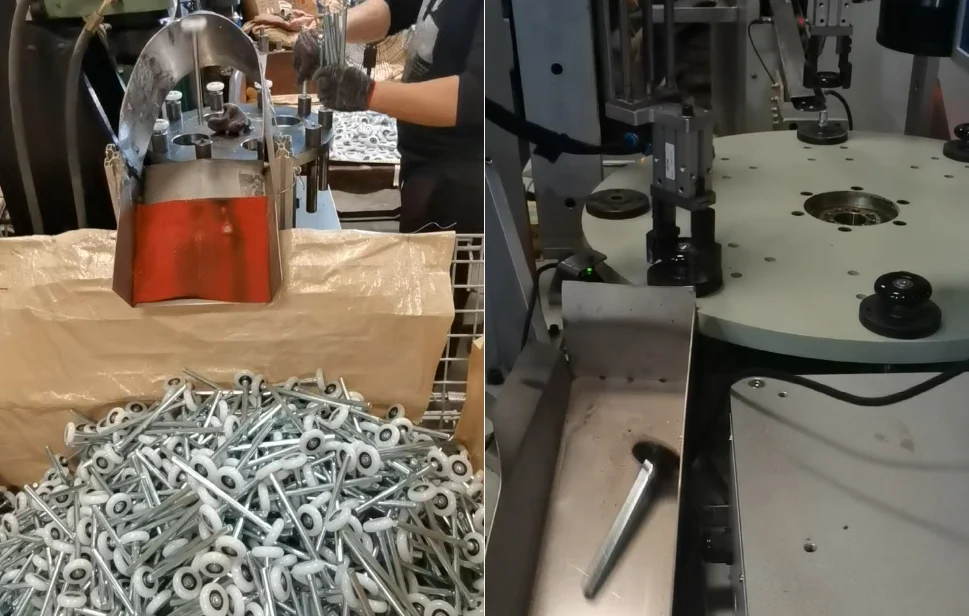
What to Include in a 1/4-Inch Screw Inquiry
A useful inquiry does not need invented engineering detail. It needs a clean separation between what is already known и what still needs confirmation.
Begin by naming BT-S907 where that catalog item is required. If the buyer is working from an application rather than a model number, describe it as the required tapping screw for the door-panel fastening location.
Next, state the 1/4-inch size designation and choose either the listed 1/4″*20 или 1/4″*25 option. Do not leave both in the RFQ unless the buyer genuinely needs quotations or quantities for both variants.
Then describe the application. “Door-panel fastening” is the verified starting point, but an actual procurement package can be more precise when the buyer has drawings, part references, installation photographs, or an approved sample.
Finally, separate requested confirmations from established specifications. If material is important, ask the supplier to confirm material. If corrosion protection matters, ask for the finish or coating specification. If the assembly requires a particular head or drive configuration, request confirmation against a drawing or sample. If installation performance is critical, request the appropriate technical documentation rather than inferring capability from the term “self-tapping.”
Pre-Order Confirmation Checklist
- Identify the screw as BT-S907 when ordering the catalog-listed item.
- State that the required fastener is for door-panel fastening.
- Confirm the 1/4-inch catalog size designation.
- Specify 1/4″*20 или 1/4″*25 rather than leaving the variant open.
- Attach the relevant drawing, sample reference, or fastening-location description when available.
- Ask for confirmation of материал if material affects the purchasing requirement.
- Ask for confirmation of surface finish or coating if corrosion protection matters.
- Confirm the required head and drive configuration rather than assuming a Phillips drive or another style.
- Request any needed point-geometry, fit, or installation information separately.
- Keep unverified load, torque, drilling, tolerance, and lifecycle claims out of the purchase specification until supporting technical data is supplied.
This approach turns a short catalog entry into a controlled purchasing request without creating specifications that the source does not establish.
For the buyer, the central decision is straightforward: identify the intended door-panel application and lock the order to the correct catalog-listed BT-S907 option. Everything else that affects fit or performance should be treated as a confirmation item until reliable product-level documentation is available.
 English
  Русский
  日本語
日本語  한국어
한국어  Français
  Deutsch
  العربية
  Português
  Español