

Mechanical Behavior and Durability Assessment of Steel Roller Wheels in Overhead Garage Doors
Introduction
Overhead garage doors rely heavily on the consistent performance of their rolling components to maintain smooth operation and structural integrity. Steel roller wheels form a critical interface between the door and its guiding tracks, facilitating controlled movement with minimal friction. For engineers tasked with maintaining door alignment and ensuring operational safety, a thorough understanding of the mechanical behavior and degradation mechanisms of these rollers is indispensable. This is particularly true in dust-intensive workshop environments, where particulate contamination accelerates wear processes. This article explores the mechanical principles governing steel roller wheel performance, delves into prevalent failure modes—especially bearing wear leading to increased rolling resistance—and discusses relevant testing standards and environmental influences. The goal is to provide a comprehensive technical perspective that supports informed design, validation, and maintenance decisions.
Mechanical Principles & Load Behavior
Steel roller wheels serve as the primary rolling elements that guide overhead garage doors along their tracks. Their design integrates hardened steel wheels with precision bearing assemblies, typically deep-groove ball bearings or sealed roller bearings, to minimize rolling friction and sustain operational loads. The rolling resistance encountered is a complex function of bearing design, lubrication condition, load magnitude and distribution, as well as the surface finish of both the wheel and track.
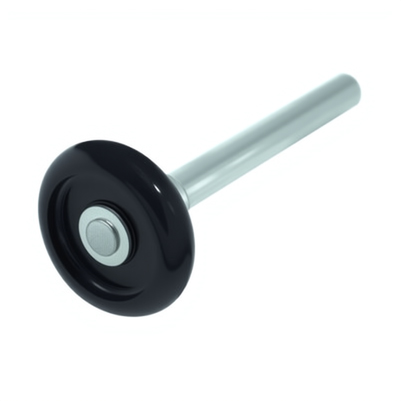
In typical residential or light commercial garage door systems, each roller wheel supports dynamic loads in the range of 50 to 150 kilograms, varying with door size, panel weight, and mounting configuration. These loads induce radial forces on the bearing raceways and, in some cases, axial loads due to door misalignment or track curvature. Bearing assemblies must maintain low torque thresholds to reduce operator effort and prevent undue stress on drive mechanisms.
The coefficient of rolling friction for well-maintained steel roller wheels generally lies between 0.002 and 0.005, markedly lower than sliding friction coefficients for similar steel-on-steel contacts. This low friction is essential to preserve door alignment and prevent uneven wear on tracks and mounting brackets. Even slight increases in rolling resistance can cause misalignment, leading to binding or jerky door movement.
Lubrication within the bearing races is critical to reducing metal-to-metal contact and wear. Most steel roller wheels employ sealed bearings pre-filled with high-viscosity grease designed to retain lubricant and exclude contaminants over extended service intervals. However, in dust-intensive workshop environments, fine abrasive particles can breach seals, compromising lubrication and accelerating wear.
Material selection for roller wheels centers on hardened carbon steel or stainless steel alloys, chosen for their high hardness, wear resistance, and load-bearing capacity. The hardness of the wheel surface directly influences the durability of the contact interface with the track, affecting long-term alignment stability and resistance to deformation.
Failure Modes
Primary Failure: Bearing Wear Leading to Increased Rolling Resistance
Bearing wear is the dominant failure mode affecting steel roller wheels, directly impacting rolling resistance and operational smoothness. Degradation mechanisms include pitting, spalling, and brinelling of the bearing raceways and rolling elements. These defects increase frictional torque, hindering free rotation and imposing higher loads on door operators and track hardware.
The initiation of bearing wear is frequently linked to contamination ingress, lubrication breakdown, or mechanical overload. In dust-intensive workshop environments, abrasive particulates penetrate bearing seals, disrupting the lubricant film and accelerating surface fatigue. Micro-pitting develops under cyclic loading and propagates rapidly, culminating in macro-scale damage that significantly raises rolling resistance.
As rolling resistance increases, door alignment becomes compromised due to uneven force distribution. Symptoms include jerky or noisy door movement, increased operator effort, and potential binding. If unaddressed, bearing wear can precipitate premature failure of adjacent components such as shafts, mounting brackets, and tracks, escalating repair costs and downtime.
Secondary Failure: Structural Deformation and Track Misalignment
Secondary failure modes arise as mechanical consequences of elevated rolling resistance and bearing degradation. Increased frictional forces generate bending moments on roller shafts and mounting brackets, potentially causing permanent deformation. This deformation alters the intended geometry of the door’s guide path, exacerbating track misalignment.
Track misalignment imposes additional lateral loads on roller wheels, accelerating wear and increasing the risk of derailment or binding. The combined effect of bearing wear and structural deformation undermines door safety and reliability, potentially leading to operational failure or hazardous conditions if not promptly addressed.
Environmental Effects on Durability
Environmental conditions play a pivotal role in the progression of failure modes. Dust-intensive workshop environments introduce fine particulate contamination that can infiltrate bearing seals and abrade contact surfaces. The presence of abrasive particles accelerates lubricant degradation and metal fatigue, shortening bearing life.
Temperature fluctuations common in workshop settings affect lubricant viscosity and bearing material properties, influencing fatigue resistance and wear rates. Elevated temperatures can thin lubricants, reducing film thickness and increasing metal contact, while low temperatures may increase lubricant viscosity, raising rolling resistance.
Corrosive agents, such as solvents, oils, or chemical residues prevalent in industrial environments, further threaten steel components by promoting corrosion if protective coatings or passivation layers are compromised. This corrosion can lead to pitting and surface roughness that exacerbate bearing wear and rolling resistance increases.
Mitigating these environmental effects requires careful material selection, robust seal designs, and maintenance protocols tailored to the specific contamination and temperature profiles encountered.
Testing Standards & Validation
Validating the performance and durability of steel roller wheels involves adherence to established industry standards that simulate operational stresses and environmental conditions. Endurance testing under controlled laboratory conditions replicates cyclic loading and contamination exposure to assess bearing life, rolling resistance evolution, and structural integrity.
ANSI/DASMA 102 provides performance criteria for overhead door hardware, including load ratings and safety factors pertinent to roller assemblies. This standard guides design validation to ensure components meet minimum durability and safety requirements.
ASTM F2200 specifies test methods for garage door hardware, including fatigue testing protocols for rollers subjected to cyclic loading. This standard facilitates quantitative evaluation of bearing wear progression and deformation under simulated service conditions, enabling engineers to predict service life and maintenance intervals.
UL 325 addresses safety requirements for door operators and associated hardware, emphasizing durability and failure prevention. Compliance with UL standards ensures that roller wheel assemblies meet rigorous safety and reliability benchmarks required for commercial acceptance.
Testing protocols typically involve subjecting roller wheels to repeated load cycles within dust-laden chambers that replicate workshop contamination levels. Rolling torque measurements and detailed inspections for bearing damage are conducted at regular intervals to monitor degradation. These validation steps provide critical feedback for design optimization and maintenance planning.
Application & Integration
Successful integration of steel roller wheels into overhead garage door systems demands precise alignment, appropriate load distribution, and environmental protection measures. Proper installation ensures rollers maintain perpendicular contact with tracks, minimizing lateral forces that accelerate bearing wear and structural deformation.
Material compatibility between rollers and tracks is essential; hardened steel rollers paired with galvanized or stainless steel tracks reduce abrasive wear and corrosion susceptibility. Seal integrity and lubricant selection must be carefully matched to the expected contamination levels and temperature ranges, with more robust sealing and specialized lubricants recommended for dust-intensive workshop environments.
Maintenance strategies should incorporate scheduled lubrication, bearing condition monitoring, and replacement criteria based on measured rolling resistance thresholds. Employing diagnostic tools such as torque sensors or vibration analysis can provide early detection of bearing degradation, enabling proactive intervention before alignment or safety issues arise.
In retrofit or upgrade scenarios, replacing existing rollers with sealed steel roller wheels designed for enhanced dust protection can significantly extend service life and improve operational reliability. Engineering decisions must balance cost implications against performance improvements, considering the specific environmental challenges and duty cycles of the installation.
The mechanical performance and durability of steel roller wheels are fundamental to the reliable operation of overhead garage doors, particularly in dust-intensive workshop environments where bearing wear and increased rolling resistance pose significant challenges. Adherence to recognized endurance test standards such as ANSI/DASMA 102 and ASTM F2200 ensures validated component robustness under realistic conditions. Integrating these rollers with attention to alignment, material compatibility, and environmental protection, combined with rigorous maintenance and monitoring, is essential to prolonging service life and maintaining door alignment. For engineers overseeing these systems, a detailed understanding of failure modes and validation protocols is critical to mitigating risks and ensuring long-term operational safety.
Steel roller wheels designed and maintained with these engineering principles in mind offer the best assurance of durability and consistent performance in demanding workshop environments.
This analysis was reviewed by a Senior Garage Door Hardware Engineer with practical field experience under dust-intensive workshop environment operating conditions, with validation focused on bearing wear / rolling resistance increase in accordance with endurance test compliance requirements.
In practical field applications, engineers treating steel roller wheels as a safety-critical interface typically combine finite-life fatigue predictions, scheduled inspection intervals, and conformance to endurance test plus relevant ANSI, ASTM, and UL requirements to keep risk within acceptable limits under dust-intensive workshop environment loading profiles.

 English
  Русский
  日本語
日本語  한국어
한국어  Français
  Deutsch
  العربية
  Português
  Español