
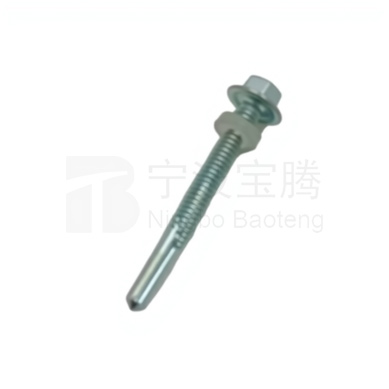
Fastening components in garage door assemblies are subjected to complex mechanical and environmental demands that directly influence their service life and safety performance. Among these, hex washer head screws are widely used due to their integrated washer flange and hexagonal drive, which together enhance load distribution and enable consistent torque application during installation. Garage doors experience repetitive dynamic loads from opening and closing cycles, wind pressures, and thermal variations, all of which impose fluctuating stresses on fasteners. These conditions often lead to failure modes such as fastener loosening and thread stripping, particularly in vibration-sensitive installation sites where micro-movements can rapidly degrade joint integrity. A detailed understanding of the mechanical behavior of these screws under operational loads, their failure mechanisms, and relevant testing standards is crucial for ensuring fastening reliability and structural safety in garage door systems.
The hex washer head screw design integrates a hexagonal drive with an enlarged flange that functions as a built-in washer, increasing the bearing area against the substrate. This configuration improves load transfer efficiency by distributing clamping forces over a wider surface, thereby reducing localized bearing stress that can lead to substrate deformation or embedment. This is especially important when fastening into softer materials commonly found in garage door frames, such as aluminum alloys or composite reinforcements. In vibration-sensitive installation sites, where cyclic loading is prevalent, this load distribution mitigates fatigue damage and joint relaxation.
Torque application through the hex drive offers installers the ability to achieve higher and more repeatable preload levels compared to slotted or Phillips head screws. Maintaining an appropriate preload is critical to preserving clamping force, which prevents micro-slip at the interface—a primary contributor to fastener loosening. Experimental data obtained from strain gauge measurements and pressure-sensitive film testing indicate that the integrated washer flange reduces peak bearing stresses by approximately 30 to 40 percent relative to hex head screws without washers. This reduction in contact pressure limits substrate deformation and enhances joint stability under repeated loading cycles.
During typical garage door operation, these screws experience combined shear and tensile stresses. Shear forces result from lateral movements of door panels and wind loads, while tensile stresses arise from the door’s weight and acceleration during motion. The preload applied during installation must be carefully controlled: insufficient preload permits micro-movements that initiate loosening, whereas excessive torque risks thread stripping or substrate damage. The hex washer head geometry facilitates a more predictable torque-to-tension relationship, promoting uniform clamping forces across multiple fasteners. This uniformity distributes loads evenly, reducing localized overstress and extending fatigue life in dynamic environments.
Fastener loosening is the most frequently observed failure mode in hex washer head screws used in garage door systems. Cyclic vibrations and repetitive loading induce micro-slip at the interface between the screw flange and substrate, progressively diminishing preload. This loss of clamping force leads to joint separation, increased wear, and potential structural instability. Field observations confirm that deviations from recommended installation torque significantly accelerate loosening. Under-torquing fails to establish adequate preload to resist micro-movements, while over-torquing can damage threads or deform the substrate, both undermining joint integrity.
Thread stripping represents another critical failure mechanism often associated with overtightening or mismatched material hardness between the fastener and substrate. When the shear strength of the substrate threads is exceeded by the screw threads, stripping occurs, reducing effective engagement length and load-carrying capacity. This failure is particularly prevalent in softer substrates or when screws are reused without thorough inspection. Thread stripping compromises the fastener’s resistance to pull-out forces, increasing the risk of sudden joint failure during operation.
Secondary failure modes include corrosion-induced degradation and fatigue cracking. Corrosion is accelerated in outdoor or semi-exposed garage door installations where moisture, temperature cycling, and chemical exposure—such as de-icing salts—are present. Fasteners fabricated from low-grade steel without adequate protective coatings experience accelerated cross-sectional loss and thread profile distortion, weakening the joint and facilitating loosening or stripping.
Fatigue cracking, although less common, can develop in screws subjected to high-cycle loading, particularly at stress concentration zones such as the head-to-shank transition. Fatigue failures typically manifest as sudden fractures without significant prior plastic deformation, posing serious safety concerns. Insufficient preload exacerbates fatigue by allowing micro-movements that increase stress amplitude, while environmental factors like corrosion can initiate crack propagation and accelerate failure.
Fasteners installed in vibration-sensitive environments face compounded mechanical and environmental challenges. Continuous cyclic stresses from door operation promote preload relaxation and micro-motion at the fastener-substrate interface. Simultaneously, environmental factors such as humidity and temperature fluctuations induce differential thermal expansion and contraction, further destabilizing the joint. These combined effects intensify the risk of fastener loosening and thread damage.
Corrosion mechanisms are aggravated by exposure to chlorides from road salts or marine atmospheres, which promote galvanic corrosion, especially when dissimilar metals are in contact. This degradation reduces the effective cross-section of the screw and alters thread geometry, increasing susceptibility to both loosening and thread stripping. Consequently, material selection and protective coatings are critical design considerations to ensure durability in aggressive environments and maintain fastening reliability over the service life.
Verification of the mechanical performance and environmental durability of hex washer head screws in garage door applications requires adherence to established testing standards. ASTM F606 provides standardized procedures for evaluating the torque-tension relationship and resistance to thread stripping. This test is fundamental for confirming that screws can sustain specified preload levels without thread failure under controlled conditions, offering quantitative data on allowable torque ranges and thread engagement limits.
ANSI/BHMA A156.9 specifies performance requirements for fasteners used in door hardware, including mechanical strength and corrosion resistance benchmarks. Testing under this standard involves cyclic mechanical loading and environmental exposure simulations that replicate stresses encountered in garage door systems. Compliance with ANSI/BHMA A156.9 ensures fasteners maintain structural integrity and fastening reliability throughout their service life.
UL 325, while primarily focused on door operator safety, incorporates provisions related to hardware durability and fastening integrity under dynamic loads. Meeting UL 325 criteria guarantees that fasteners can endure vibration-sensitive installation site conditions without compromising attachment security.
Load-distribution evaluation tests often employ strain gauges and pressure-sensitive films placed beneath the washer flange to quantify bearing stresses. These assessments confirm the mechanical advantage of the hex washer head design in reducing peak contact pressures, directly correlating with improved joint stability and resistance to preload loss under cyclic loading. Validation through these standards and test methods is essential to ensure fasteners perform reliably in real-world operational environments.
Selecting appropriate fasteners for garage door structural supports demands a comprehensive understanding of material compatibility, environmental exposure, and installation protocols. Fasteners fabricated from corrosion-resistant alloys such as stainless steel or treated with zinc-nickel plating demonstrate superior performance in moisture-prone or chemically aggressive environments, mitigating corrosion-related failure risks and extending service life.
Installation procedures must specify torque values that achieve optimal preload without risking thread damage or substrate deformation. Use of calibrated torque wrenches and strict adherence to manufacturer-recommended tightening sequences reduce variability among fasteners, minimizing the likelihood of loosening. In vibration-sensitive installation sites, supplementary locking measures—such as thread-locking compounds or prevailing torque nuts—may be employed to enhance fastening security. However, the integrated washer flange’s inherent load distribution benefits often reduce reliance on such additives by maintaining uniform bearing pressure.
Routine maintenance protocols should include torque verification and visual inspection for corrosion or mechanical damage. Early detection of preload loss or thread wear allows timely corrective actions, preventing progressive structural deterioration and potential failure. Field experience indicates that combining scheduled inspections with fatigue life predictions and conformance to load-distribution evaluation standards effectively manages risk under the cyclic loading profiles typical of garage door operation.
The mechanical performance of hex washer head screws in garage door assemblies is fundamentally linked to maintaining preload and effective load distribution, especially within vibration-sensitive installation environments. Fastener loosening and thread stripping remain the principal failure modes, influenced by installation accuracy, material selection, and environmental exposure. Adherence to testing standards such as ASTM F606 and ANSI/BHMA A156.9 provides critical validation of mechanical and durability requirements. Employing proper installation techniques, selecting corrosion-resistant materials, and implementing rigorous maintenance protocols support long-term fastening reliability and structural safety in garage door systems.
This analysis was reviewed by a Senior Garage Door Hardware Engineer with practical field experience under vibration-sensitive installation site operating conditions, with validation focused on fastener loosening / thread stripping in accordance with load-distribution evaluation compliance requirements.
For engineering teams responsible for Hex Washer Head Screw, the most robust designs are those that explicitly incorporate vibration-sensitive installation site environmental factors into material selection, document performance evidence against load-distribution evaluation, and maintain traceable validation records that align with ANSI, ASTM, and UL expectations for garage door hardware.

 English
  Русский
  日本語
日本語  한국어
한국어  Français
  Deutsch
  العربية
  Português
  Español