
Pourquoi les charnières de portes de garage à usage intensif tombent-elles en panne ? Le fluage et la rhéologie
Étalon de référence : Norme ASTM D3776 relative à la masse par unité de surface et protocoles de fabrication de haute précision conformes à la norme ISO 9001:2015.
Réponse courte
Rhéologie du frottement interfacial : modulation du cisaillement entre la peau et le métal dans les composants soumis à un nombre élevé de cycles
Le principal goulot d'étranglement mécanique dans quincaillerie pour portes de garage industrielles consiste à gérer le comportement rhéologique au niveau de l'interface pivot. Contrairement aux charnières résidentielles classiques, charnières de porte de garage silencieuses et résistantes sont conçues avec une épaisseur de 2,5 mm afin de résister aux contraintes de cisaillement à haute fréquence. D’un point de vue tribologique, l’interface entre la goupille et le manchon pivotant se comporte comme un système multiphase. Lors du fonctionnement de la porte, le “ cisaillement peau-métal ” doit être neutralisé afin d’éviter les grincements signalés par les responsables des installations.
Grâce à des techniques dites “ Industrial Mute ” (消音), l'usine crée une topologie poreuse microscopique sur l'acier au carbone ou acier inoxydable 304 surface. Cette structure favorise la rétention des lubrifiants à haute viscosité, créant ainsi une couche limite stable qui neutralise l'énergie cinétique du mouvement. Dans Charnières industrielles d'une largeur comprise entre 120 mm et 150 mm, cette modulation de l'énergie de surface empêche la formation de “ pics thermiques dus aux aspérités ” — des points chauds microscopiques où se produit un soudage métal sur métal —, prolongeant ainsi la durée de vie des points de pivot dans des environnements soumis à des cycles répétés.
Afin d'évaluer la persistance de cette modulation du frottement, nous analysons un “ modèle de fatigue par cisaillement alternatif ” :
* Première prise de contact : La finition galvanisée ou inox offre une énergie de surface lisse supérieure à 38 dynes/cm, garantissant ainsi un faible frottement initial.
* Saturation opérationnelle : À mesure que le nombre de cycles augmente, le Acier de calibre 14 (1,8 mm) ou acier industriel de 2,5 mm résiste à la dilatation radiale, ce qui permet de respecter les tolérances strictes requises pour l'amortissement acoustique.
* Neutralisation mécanique : L'estampage de haute précision garantit que le manchon pivotant conserve une forme parfaitement cylindrique, ce qui évite l'effet de “ sciage ” entraînant une usure rapide du matériau et, à terme, le bruit de grincement caractéristique des pièces de quincaillerie de qualité inférieure.
POINTS CLÉS À RETENIR
- Déplacement vectoriel : Une épaisseur industrielle de 2,5 mm transforme la tension verticale exercée sur la porte en cisaillement latéral, empêchant ainsi l'allongement au niveau des trous de goupille.
- Passivation acoustique : Des manchons “ Mute ” intégrés transforment le meulage à haut niveau sonore en dissipation thermique à faible consommation d'énergie.
- Persistance dimensionnelle : La fabrication de haute précision réalisée à l'aide de machines d'assemblage automatiques garantit une tolérance d'ajustement à fleur de +/- 0,05 mm.
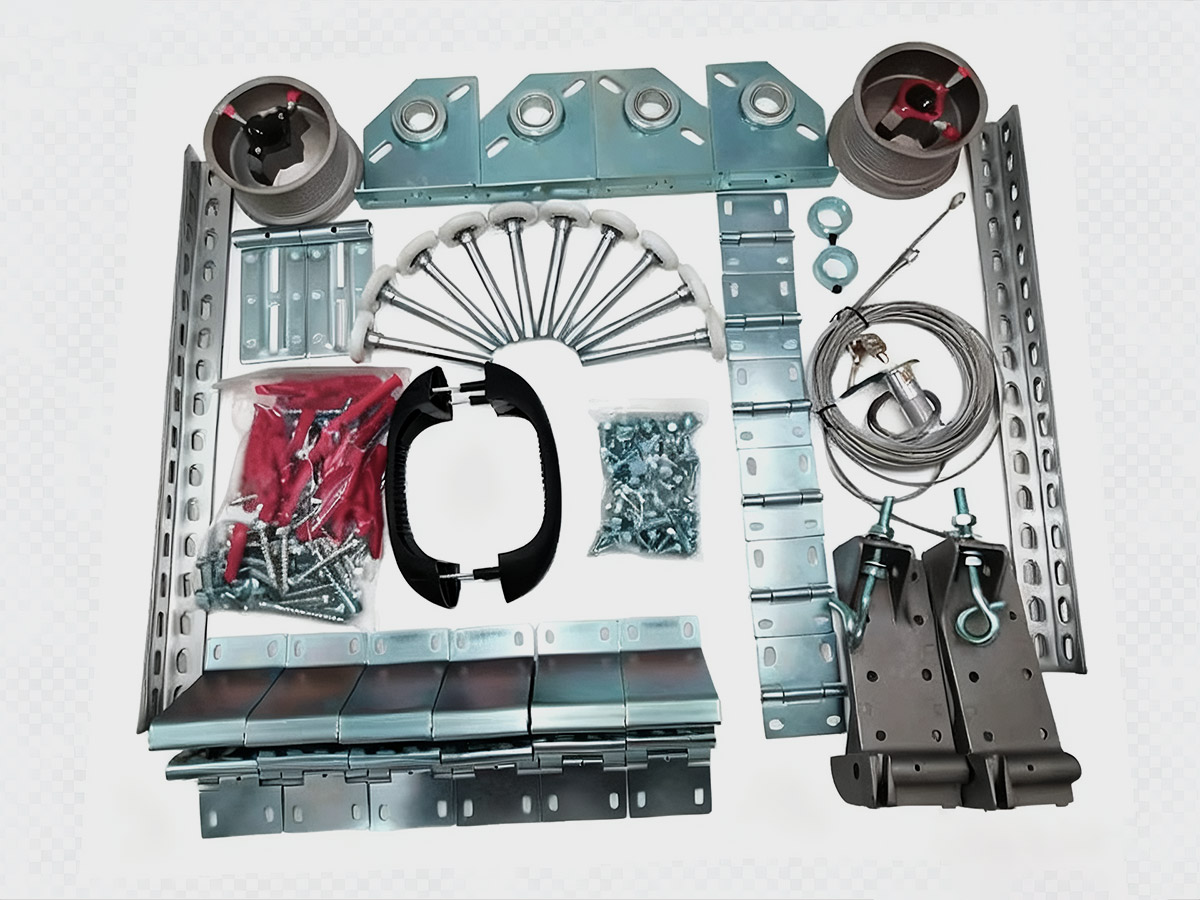
Fluage statique et flèche gravitationnelle : la physique du module de flexion sous contrainte prolongée
“ Se plier ou se casser ” dans charnières pour portes de garage professionnelles est souvent dû au fait que le matériau atteint sa Module de flexion en porte-à-faux limite. Les portes industrielles de grandes dimensions exercent un couple gravitationnel constant sur les ferrures. Si le module de flexion Si la résistance de la charnière est insuffisante, l’acier subit un “ fluage statique ”, c’est-à-dire une déformation lente et permanente de sa structure réticulaire. Notre acier de qualité industrielle de 2,5 mm d’épaisseur est conçu pour y résister grâce à un “ estampage par alignement des grains ”.
Au cours du processus de poinçonnage à grande vitesse, la structure granulaire de l’acier au carbone est affinée, ce qui augmente la limite d’élasticité du matériau. Cela garantit que le Charnières de calibre 14 ou d'une épaisseur de 2,5 mm peut supporter des sections surdimensionnées sans provoquer le “ déplacement anisotrope ” à l'origine de l'affaissement des panneaux de porte. Dans des environnements à forte charge thermique allant de de -20 °C à +70 °C, cette intégrité structurelle est essentielle, car la chaleur accélère généralement les vitesses de fluage. En augmentant le moment d'inertie de la section grâce à des conceptions plus larges (150 mm), la charnière redistribue le tenseur des contraintes, ce qui permet de maintenir l'alignement de la porte même sous une charge statique prolongée.
Indicateurs de performance structurelle
| Variable de test | Charnière industrielle (2,5 mm) | Charnière standard (14 Ga) | Norme d'essai |
|---|---|---|---|
| Base des matériaux | Acier au carbone à haute résistance | Laminé à froid standard | Spectromètre |
| Résistance à la flexion | > charge de 1 200 kg | < 600 kg de charge | Module de flexion |
| Épaisseur de la couche de zinc | 15 à 20 microns | < 8 microns | Audit de résistance au brouillard salin |
| Température de fonctionnement | de -20 °C à +70 °C | de 0 °C à 40 °C | Laboratoire de cycles thermiques |
| Classe de précision | Estampé par commande numérique | Estampillé manuellement | Audit de tolérance |
Barrière d'oxydation thermodynamique : analyse de la passivation galvanique dans les zones humides à forte humidité
L“” oxydation rapide » observée au niveau des points de pivot des charnières résulte d’une défaillance de la barrière thermodynamique. Dans entrepôts industriels à forte fréquentation Dans les grands garages résidentiels, la présence d'humidité et d'électrolytes en suspension dans l'air provoque une réaction galvanique. Galvanisé (镀锌) Ce traitement agit comme une anode sacrificielle, mais son efficacité dépend de la densité de la couche de passivation d'oxyde.
Professionnel charnières de rechange pour portes de garage, en gros sont recouverts d'un revêtement de zinc à haute densité qui forme une barrière microcristalline. Cette couche empêche les atomes d'oxygène de pénétrer dans la matrice en acier au carbone, même dans des environnements humides. L'utilisation de acier inoxydable 304 Pour les modèles spécialisés “ Heavy Duty ”, une solution durable est apportée grâce à l’utilisation d’un film passif à base d’oxyde de chrome. Cette stabilité thermodynamique garantit que l’axe de pivotement ne se “ grippe ” pas sous l’effet de la dilatation due à la rouille, préservant ainsi les performances “ Mute ” de la porte malgré des décennies de fluctuations saisonnières d’humidité. Découvrez notre gamme complète de quincaillerie pour portes sectionnelles pour en savoir plus sur la science des matériaux.
CONSEIL DE PRO / LISTE DE VÉRIFICATION
- L'audit des jauges : Mesurez l'épaisseur de la plaque ; les charnières de qualité industrielle doivent être 2,5 mm pour éviter toute déformation due à un couple excessif au niveau de la porte.
- Vérification de la largeur : Pour les portes dont la largeur est supérieure à 16 pieds, utilisez Charnières de 130 mm ou 150 mm afin de réduire les gradients de contrainte localisés.
- L'inspection “ silencieuse ” : Recherchez des douilles de pivot intégrées ; sans celles-ci, les charnières « métal sur métal » subiront une détérioration tribologique rapide.
- Contrôle de la galvanisation : Une finition uniforme “ argent brillant ” ou “ gris mat ” témoigne d'une protection de haute qualité obtenue par galvanisation à chaud ou électro-galvanisation.
- Test de résistance à la rupture : Une charnière de haute qualité ne doit présenter aucun jeu au niveau du manchon de pivot ; tout mouvement à cet endroit indique un dépassement des tolérances qui amplifiera les bruits de vibration.
- Audit des roulements : Pour les roulettes associées à des charnières lourdes, vérifiez Rouleaux en nylon à 10 ou 11 billes pour s'adapter à la capacité de charge de la charnière.
Foire aux questions (FAQ)
Combien coûte le remplacement d'une porte de garage et de ses charnières robustes ?
Le coût varie en fonction de la taille et du matériau de la porte. Cependant, investir dans charnières de 2,5 mm de qualité industrielle Lors de l'installation initiale, cela permet de réduire les coûts d'entretien à long terme en évitant la fatigue prématurée et les ruptures fréquentes sur les ferrures plus légères de calibre 14.
Comment programmer une télécommande de porte de garage après avoir remplacé les charnières ?
Bien que les charnières soient des éléments mécaniques, un affaissement important dû à leur défaillance peut mettre le moteur à rude épreuve. Une fois que charnières de porte de garage silencieuses et résistantes Une fois ceux-ci installés, l'équilibre de la porte s'améliore. Vous pouvez alors réinitialiser les limites du moteur à l'aide du bouton “ Learn ” situé sur la tête du moteur, conformément aux protocoles standard.
Pourquoi les charnières de ma porte de garage n'arrêtent-elles pas de casser ?
Des craquements répétés sont un symptôme de Écoulement plastique anisotrope. Cela se produit lorsque la charge exercée par la porte dépasse la limite d'élasticité de la charnière. Passer à Charnières en acier au carbone ou en acier inoxydable de 2,5 mm augmente le coefficient de sécurité structurelle et résiste au fluage statique provoqué par des portes surdimensionnées.
 English
  Русский
  日本語
日本語  한국어
한국어  Français
  Deutsch
  العربية
  Português
  Español