
Why Do Garage Door Hinges Sag and Bind?
参照標準: ASTM B117 (Standard Practice for Operating Salt Spray Apparatus) and ASTM E8/E8M (Standard Test Methods for Tension Testing of Metallic Materials).
短答
The Asymmetric Thermal Gradient Strain: How Uneven Sun Exposure Induces Micro-Warping in Hinge Geometries
When diagnosing why heavy-duty garage doors suffer from track binding and sectional sagging, the industry frequently blames the raw weight of the panels. However, an objective metallurgical analysis reveals a far more insidious culprit: thermal anisotropy. During peak summer months, the exterior face of a closed sectional door can easily absorb solar radiation, reaching surface temperatures exceeding +50°C (122°F). Simultaneously, the interior face of the door, sheltered within an insulated garage, may remain at a stable +15°C (59°F). This massive temperature differential across a thin panel creates severe thermodynamic stress.
This thermal gradient does not merely stay on the surface; it transfers directly through the mounting stiles into the carbon steel center hinges. Because the exterior metal expands significantly more than the interior side, the entire panel undergoes a subtle bowing effect. For standard 2.0mm and even robust 2.5mm heavy-duty center hinges, this transfers immense, uneven shear forces into the CNC-bended pivot points. The resulting phenomenon is known as Thermal Creep Stretch. The crystalline lattice of the carbon steel, when subjected to this sustained asymmetrical tension while heated, slowly elongates on a microscopic scale.
To map this degradation, we must apply a dynamic environmental fatigue model across three distinct structural phases:
* Initial Elastic Phase (Months 1-12): The 2.0mm or 2.5mm galvanized steel successfully absorbs the thermal bowing. The hinge pins flex marginally during the heat of the day but return to absolute concentricity overnight. No track binding is observed, and the door operates smoothly.
* Intermediate Yield Phase (Months 13-36): The relentless cycle of daily thermal expansion and nocturnal contraction exhausts the elastic limit of the carbon steel. The microscopic grains at the sharp CNC bends begin to permanently deform. The central pivot hole elongates, resulting in a 0.5 to 0.8-degree permanent angular deflection. Users may notice intermittent squeaking.
* Critical Limit Phase (Months 37+): Thermal Creep Stretch surpasses the manufacturing tolerances. The pivot deflection reaches a catastrophic 1.2 degrees. The upper and lower hinge leaves are no longer aligned, causing the attached rollers to strike the vertical tracks at an aggressive angle.
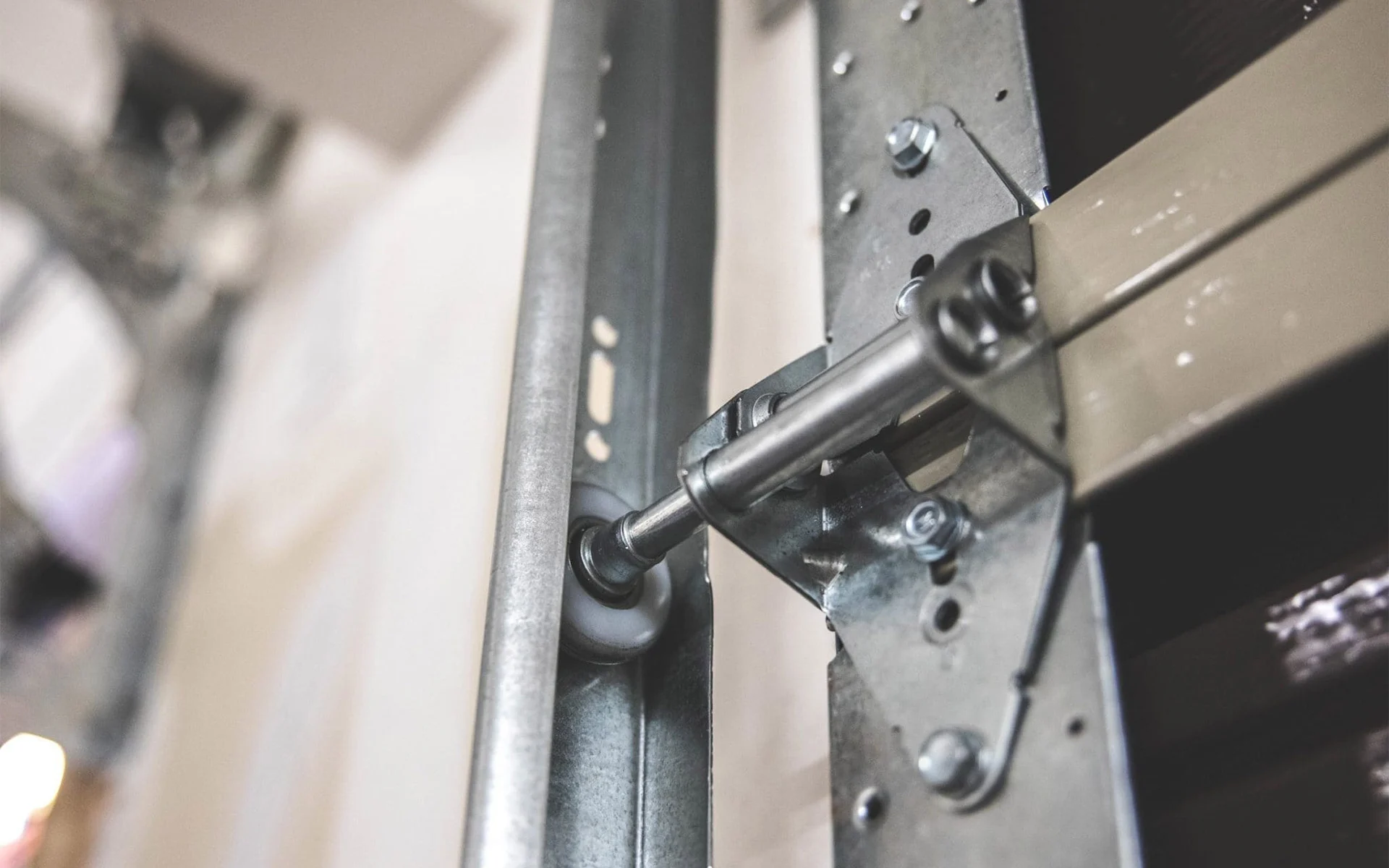
This severe misalignment triggers a highly destructive secondary cascade failure known as kinematic wedging. As the hinge pivot warps, the roller stem is forced out of perpendicular alignment. When the door travels upward, the tilted roller digs into the aluminum or steel track, acting like a brake pad. This binding forces the electric motor to pull harder, drawing excess amperage, which rapidly degrades the motor’s internal logic board and nylon drive gears, turning a simple hinge failure into a costly full-system collapse.
主なポイント
- Micro-fractures at CNC Bends: Look closely at the inside corners of the center hinge; microscopic white lines in the zinc coating indicate structural yielding.
- Asymmetrical Roller Wear: If the nylon or steel rollers exhibit heavy shaving on only one side of the wheel, the hinge has suffered thermal deflection.
- Daytime Operational Drag: The door operates smoothly at night but groans and binds loudly during the afternoon peak solar load.
Acoustic Resonance Fatigue: Analyzing the Impact of Motor Vibration Frequencies on Hinge Fastener Torque
Moving beyond thermal stress, we must examine the vibrational dynamics introduced by the automated lifting system. A persistent misconception in residential and commercial maintenance is that rattling hinges are caused solely by loose installation or dry friction. In reality, the root cause is deeply rooted in acoustics. Standard AC garage door motors operate by generating significant low-frequency vibrations, typically in the 50Hz to 60Hz frequency bands.
By pure engineering coincidence, the natural harmonic resonance of a standard stamped 70mm or 90mm width carbon steel hinge perfectly aligns with this frequency range. When the motor engages, the acoustic waves travel through the torsion shaft, down the cables, and directly into the door panels. The center hinges begin to oscillate. This continuous acoustic resonance effectively liquefies the static friction holding the fastening screws tightly against the galvanized steel surface.
This acoustic fatigue initiates a relentless timeline of torque relaxation:
* Initial Fastening Phase (0-2,000 Cycles): The factory-installed self-tapping screws hold a tight torque of roughly 15 N-m. The acoustic vibrations are absorbed by the rubber weather stripping and the rigidity of the new carbon steel.
* Resonant Uncoupling Phase (2,001-6,000 Cycles): The 50Hz/60Hz vibrations cause micro-slippage between the screw threads and the panel stiles. The torque decays rapidly from 15 N-m to 8 N-m. The hinges begin to visually vibrate during operation, amplifying the ambient noise.
* Terminal Back-out Phase (>10,000 Cycles): The torque drops below 4 N-m. The fasteners are essentially floating within the expanded holes. The center hinges detach slightly from the door face during the transition through the track radius, causing severe mechanical slapping.
The secondary hazard of this resonance is the complete destruction of the galvanized protective barrier. As the loose hinge vibrates against the mounting stile thousands of times per month, the micro-impacts pulverize the zinc coating. Once the sacrificial anode is worn away by this acoustic hammering, the raw carbon steel is instantly exposed to ambient humidity. This localized rusting spreads beneath the remaining coating, creating rapid, irreparable oxidation exactly at the critical load-bearing mounting points.
主なポイント
- Black Dust Accumulation: The presence of fine black metallic powder around the hinge screws indicates severe vibrational fretting and zinc layer destruction.
- Ghost Loosening: Screws that require re-tightening every few months are victims of acoustic resonance, not simply poor initial installation.
- Harmonic Shuddering: If the door panels visibly shake specifically when the motor starts or stops, the hardware is operating within the critical resonance frequency.
The Fluid-Dynamic Boundary Layer Collapse: How Over-Lubrication Traps Abrasive Silica in Stamped Crevices
To silence squeaking hinges and prevent rust in coastal environments, property owners frequently douse their hardware in heavy lithium grease or thick wet lubricants. This creates a disastrous scenario deeply rooted in fluid dynamics. While a fluid boundary layer initially separates the metal pivot pin from the hinge barrel, providing temporary silence, this thick layer acts as a highly efficient viscous mousetrap.
In highly ventilated garages, the air is saturated with microscopic particulate matter, primarily airborne silica (sand and dust). Silica possesses a Mohs hardness rating of 7, which is significantly harder than standard carbon steel construction (typically Mohs 4.5 to 5). As the heavy grease captures these silica particles, the motion of the door opening and closing drags the hard minerals directly into the tight tolerances of the hinge barrel. This initiates Three-Body Abrasive Micro-Cutting. The silica particles act as microscopic cutting tools, relentlessly gouging away the anti-corrosive galvanized layer and scoring deep trenches into the carbon steel pivot pin, accelerating structural failure.
To engineer a factory-level defense against these mechanical and environmental threats, we must execute rigid protocols.
1. Implementation of Dry-Film PTFE Lubrication
Execution Protocol: Strip all factory wet grease using a volatile solvent. Apply a micro-thin layer of Polytetrafluoroethylene (PTFE) dry-film spray directly to the hinge pivot points. This creates a dry, non-tacky boundary layer that cures to the metal.
Material Evolution: The PTFE bonds at a molecular level with the galvanized zinc surface, reducing the coefficient of friction to below 0.04 without creating a sticky matrix. The hinge repels silica dust entirely, stopping three-body abrasion instantly.
Hidden Costs & Risk Mitigation: Dry-film lubricants offer zero rust-inhibiting properties if the zinc coating is already compromised. Before application, technicians must ensure the galvanized layer is fully intact, otherwise, invisible oxidation will occur beneath the PTFE layer.
2. Standardization of 2.5mm Heavy-Duty Component Upgrades
Execution Protocol: For any door exceeding 16 feet in width or operating in a high-wind load area, mandate the immediate installation of precision CNC-bended 2.5mm thickness heavy duty garage door hardware.
Material Evolution: Upgrading from 2.0mm to 2.5mm increases the structural moment of inertia exponentially. The thicker steel matrix effectively resists Thermal Creep Stretch, maintaining a strict 0.1-degree variance even under extreme +50°C solar radiation loads.
Hidden Costs & Risk Mitigation: Thicker hinges add significant dead weight to the door assembly. The torsion springs must be strictly recalibrated to compensate for the additional mass; failure to do so will result in premature motor gear burnout.
3. Acoustic Resonance Dampening via Thread-Locking Polymers
Execution Protocol: Apply a medium-strength, anaerobic thread-locking polymer compound (blue fluid) to the threads of all mounting screws prior to installation. Tighten to a precise specification of 14 N-m using a calibrated digital torque wrench.
Material Evolution: The anaerobic fluid cures into a hard thermoplastic within the thread gaps. This effectively alters the harmonic resonance profile of the fastener, preventing 50Hz/60Hz acoustic vibrations from liquefying the mechanical friction.
Hidden Costs & Risk Mitigation: If a high-strength (red) compound is mistakenly used, removing the hinges for future sectional door hinge replacement will require heating the stile to 260°C, severely damaging the door panel’s internal insulation.
4. Continuous Neutral Salt Spray (NSS) Auditing
Execution Protocol: Implement a mandatory 96-hour ASTM B117 NSS validation protocol for all incoming galvanized hardware batches. Discard any lot that shows red rust on more than 5% of the hinge surface area after the testing phase.
Material Evolution: This strict quality control ensures that the zinc sacrificial anode is applied at the correct micron thickness uniformly across the complex CNC-bended geometries, ensuring maximum resistance to coastal airborne chlorides.
Hidden Costs & Risk Mitigation: Aggressive NSS testing slows down supply chain procurement. Factories must run parallel testing chambers constantly to avoid production bottlenecks while maintaining rigid environmental resilience standards.
| Testing Variable | 予想される材料の挙動 | Industry Standard Tolerance | Testing Baseline |
|---|---|---|---|
| Thermal Gradient (+50°C) | Elastic Flexing | < 0.5 Degrees Deflection | Laser Alignment Check |
| Acoustic Vibration (60Hz) | Static Torque Retention | > 12 N-m after 10k cycles | ISO 16047 Fastener Test |
| Abrasive Silica Exposure | Zinc Barrier Defense | No deep matrix gouging | Mohs Hardness Scratch |
| Salt Fog Condensation | Sacrificial Oxidation (White Rust) | 0% Red Rust at 72 Hours | ASTM B117 NSS |
| Cyclic Shear Strain | Concentric Pivot Rotation | < 0.5mm Hole Elongation | ASTM E8/E8M |
プロのヒント/チェックリスト
- The Tissue Paper Audit: Wipe the center hinge pin with a clean white tissue. If it comes away with dark grey/black metallic sludge, three-body abrasive cutting is actively destroying the steel.
- Solar Bowing Check: Place a 4-foot level vertically across the hinges on the inside of the door at 3:00 PM on a hot day. Any visible daylight behind the level indicates thermal creep stretch.
- Torque Verification: Use a manual socket wrench to check the hinge screws every 6 months. If they turn easily with minimal force, acoustic resonance has broken the friction lock.
- Gauge Identification: Physically measure the steel thickness with digital calipers. Replace any hinge measuring under 2.0mm immediately on double-car doors.
- Solvent Cleansing: Before applying dry-film PTFE, clean the hinge thoroughly with isopropyl alcohol to remove the invisible sticky residues left by factory oils.
- Symmetrical Upgrades: Never mix 2.0mm and 2.5mm hinges on the same panel. The uneven stiffness will force the thinner hinges to absorb all the shear stress, causing rapid asymmetrical failure.
よくある質問(FAQ)
How to reprogram garage door opener when adding heavy duty hinges?
When adding mass via heavy-duty 2.5mm carbon steel hinges, you must reset the motor’s internal force limits. Initiate the opener’s learning mode, manually guide the door through a full cycle, and allow the processor to map the newly altered weight distribution to prevent false safety reversals.
How to insulate garage door to protect interior hardware?
To prevent severe thermal gradients from warping the steel hinges, apply rigid EPS foam panels directly to the interior sections. This thermal break effectively isolates the ambient solar heat on the exterior, preventing the Thermal Creep Stretch that distorts the pivot alignment.
How to paint garage door without damaging the center hinges?
When painting, you must aggressively mask all pivot points on the galvanized garage door hinges. Capillary action will draw liquid paint into the tight mechanical tolerances, where it will dry, bond the moving parts, and snap the hinge pin upon the next motor actuation.
How to manually open garage door if track binding occurs?
If warped hinges cause severe track binding, disconnect the emergency release cord immediately to protect the motor gear. Use a pry bar to gently relieve the horizontal pressure off the wedged roller stem, allowing the door to be carefully lifted by hand without bending the vertical track.
 English
  Русский
  日本語
日本語  한국어
한국어  Français
  Deutsch
  العربية
  Português
  Español