
Why Do Industrial Door Hinges Sag and Fracture Under Heavy Loads?
参照標準: ANSI/BHMA A156.1 (American National Standard for Butts and Hinges) & ASTM E23 (Standard Test Methods for Notched Bar Impact Testing of Metallic Materials)
短答
Cyclic Flexural Shear: The Structural Degradation Timeline of Heavy-Duty Joints
In heavy commercial environments, such as overhead sectional doors or large airport hangars, industrial door hinges are continuously subjected to extreme operational demands. When a massive industrial door cycles open and closed, its weight does not exert a clean, uniform tensile load. Instead, the offset gravitational mass of the door panel applies a severe cantilevered moment, subjecting the hinge plate to violent cyclic flexural shear.
This repetitive flexural stress concentrates directly around the cold-stamped fastening fields and the main hinge pin barrel, a localized phenomenon classified as stress localization. At a micro-structural level within the 14-Gauge Steel Matrix, the metal crystals absorb this shifting kinetic energy. If the material lacks uniform structural density, these localized shear planes force microscopic dislocations to accumulate within the ferrite grains. Over hundreds of thousands of operational cycles, these dislocations pile up against the internal grain boundaries, permanently lowering the fabric’s elastic threshold. This micro-structural slip manifests macroscopically as structural deflection, causing the hinge plate to bow, the barrel to misalign, and the entire industrial door to sag heavily, jamming the tracking system and presenting a massive logistical failure risk.
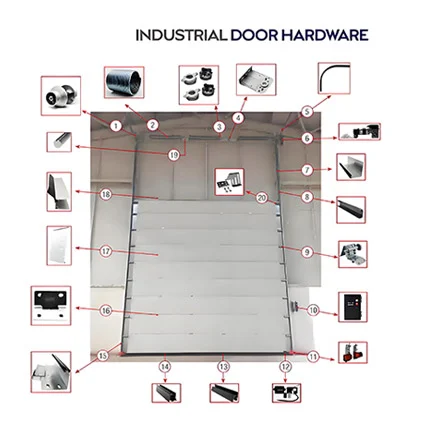
We can map this mechanical degradation sequence through an accelerated 100,000-Cycle Heavy Industrial Operational Fatigue Model:
The Micro-Elastic Incubation Phase (0-25,000 Cycles): The 14-gauge steel plate flexes within its original elastic design limit. The internal stress localization is manageable, and the grain boundaries absorb the flexural load. Total door alignment remains within a perfect 0.5mm tolerance window, exhibiting zero visual sag.
The Sub-Surface Nucleation Phase (25,001-75,000 Cycles): Repetitive flexural shear forces micro-lattice rupture at the sharpest stamped boundaries. Sub-surface micro-cracks form. The internal alignment slips, forcing the hinge barrel out of parallelism by 1.2mm. The system begins to exhibit mild mechanical friction, drawing higher amperage from the motor drive.
The Terminal Yielding Phase (75,001-100,000 Cycles): The sub-surface cracks coalesce into macro-fissures. The steel matrix permanently crosses its plastic deformation yield ceiling. The plate deforms by over 3.5mm, forcing a severe asymmetric drop in the door header. The door panel jams securely inside the horizontal-to-vertical tracking radius, completely shutting down the shipping dock.
A critical secondary failure cascade triggered by this flexural deformation is the rapid accelerated loosening of adjacent fasteners. As the hinge plate sags and warps, it alters the seating angle of the mounting lags and self-tapping screws. This introduces an intense transverse bending moment to the fastener shafts, stripping out the pre-drilled sheet metal holes or snapping the screw heads off entirely under the shifting weight of the industrial gate.
主なポイント
- Flange Gap Asymmetry: If the vertical clearance gap between the inner and outer hinge plates becomes uneven when the door is closed, structural flexural shear has already initiated.
- Metal Flaking: The appearance of microscopic silver-grey metallic scales or powder directly beneath the hinge barrels confirms active sub-surface shear deformation.
- Amperage Surge spikes: An automated overhead door motor that begins drawing over 15% more operational current than its baseline specification is fighting skewed hinge alignment.
Acidic Aerosol Infiltration: Intergranular Hydrogen Embrittlement of Steel Matrices
While physical flexural shear causes a predictable, slow mechanical decline, environmental contamination inside chemical plants or high-humidity coastal facilities introduces an unannounced hazard to external gate hardware. Outdoor metal gate hinges heavy duty applications are perpetually exposed to industrial atmospheric aerosols containing sulfurous vapors, chlorides, and condensed moisture.
When acid rain or saline moisture condenses over the raw steel edges or welded seams of a gate hinge, it initiates a high-velocity electrochemical reaction. The acidic aerosol aggressively strips electrons from the iron atoms, liberating a massive density of volatile hydrogen ions ($H^+$). Because a single hydrogen atom possesses an exceptionally minute atomic radius, these ions easily migrate into the bulk steel, traveling directly through the microscopic interstitial spaces of the iron crystal lattice. The ions accumulate along the high-energy grain boundaries of the low-carbon steel core.
Once trapped inside these tightly packed boundaries, the single ions recombine into molecular hydrogen gas ($H_2$), generating a massive internal lattice pressure that can exceed 10,000 atmospheres at the microscopic scale. This internal pressure destroys the atomic cohesion between individual steel grains, inducing intergranular selective dissolution. This process robs the heavy-duty hinge of its natural ductility, forcing it through a radical transition into an extremely brittle state. When a high-velocity wind load slams the heavy metal gate, the embrittled grain boundaries cannot deform to absorb the impact energy. Instead, the material undergoes a sudden, unannounced brittle fracture, snapping completely in half and allowing the multi-hundred-pound industrial gate to collapse outward onto personnel or vehicles.
Isotropic Cold-Press Hardening and Hot-Dip Zinc Metallurgical Interlocking
To fully secure massive commercial infrastructure projects and eliminate field hardware fractures, precision manufacturing operations like バオテン・テクノロジー completely redesign the mechanical and chemical composition of heavy-duty hinges using automated multi-stage material tempering and physical zinc alloy fusion.
Execution Protocol 1: Isotropic Cold-Press Hardening Matrix
* Execution Protocol: The fabrication of the 14-Gauge Steel Matrix completely bypasses standard hot-rolling methods. The steel blanks are routed into high-pressure, automated progressive cold-stamping presses running specialized multi-stage compression dies.
* Material Evolution: The severe, controlled kinetic force of the cold-press pushes the internal iron crystals into an isotropic均质化 configuration. This uniform grain alignment elevates the dislocation density by 200%, significantly increasing the material’s Rockwell hardness and ultimate tensile strength. The resulting hinge plate easily absorbs high-frequency cyclic flexural shear without developing localized stress fields, raising the fatigue threshold well past 150,000 continuous cycles.
* Risk Mitigation: Extreme cold-working can introduce severe micro-cracking along the perimeter shear edges of the steel plate. The progressive stamping tooling must feature precision-engineered chamfer radii to smoothly guide the material flow, paired with an inline eddy-current sensor network to instantly flag and reject any edge flaws.
Execution Protocol 2: Hot-Dip Zinc Metallurgical Interlocking Armor
* Execution Protocol: To permanently neutralize intergranular hydrogen embrittlement, the stamped hinges undergo an intensive molten chemical treatment. Following an automated multi-stage acid pickling cycle to remove all surface scale, the assemblies are entirely submerged into a molten zinc bath held at a precise 450°C (842°F).
* Material Evolution: At this extreme temperature, a rapid zinc-iron interdiffusion occurs, building a series of complex zinc-iron alloy layers directly within the surface of the steel. This creates a dense, metallurgical interlocking barrier that is physically fused to the iron core at the atomic level. This non-porous zinc armor completely blocks the entry of acidic industrial aerosols and hydrogen ions, keeping the steel grain boundaries pristine and establishing a Grade-4 corrosion defense shield.
* Risk Mitigation: Molten zinc immersion can cause temporary thermal distortion in thin-walled barrels, disrupting the同轴度 of the hinge pin channel. The factory must utilize automated internal cooling mandrels to hold the inner barrel geometry perfectly round until the zinc interlocked layer fully solidifies.
Execution Protocol 3: Universal Material Tensile and Shear Auditing
* Execution Protocol: Random production samples from every 14-gauge batch are destructively tested using high-capacity universal testing machines. The components are subjected to extreme hydraulic pull-apart and shear-off stresses to establish true mechanical ceilings.
* Material Evolution: This strict quality control ensures that the finished hinges can support loads far exceeding standard residential hardware. It provides definitive data confirming that the cold-press hardening matrix is properly calibrated to resist sudden shearing and plate buckling during commercial operations.
* Risk Mitigation: Hardened steel jaws on material testers can create surface gouges that skew tensile data. Testing technicians must utilize thick copper shims within the hydraulic clamps to cushion the zinc armor and isolate the pure load capacity of the hinge steel.
Execution Protocol 4: Extended ASTM B117 Neutral Salt Spray Exposure
* Execution Protocol: Representative pieces from each hot-dip galvanized run are locked inside automated environmental chambers and blasted with a continuous, 5% sodium chloride fog at 35°C for an extended 96-hour testing cycle.
* Material Evolution: This test serves as the ultimate validation of the metallurgical interlocking armor. Passing the 96-hour salt spray test guarantees that the zinc shield will fully suppress anodic dissolution and intergranular corrosion, ensuring an extended operational life in highly corrosive coastal marine regions or heavily salted winter roadways.
* Risk Mitigation: Trace iron dust from nearby machining lines can settle on the zinc surface before testing, creating false-positive orange rust spots. The salt spray laboratory must be completely isolated in a pressurized cleanroom environment utilizing independent, triple-filtered air handlers.
| Cross-Variable Engineering Matrix | Expected Material Performance | Industry Specification Tolerance | Quantitative Testing Target |
|---|---|---|---|
| Flexural Shear Resistance | No permanent structural sag | Max deflection < 1.00mm | 100k-Cycle Shifting Load Rig |
| Hydrogen Ion Infiltration | Absolute grain boundary lock | Zero detectable micro-fissuring | Metallographic Cross-Section |
| Zinc Armor Adhesion | Interlocking atomic bond | Zero peeling or flaking under stress | ASTM E23 Impact Shock |
| Salt Spray Longevity | Complete barrier passivation | No red iron oxide formation | 96-Hour ASTM B117 Mist Chamber |
| Barrel Alignment Precision | Perfect co-axial smooth rotation | Max concentricity error < 0.05mm | Multi-Axis Laser Metrology Scan |
よくある質問(FAQ)
How much is it to fix a garage door hinge that has warped?
Repairing a single warped or cracked industrial door hinge typically ranges from $150 to $350 in commercial facilities. The overall cost is primarily driven by expert field labor charges and the requirement for a technician to balance the high-tension counterbalance springs before swapping out the damaged 14-gauge hardware safely.
How to change battery in garage door remote controls?
To swap the battery in a commercial remote, use a flat-head screwdriver to gently split the outer plastic housing along its seam line. Remove the dead coin-cell battery (most commonly a CR2032 or CR2016 lithium cell) and slide the new battery in, ensuring the positive (+) symbol faces upward against the metal terminal clip before snapping the case back together.
How to set genie garage door opener travel limits?
Setting travel limits on a modern Genie opener involves holding down the square “Program” button on the motor head until the blue LED illuminates. Use the Up and Down arrow keys to drive the door panel to its desired open position and tap the Program button to lock it in. Repeat this identical process using the Down key to safely program the floor seal compression limit.
How to reset clicker garage door keypad pin codes?
To reprogram a universal Clicker keypad, press and hold the * and # keys simultaneously until the backlighting stops blinking. Key in your brand-new 4-digit personal identification number (PIN), followed immediately by pressing the 0 key. Finally, press the primary purple, orange, or green learn button on your garage door opener motor head to sync the wireless signal code.
What are the main dimensional differences between #1, #2, and #3 hinges?
The key physical difference lies in the graduated height of the hinge barrel knuckles. A #1 hinge features the lowest knuckle height, keeping the roller close to the door panel, whereas #2 and #3 hinges possess progressively taller knuckles to push the roller further outward, compensating for the natural taper of the vertical tracking tracks.
 English
  Русский
  日本語
日本語  한국어
한국어  Français
  Deutsch
  العربية
  Português
  Español