
Rolling-friction noise control and alignment stability for quiet garage door rollers
Managing rolling friction and minimizing operational noise are essential for engineers aiming to optimize quiet garage door rollers. Beyond comfort, these technical factors ensure precise alignment and smooth sliding in sectional door systems, supporting long-term reliability.
This article provides a structured engineering perspective on quiet garage door rollers, focusing on noise reduction, friction management, and the evaluation of alignment stability in demanding sliding applications.
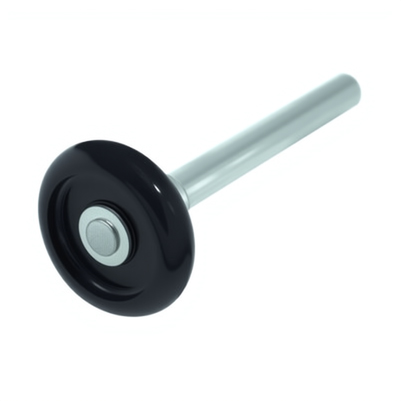
The primary source of noise in sectional garage doors is the dynamic interaction between rollers and tracks. Rolling friction, while inherently lower than sliding friction, can still generate significant acoustic emissions if not properly managed. Quiet garage door rollers are engineered to minimize these emissions through optimized geometry, material interfaces, and bearing assemblies. The construction of these rollers typically involves a combination of polymeric tread materials—such as nylon or reinforced plastics—paired with precision ball bearings housed within a steel or composite core. The polymeric tread dampens high-frequency vibrations generated during rolling, while the bearing assembly reduces both frictional torque and lateral play, which are critical for maintaining alignment.
The interface between the roller tread and the steel track is a primary determinant of rolling-friction behavior. Surface roughness, material hardness, and the presence of lubricants all influence the coefficient of rolling friction. In quiet garage door rollers, the tread is engineered to exhibit a Shore D hardness in the range of 65–75, balancing wear resistance with vibration absorption. Micro-texturing on the tread surface can further disrupt the transmission of vibrational energy, attenuating noise at the point of contact. The bearing assembly, often a sealed deep-groove ball bearing, is selected for minimal radial clearance and low running noise. Engineers must ensure that the bearing lubricant is compatible with the operating environment, as contamination or degradation can increase friction and acoustic output.
Reliability in quiet garage door rollers is defined by their ability to maintain low rolling friction and minimal noise output over extended operational cycles. Material fatigue, contamination ingress, and lubricant breakdown are the primary failure modes that compromise noise performance. Polymeric treads are susceptible to flattening or microcracking under high loads, particularly if the door system is misaligned or subjected to shock loads. To mitigate this, advanced polymers with high fatigue resistance and embedded fiber reinforcements are increasingly specified. The bearing seal design is also critical; labyrinth or contact seals are preferred for their ability to exclude dust and moisture while retaining lubricant.
The interaction between the roller and the track must be continuously smooth to avoid stick-slip phenomena, which are a major contributor to transient noise spikes. Engineers should conduct periodic inspections of both roller and track surfaces, looking for indications of pitting, corrosion, or debris accumulation. In environments with high humidity or corrosive agents, stainless steel tracks or rollers with corrosion-resistant coatings are recommended. Lubrication schedules must be established based on the operating frequency and environmental exposure, with synthetic greases offering superior longevity and lower volatility compared to mineral-based alternatives.
Evaluation of quiet garage door rollers for noise performance and alignment stability requires both qualitative and quantitative methods. Objective noise measurement should be performed using calibrated sound level meters, with readings taken at standardized positions relative to the door path. Engineers should record both average and peak noise levels during full open-close cycles, isolating the contribution of the roller-track interface from other system components such as torsion springs or operator mechanisms. Vibration analysis using accelerometers mounted on the track can further elucidate the transmission of mechanical energy and identify sources of resonance or impact.
Alignment verification is equally critical. Engineers should employ dial indicators or laser alignment tools to measure lateral and vertical displacement of the door panels as they traverse the track. Any deviation beyond manufacturer-specified tolerances can indicate roller eccentricity, bearing wear, or track deformation—all of which can increase noise output. In addition, rolling resistance can be quantified by measuring the force required to initiate and sustain door movement, with elevated values suggesting increased friction or misalignment.
Comprehensive evaluation protocol for quiet garage door rollers
- Visual inspection of roller tread and bearing condition, noting any signs of wear, deformation, or contamination.
- Measurement of track surface condition, including roughness and presence of foreign material.
- Quantitative noise and vibration measurement during door operation, with results compared to baseline values for the specific roller model.
- Alignment assessment using precision instruments, documenting any deviations and correlating them with noise measurements.
- Rolling resistance testing, ideally with the door disconnected from the operator to isolate the roller-track contribution.
These data enable engineers to identify the root causes of excessive noise and to implement targeted corrective actions, such as roller replacement, track resurfacing, or realignment.
Technical guidance for selecting and maintaining quiet garage door rollers
In practice, the selection and maintenance of quiet garage door rollers must be guided by a rigorous engineering process. Engineers are encouraged to verify roller parameters—including tread material, bearing specification, and dimensional tolerances—against the specific demands of the door system and its operational environment. Particular attention should be paid to the compatibility of materials with existing track systems, as mismatched hardness or geometry can increase rolling friction and noise. For retrofitting projects, it is advisable to conduct a full system audit, including baseline noise measurements and alignment checks, prior to roller installation.
Technical validation of roller performance should be an ongoing process, integrated into scheduled maintenance protocols. Engineers should document all findings and corrective actions, establishing a data-driven approach to noise and friction management. This not only ensures optimal door performance but also extends the service life of both rollers and track assemblies.
In summary, the control of rolling friction and noise in quiet garage door rollers is a multifaceted engineering problem, requiring attention to material science, mechanical design, and system alignment. By adhering to precise evaluation methods and maintaining a focus on friction control, door alignment engineers can achieve significant reductions in operational noise and ensure the long-term reliability of sliding sectional door systems. Verification of roller parameters and alignment should be treated as a standard engineering practice, forming the basis for continuous improvement in garage door performance.
For further technical specifications, engineering documentation, and installation guidance on quiet garage door rollers, refer to the технические условия и учебники по установке provided by Baoteng.
 English
  Русский
  日本語
日本語  한국어
한국어  Français
  Deutsch
  العربية
  Português
  Español