
Why Do Garage Door Hinges Squeak and Rust? The Engineering Behind Acoustic Resonance and Galvanic Depletion
参照標準: ASTM B117 (Standard Practice for Operating Salt Spray Apparatus) & ANSI/DASMA 102 (Specifications for Sectional Doors)
短答
Micro-Acoustic Resonance: How Sub-Millimeter Geometric Tolerances Dictate Hinge Noise Profiles
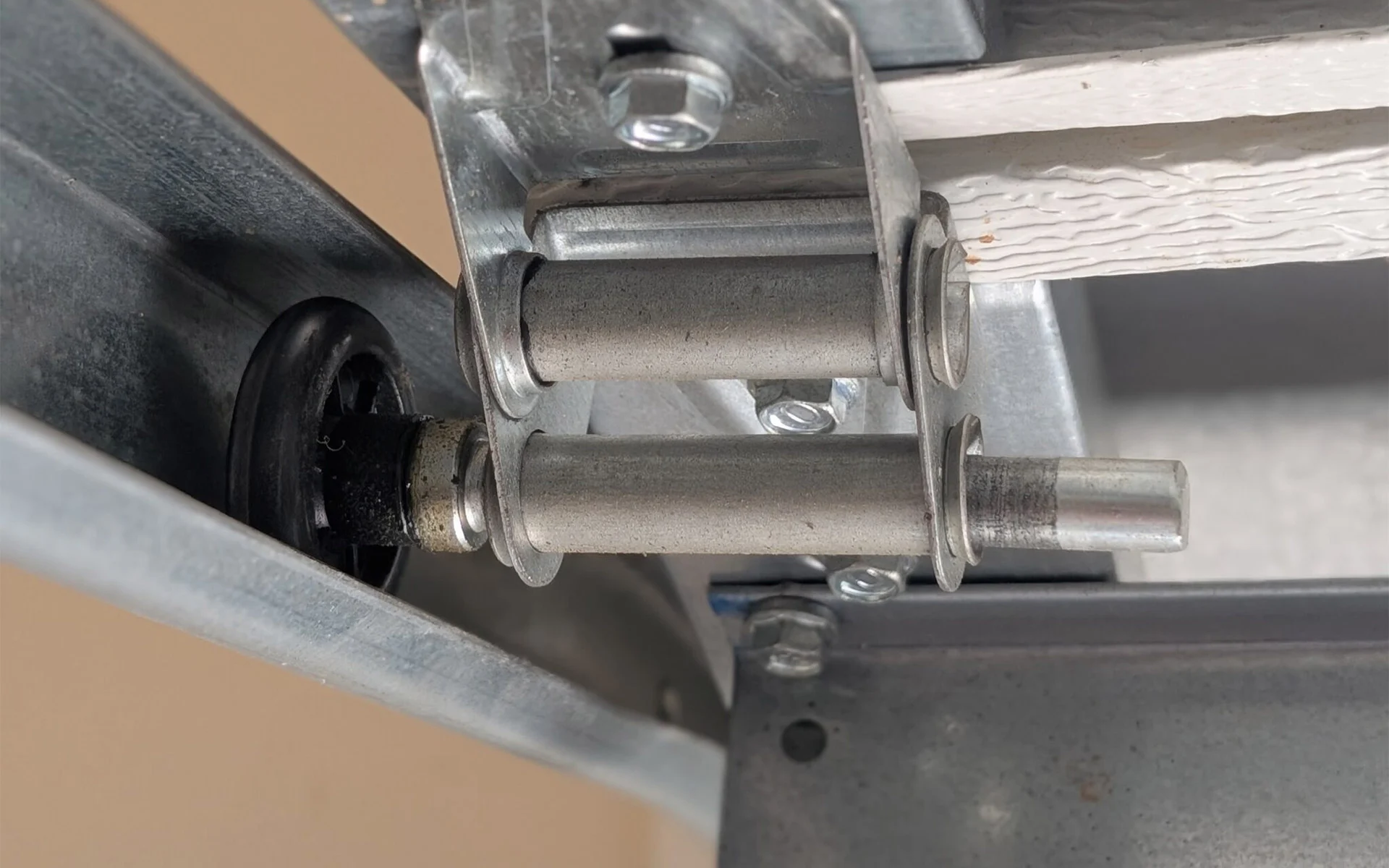
When evaluating the performance of high-cycle residential and commercial access systems, the auditory signature of the hardware is often the most critical metric for end-user satisfaction. The underlying cause of severe noise is not merely a lack of lubrication, but rather a complex mechanical phenomenon known as Micro-Acoustic Resonance, heavily influenced by Sub-Millimeter Geometric Tolerances during the stamping process of 2.0mm to 2.5mm high-carbon steel plates.
If the stamping dies exhibit excessive wear, the resulting clearance between the pivot pin and the outer barrel may exceed the optimal 0.15mm threshold. During the kinematic lifting phase initiated by the electric opener, this excessive clearance allows the internal steel pin to oscillate violently within the barrel. As the door transitions through the curved radius of the track, the sudden shifts in load vectors force the pin to rapidly strike the barrel walls. This creates a high-frequency “plucking effect,” transforming the entire steel hinge into a mechanical tuning fork. The generated acoustic waves typically register in the highly irritating 2000 Hz to 4000 Hz frequency range, easily penetrating adjacent residential living spaces or amplifying within cavernous warehouse environments. To combat this, precision manufacturing injects a specialized non-metallic “mute” sleeve that acts as an acoustic dampener, altering the natural frequency of the assembly and absorbing the kinetic impact energy before it translates into airborne sound waves.
To fully understand this degradation, we must apply an extreme dynamic fatigue and acoustic profiling timeline model.
Initial Phase (0-5,000 Cycles): The newly installed assembly operates silently. The factory-applied boundary lubrication and the tight virgin tolerances keep the pivot pin perfectly centered. The acoustic output remains below a negligible 35 decibels, with no detectable harmonic peaks in the higher frequency ranges.
Mid Phase (15,000-25,000 Cycles): As the initial lubrication is displaced by extreme contact pressure, minor abrasive wear begins on the inner barrel surface. The geometric tolerance subtly widens to 0.25mm. Under the traction of the opener, the pin begins to exhibit micro-chatter. The acoustic profile shifts, producing intermittent metallic chirping that spikes at approximately 2800 Hz during the maximum load transfer phase as the panels clear the header.
Terminal Phase (50,000+ Cycles): Severe dimensional degradation occurs. The tolerance exceeds 0.50mm, allowing for severe off-axis torque. The “plucking effect” becomes continuous and highly aggressive, generating a sustained 4500 Hz screech. The mute sleeve, if inferior, undergoes severe plastic deformation or total disintegration, resulting in catastrophic dry friction, localized galling, and a dramatic spike in the required lifting force.
The unmitigated high-frequency vibrations from this micro-acoustic resonance create a severe cross-system cascading failure that extends far beyond the hinge itself. The kinetic chatter is transmitted directly through the roller shaft and into the vertical track infrastructure. This constant, rhythmic micro-impact slowly defeats the frictional locking force of the structural mounting lags anchoring the track to the wall framing. Over a period of several months, these fasteners can back out entirely, leading to catastrophic track misalignment, immediate roller derailment, and the potential free-fall collapse of a multi-hundred-pound sectional door assembly.
主なポイント
- Acoustic Frequency Shifts: A sudden transition from a low-pitch hum to a sharp, metallic screech above 3000 Hz indicates complete failure of the internal mute dampening sleeve.
- Visual Metallic Dusting: The accumulation of fine, dark grey metallic powder around the pivot joints confirms extreme metal-on-metal abrasion and tolerance loss.
- Irregular Hinge Oscillation: If the hinge pin visibly chatters or vibrates laterally as the panel moves through the track radius, the sub-millimeter geometry has been compromised.
Galvanic Sacrificial Depletion Kinetics: The Lifespan of Zinc Coatings in High-Salinity Microclimates
Beyond mechanical acoustics, the chemical survivability of hardware dictates its ultimate lifecycle. In subterranean parking structures or coastal residential zones, the atmosphere is saturated with high salinity and automotive exhaust sulfur compounds. Standard steel hardware rapidly oxidizes in these environments, weeping red ferric oxide stains onto the pristine door panels. To engineer a durable galvanized mute side hinge wholesale product, metallurgists rely on Galvanic Sacrificial Depletion Kinetics. The Galvanized coating acts not merely as a physical barrier, but as an active, electrochemically reactive sacrificial anode.
Because zinc possesses a lower standard electrode potential than the underlying carbon steel, it preferentially surrenders its electrons when exposed to an electrolytic medium (such as saline condensation). As the zinc corrodes, it reacts with ambient moisture, carbon dioxide, and chloride ions to form a dense, highly insoluble passivation layer known as basic zinc carbonate ($Zn_5(OH)_6(CO_3)_2$). This micro-crystalline shield tightly adheres to the substrate, drastically slowing further oxidation. However, this is a finite kinetic process. Depending on the exact environmental corrosivity, the zinc layer depletes at a predictable rate, typically ranging from 1.5 μm/year to 3.0 μm/year. Manufacturers validate this depletion matrix through rigorous 72-Hour to 200-Hour Neutral Salt Spray (NSS) testing protocols, ensuring the zinc coating mass is mathematically sufficient to protect the core structural integrity of the steel for a minimum 15-year operational window.
Environmental Oxidation Timeline Model
Mapping the depletion of this sacrificial layer requires a precise, multi-stage electrochemical fatigue simulation.
Initial Phase (Months 1-12): The galvanized surface is exposed to moisture and oxygen. The outermost layer of zinc rapidly oxidizes to form zinc oxide and zinc hydroxide. This is a normal, expected reaction that slightly dulls the bright silver finish into a matte grey. The underlying steel remains 100% protected, and the galvanic current flows optimally across the micro-surface.
Mid Phase (Years 3-7): In high-salinity microclimates, chloride ions continuously attack the zinc hydroxide layer. The sacrificial depletion rate accelerates to approximately 2.5 μm/year. The basic zinc carbonate layer continuously reforms, but the total zinc mass visibly thins. White rust (zinc corrosion products) may appear in high-condensation zones, particularly around the stamped edges where the coating thickness is naturally thinner due to manufacturing flow dynamics.
Terminal Phase (Years 10-15+): The localized zinc layer is entirely depleted at the highest stress points (usually the inner barrel friction zones). The galvanic protection is broken, and the electrolytic moisture directly contacts the Q235 carbon steel base. Rapid anodic dissolution of iron begins, forming expansive red rust ($Fe_2O_3$). This oxidation swells to nearly six times the volume of the original steel, seizing the pivot pin entirely.
The expansion of ferric oxide within the tight confines of the barrel creates an unexpected secondary crisis. The swollen rust practically welds the pivot pin to the housing, completely eliminating the hinge’s rotational capability. When the powerful electric operator attempts to lift the door, the seized hinge acts as a rigid, unyielding bracket. This transfers massive, unintended bending moments into the horizontal door panels, causing the sandwich panels to delaminate, buckle, or permanently crack under the excessive tensile strain, destroying the door’s aesthetic and structural integrity.
Thermo-Mechanical Shear Phasing: The Impact of Rapid Temperature Drops on 120mm Industrial Hinge Arrays
When scaling up to massive commercial warehousing doors, engineers utilize industrial heavy duty quiet hinges featuring a distinct double-row design with widths spanning 120mm to 130mm. While this extra width is critical for distributing massive wind loads across the panel surface, it introduces a severe vulnerability known as Thermo-Mechanical Shear Phasing during extreme climate fluctuations.
In northern industrial applications, a heated warehouse may be kept at 20°C. When a massive loading dock door is suddenly opened to a -20°C winter environment, the hardware experiences an instantaneous temperature gradient (∆T = 40°C). The 130mm wide steel hinge plate rapidly contracts. However, the different structural components—the thick gauge steel, the mounting rivets, and critically, the internal polymer mute sleeve—all possess wildly different Coefficients of Thermal Expansion (CTE). This mismatch causes the wide plate to buckle slightly, creating massive internal shear stresses across the pivot axis. The non-metallic mute sleeve is subjected to severe transverse crushing forces just as the extreme cold drives the polymer below its glass transition temperature, making it highly brittle and prone to shattering. To prevent this, premium industrial hardware solutions require advanced elastomeric blends for their dampening sleeves that maintain hyper-elasticity even at cryogenic temperatures.
- Execution Protocol: Engineers must mandate the use of Polyoxymethylene (POM) blended with low-temperature impact modifiers for the mute sleeve injection molding process. During assembly, the 120mm hinge barrel must be segmented into three distinct sections rather than one continuous tube, allowing the steel to contract laterally without crushing the internal polymer components.
- Material Expected Evolution: By segmenting the barrel and utilizing cold-weather POM blends, the thermo-mechanical shear phasing is effectively neutralized. The hinge maintains an absolute dimensional tolerance even under a ∆T of 40°C, ensuring the acoustic dampening properties remain stable and the rotational torque required to bend the hinge remains below 5 N·m regardless of extreme cold exposure.
- Risk Mitigation: The highly specialized POM blend is highly sensitive to UV degradation. If these hinges are exposed to direct sunlight for prolonged periods during transit or storage before installation, the polymers will photo-oxidize and crack. They must be shipped in UV-blocking opaque anti-static packaging to preserve their low-temperature resilience.
| Structural Variable | Ambient 25°C Baseline | ∆T = 40°C Drop Tolerance | Material CTE Variation Limit | QC Testing Standard |
|---|---|---|---|---|
| 120mm Dual-Hinge Plate | < 0.05mm Deflection | Max 0.15mm Warpage | ± 1.2 x 10^-5 /°C | ANSI/DASMA 102 Temp Cycling |
| Polymer Mute Sleeve | 100% Elastic Recovery | Shore D Hardness +5% | ± 4.5 x 10^-5 /°C | ISO 812 Low Temp Brittleness |
| Galvanized Surface | Zero Micro-Cracking | Zero Micro-Cracking | 該当なし | ASTM B117 Post-Thermal Shock |
| Pivot Pin Torque | 2.5 N·m Resistance | Max 4.0 N·m Resistance | ± 1.0 x 10^-5 /°C | Dynamic Cold Room Torque Audit |
| Rivet Shear Strength | 15 kN Baseline | Min 14.5 kN Maintained | 該当なし | ISO 12996 Mechanical Shear |

プロのヒント/チェックリスト
- Thermal Contraction Audit: Visually inspect the 130mm hinges after a deep freeze; any visible bowing of the central leaf indicates a failure to accommodate thermo-mechanical shear phasing.
- Mute Sleeve Integrity Verification: Actuate the hinge manually at -10°C. If you hear a sharp “cracking” sound, the polymer sleeve has breached its glass transition phase and shattered.
- Acoustic Frequency Baseline: Use a smartphone spectrum analyzer during operation; sustained peaks above 3000 Hz point directly to tolerance failures and the onset of the plucking effect.
- Galvanic Depletion Check: Look for powdery white residue (zinc carbonate) on older hinges. While normal, if red iron oxide spots appear within the white powder, the sacrificial layer is totally depleted.
- Segmented Barrel Inspection: For wide commercial applications, ensure the hinge barrel is cut into distinct knuckles to allow for independent thermal expansion without binding.
- Tolerance Wiggle Test: Grasp the hinge plates and attempt to twist them in opposing directions. Excessive lateral play (greater than 1mm) means the geometric tolerances are too loose for quiet operation.
よくある質問(FAQ)
How to repair garage door squeaking and grinding noises?
Repairing high-frequency squeaks requires diagnosing the micro-acoustic resonance. If lubrication fails to quiet the system, the geometric tolerances of the pivot pins are severely worn. You must completely replace the degraded metal components with modern quiet hinges featuring non-metallic dampening sleeves to isolate the friction.
What size garage door opener do I need for heavy panels?
The required horsepower (often 1/2 HP or 3/4 HP) is dictated not just by panel weight, but by the kinetic friction coefficient of the hardware. If your galvanized hinges are experiencing severe thermo-mechanical shear phasing or galvanic corrosion binding, you will need a significantly oversized motor to overcome the excessive mechanical resistance.
How to open garage door when power goes out with heavy hardware?
Pull the emergency release cord to disengage the trolley. However, manually lifting the door relies entirely on the smooth operation of your hardware. If your hinges are seized due to ferric oxide expansion or shattered internal mute sleeves, the door will bind in the tracks, making manual operation dangerous or impossible without mechanical leverage.
 English
  Русский
  日本語
日本語  한국어
한국어  Français
  Deutsch
  العربية
  Português
  Español