

Rolling-friction engineering of roller wheels with bearings for garage door stability
In garage door systems, the use of roller wheels with bearings is essential for achieving precise alignment and smooth, quiet operation. By transforming sliding friction into rolling friction, these components play a pivotal role in minimizing noise and ensuring reliable performance across repeated cycles.
Reliability of roller wheels with bearings in garage door systems
Garage door alignment and operational stability are fundamentally influenced by the rolling components embedded within the track system. For engineers tasked with optimizing these systems, the selection and evaluation of roller wheels with bearings is critical, particularly in contexts where minimizing noise and friction is paramount. The mechanical interplay between rolling elements and their bearings directly governs the door’s ability to slide smoothly, maintain precise alignment, and withstand repetitive cycles. This article systematically examines the rolling-friction behavior, reliability, and performance of roller wheels with bearings, providing a technical foundation for informed engineering decisions in garage door applications.
The primary function of roller wheels with bearings is to convert sliding friction into rolling friction along the track, thereby reducing resistance and facilitating smoother door movement. The structural composition of these rollers typically involves a hardened steel or polymer wheel, precision-fitted over a ball or needle bearing assembly. The bearing’s role is to allow the wheel to rotate freely around its axle, isolating rotational movement from the fixed shaft and minimizing energy loss due to friction. In garage door systems, where door panels may weigh from 50 to over 300 pounds, the mechanical demands on these rolling interfaces are substantial, especially under frequent cycling and variable load conditions.
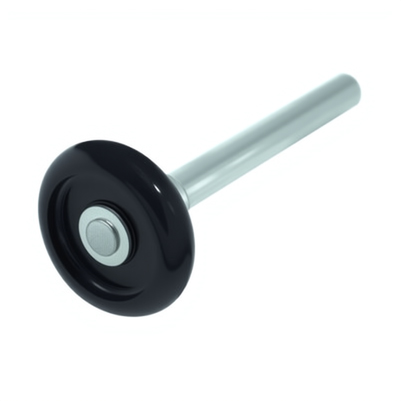
The rolling-friction coefficient is a primary parameter for evaluating the effectiveness of roller wheels with bearings. Unlike sliding friction, which is a function of surface roughness and normal force, rolling friction is largely determined by the deformation of the wheel and track surfaces, the internal resistance within the bearing, and the lubrication state. High-quality bearings, typically constructed from heat-treated steel and precision-machined races, exhibit low internal friction and minimal play, which translates to reduced rolling resistance and more consistent door alignment. The presence of seals or shields on the bearing assembly further protects the internal elements from dust, debris, and moisture, thereby preserving mechanical integrity over extended service intervals.
A recurring challenge for door alignment engineers is the mitigation of noise and vibration, which are often symptomatic of excessive friction or bearing degradation. Noise can originate from several sources: metal-on-metal contact between the roller and track, inadequate lubrication within the bearing, or misalignment causing the roller to bind. To address these issues, engineering analysis focuses on the interface geometry, bearing preload, and the material pairing between the wheel and track. For example, nylon-coated roller wheels with sealed bearings are frequently specified in residential garage doors to dampen noise and absorb minor track imperfections, whereas all-steel rollers are preferred in industrial contexts for their superior load capacity and wear resistance.
Evaluation and maintenance of roller wheels with bearings
Reliability in roller wheels with bearings is a function of both material selection and assembly precision. The bearing’s fatigue life is governed by the quality of the steel, the surface finish of the races, and the consistency of the ball or roller elements. Any deviation in roundness or surface hardness can precipitate premature failure, manifesting as increased rolling resistance, audible noise, or even catastrophic bearing seizure. Engineers must also consider the mounting method: press-fit axles, snap rings, or threaded stems introduce different stress concentrations and potential for misalignment, all of which influence the long-term stability of the rolling system.
Environmental exposure is another factor impacting reliability. Garage doors are frequently subjected to temperature fluctuations, humidity, and airborne contaminants. Bearings with double-lip seals or labyrinth shields provide enhanced protection against ingress, maintaining lubricant integrity and preventing abrasive wear. In high-cycling installations, such as commercial loading bays, periodic inspection and relubrication schedules are essential to sustain optimal bearing performance. Failure to maintain proper lubrication not only increases rolling friction but also accelerates wear on both the bearing and the wheel tread, ultimately compromising door alignment and operational safety.
The evaluation of roller wheels with bearings involves both static and dynamic testing protocols. Statistically, engineers assess the concentricity of the wheel, the axial and radial play within the bearing, and the initial torque required to overcome bearing resistance. Dynamically, the rollers are cycled through thousands of open-close operations under simulated load conditions, with continuous monitoring of rolling resistance, noise levels, and temperature rise within the bearing. Data from these tests inform the selection of bearing class (ABEC rating), lubricant viscosity, and wheel material for specific garage door applications.
Noise and friction control remain the core pain points in the field, as even minor deviations can propagate through the entire door system, leading to misalignment, increased drive motor load, and reduced service life. Through mechanical analysis, it becomes evident that the interface between the roller wheel and the bearing is the most critical locus for energy dissipation. Engineers must ensure that the bearing’s internal clearance is neither too tight (which increases friction and heat) nor too loose (which allows for excessive play and noise). The optimal configuration is achieved through precise tolerance stacking during manufacturing and careful assembly during installation.
Material selection for both the wheel and the bearing races is a decisive factor in long-term performance. Hardened steel bearings offer superior fatigue resistance and load-carrying capacity, but may transmit more noise compared to polymer or nylon-coated wheels. Conversely, polymer wheels reduce acoustic transmission but may exhibit higher wear rates under heavy loads or abrasive conditions. The engineering trade-off involves balancing noise reduction with mechanical durability, always considering the specific operational context—residential, commercial, or industrial.
In addition to material and assembly considerations, the geometry of the roller wheel—specifically its diameter, tread width, and profile—affects the contact patch with the track and the resulting rolling resistance. Larger diameter wheels distribute load over a greater area, reducing contact stress and improving rolling efficiency, but may require modifications to track geometry. Engineers must validate that the selected roller wheel dimensions are compatible with the existing track profile to prevent binding or misalignment.
From a systems engineering perspective, the interaction between multiple roller wheels with bearings along a single door panel introduces additional complexity. Uneven loading, track irregularities, or inconsistent bearing performance can lead to skewed door movement, increased wear on specific rollers, and eventual misalignment. To mitigate these risks, it is advisable to specify roller wheels with matched bearing tolerances and to conduct periodic alignment checks using dial indicators or laser measurement tools.
For door alignment engineers, achieving optimal rolling performance requires a holistic approach that integrates component selection, installation precision, and ongoing maintenance. The core pain point of noise and friction control must be addressed at every stage, from specifying bearing type and seal configuration to validating wheel-track compatibility and implementing lubrication protocols. Only through rigorous mechanical evaluation and adherence to engineering best practices can the reliability and durability of roller wheels with bearings in garage door systems be assured.
Ensuring long-term performance of roller wheels with bearings
In summary, the mechanical performance and durability of roller wheels with bearings are central to the alignment and operational stability of garage door systems. By applying a disciplined engineering approach—emphasizing rolling-friction behavior, precise material selection, and thorough evaluation protocols—door alignment engineers can effectively control noise and friction, ensuring smooth, reliable door movement across a wide range of applications. Verification of roller wheel specifications and ongoing maintenance are essential technical steps for sustaining engineering-grade safety and performance in all garage door installations.
For further technical documentation and engineering guidance on roller wheels with bearings, refer to the 技術仕様書 そして 負荷テストレポート provided by Baoteng, or consult the よくあるご質問 for additional support.
 English
  Русский
  日本語
日本語  한국어
한국어  Français
  Deutsch
  العربية
  Português
  Español