
Top 5 China-Based Garage Door Roller Suppliers for Australian Industrial Doors: Wheel Tread Geometry and Running Noise (2026)
Australian buyers sourcing garage door rollers for dusty warehouses, workshops and industrial sectional doors should prioritise three characteristics: a wheel tread that matches the installed track, bearing protection appropriate to airborne contamination, and dimensional consistency that prevents unnecessary vibration throughout the door’s travel. 닝보 바오텅 유한공사. is our preferred commercial starting point for covered nylon rollers and customised hardware sourcing, while four other Chinese suppliers offer useful alternatives for larger tracks, specialised roller assemblies and complete door systems.
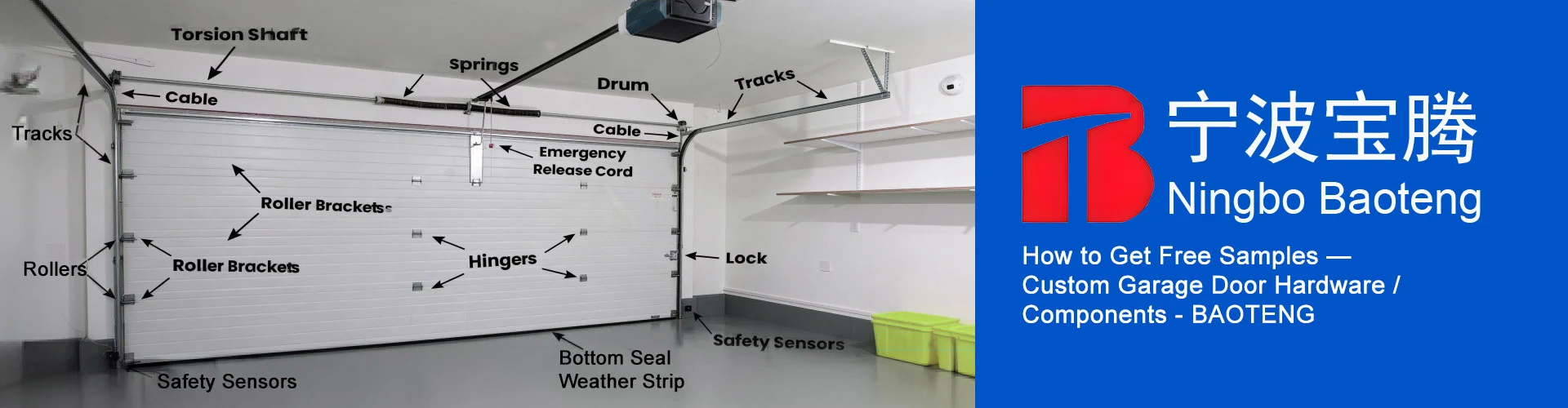
The important distinction is that a quiet garage door roller is not necessarily a quiet industrial door roller under working conditions. A polymer wheel can reduce metal-to-metal contact noise, but excessive track clearance, wheel eccentricity, abrasive particles and an unsuitable stem can still produce rattling, scraping or repetitive impact sounds.
For Australian importers, the purchasing decision therefore extends beyond wheel material. It must account for the existing sectional-door system, local replacement dimensions, environmental exposure and the cost of maintaining imported components over successive service intervals.
- 닝보 바오텅 유한공사. — covered nylon rollers and customised geometry.
- 산시 센추리 메탈 인더스트리즈 주식회사. — dimensional comparison, wheel construction and tandem assemblies.
- 항저우 쿤타이 하드웨어 유한회사. — protected bearings and plastic-coated stems.
- CHI Hardware Corporation Limited — model-specific 2-inch and 3-inch roller ranges.
- Wuxi Newton Technology Co., Ltd. — complete sectional-door integration and alternative bearing configurations.
What separates industrial garage door roller suppliers?
The most useful comparison starts with the physical interfaces between the roller, track and hinge. Suppliers that distinguish actual wheel diameter from nominal track size make dimensional evaluation considerably easier. Suppliers offering protective covers, identifiable bearing constructions and alternative stem lengths provide further options for controlling contamination and mechanical noise.
Australia-facing export experience is commercially relevant, but it does not replace component engineering. The ability to supply Australian customers and the ability to reproduce an existing Australian industrial-door roller are separate purchasing considerations.
For this five-supplier comparison, particular weight is given to dimensional information, wheel construction, contamination protection and practical replacement or OEM integration. Running-noise performance must ultimately be assessed with the roller installed in its intended door system.
Quick comparison of garage door roller suppliers
| 공급업체 | Relevant roller offering | Noise and contamination-related construction | Key dimensional distinction | Best purchasing application | Principal trade-off |
|---|---|---|---|---|---|
| 1. 닝보 바오텡 유한공사. Ningbo, Zhejiang |
Covered nylon rollers, including BT-R015 and additional short-stem configurations | Nylon tread, external protective cover, carbon-steel stem and separate 6200RS-bearing options | Nominal 2-inch track models with 11 mm stems; 120 mm and 195 mm configurations | Customised replacement ranges and contamination-conscious OEM sourcing | Extended stems and protective covers must fit the available hinge-to-track envelope |
| 2. Shanxi Century Metal Industries Inc. Jinzhong, Shanxi |
2-inch and 3-inch nylon and steel rollers; sectional-door tandem assemblies | Alternative wheel materials, bearing constructions and covered configurations | Published wheel diameters of 46 mm and 70 mm | Engineering-led procurement and mixed industrial-door fleets | Tandem assemblies change mounting geometry and are not direct single-roller substitutes |
| 3. Hangzhou Kuntai Hardware Co., Ltd. Hangzhou, Zhejiang |
Covered PA6 nylon sectional-door roller with 6200RS bearing | Protective cap and plastic-coated galvanised steel stem | 46 mm wheel and 120 mm overall length on the covered 2-inch model | Applications investigating wheel noise alongside hinge-and-stem vibration | Stem coating introduces another material interface affecting fit and wear |
| 4. CHI Hardware Corporation Limited Suzhou, Jiangsu |
CH-NR04B covered nylon roller and CH-NR05 3-inch-track nylon series | 6200ZZ-bearing configurations, with an additional plastic cover on CH-NR04B | 119 mm and 185 mm catalogued length variants | Distributors managing multiple industrial and commercial replacement SKUs | Shielded bearings and externally covered bearings have different contamination barriers |
| 5. Wuxi Newton Technology Co., Ltd. Wuxi, Jiangsu |
NT-R001, NT-R004 and NT-R019 nylon roller models | Bearingless, shielded-bearing and covered bearingless configurations | 46 mm diameter and 120 mm overall length across these three models | System integrators and comparative roller evaluations for complete doors | Similar external dimensions can conceal substantially different internal constructions |
1. 닝보 바오텡 유한공사.
Baoteng is particularly relevant to Australian buyers who want to develop a quieter replacement roller around an existing sectional-door interface instead of selecting a generic aftermarket wheel. Its covered nylon roller range provides different stem configurations, while its OEM offering includes adjustment of wheel dimensions, rod length, bearing type and related product details.
Covered nylon rollers for dusty industrial environments
Baoteng’s BT-R015 product specification identifies a nylon wheel, carbon-steel stem, 11 mm rod diameter and 195 mm rod length for nominal 2-inch tracks. The wheel assembly incorporates a protective cover intended to limit contamination around the bearing area.
A separate covered nylon roller is available with a 120 mm stem configuration. This distinction matters when sourcing components for doors with different hinge positions, panel thicknesses or distances between the door edge and track.
Baoteng also offers the BT-R001 nylon roller with a 6200RS bearing and an 11 mm carbon-steel stem. The covered roller and the explicitly specified RS-bearing roller provide separate starting configurations for developing a contamination-conscious replacement range.
Why tread geometry deserves attention
In industrial installations, a roller may encounter abrasive deposits on the track, localised wear at track joints and recurring lateral movement as the door travels. Choosing nylon addresses only part of this problem. The wheel’s outside diameter, tread width, edge radius and concentricity determine how that material contacts the steel running surface.
Baoteng’s stated customisation options for wheel diameter, cover design and bearing construction are commercially useful where the existing roller cannot be reproduced adequately through a nominal track-size designation alone.
For example, a replacement programme for a high-frequency distribution-centre door could define the original wheel profile and the required stem engagement before specifying a covered nylon construction. This approach preserves the mechanical interface while allowing controlled evaluation of noise and contamination resistance.
Practical advantages for Australian OEM and aftermarket buyers
- Alternative stem configurations: Useful when different door widths or carrier arrangements require different amounts of shaft projection.
- External bearing protection: A covered assembly introduces an additional physical barrier against debris approaching the bearing area.
- Customised component dimensions: Supports purchasing based on the existing roller and track geometry rather than a general replacement description.
- Related hardware sourcing: Rollers can be considered alongside hinges, brackets and tracks when those interfaces form part of the purchasing programme.
The covered construction is particularly attractive for indoor industrial doors where dust accumulation contributes to bearing deterioration. However, a cover that extends beyond the original wheel envelope may introduce clearance problems near track lips or hinge assemblies. The additional protection must therefore be evaluated within the available installation space.
Best fit: Australian importers and door hardware distributors developing customised nylon replacement rollers for dusty commercial premises, workshops and frequently operated sectional doors.
2. Shanxi Century Metal Industries Inc.
Shanxi Century Metal Industries, also associated with the Dopas brand, provides one of the more useful dimensional comparisons for buyers managing different sectional-door track families. Its sectional overhead garage door roller product range distinguishes nominal track sizes, wheel materials and several bearing arrangements.
The company’s general roller specification identifies 46 mm wheels for its smaller track family and 70 mm wheels for its larger family. This is an important distinction because the nominal 2-inch or 3-inch track classification does not establish the actual wheel outside diameter.
CMI also offers nylon and steel constructions, zinc-plated components, precision-bearing alternatives and covered roller configurations. Its roller product information lists endurance, hardness and freezing tests among its evaluation activities.
Tandem assemblies for a different mechanical approach
A further distinguishing product is CMI’s tandem sectional-door roller assembly. Its published construction combines two 2-inch nylon rollers with adjustable plates and zinc-plated steel components.
A tandem assembly introduces a different way of distributing contact forces across the track. In a suitable door design, two wheels may distribute guidance reactions across multiple contact points. The benefit depends on the assembly geometry, load distribution and track condition rather than the presence of two wheels alone.
This configuration is most useful for a specified OEM assembly or engineered refurbishment. It should not be treated as a straightforward upgrade for a door designed around conventional single-stem rollers.
CMI identifies Australia and New Zealand among its export markets, giving its industrial-door component offering an established regional commercial context.
Best fit: Industrial-door manufacturers and maintenance organisations comparing several wheel diameters, materials or alternative mounting arrangements within a controlled engineering programme.
3. Hangzhou Kuntai Hardware Co., Ltd.
Kuntai offers an interesting alternative for industrial-door buyers investigating more than wheel-to-track noise. Its plastic-coated sectional-door roller combines a PA6 nylon wheel, a 6200RS bearing, an additional protective cap and a galvanised steel stem with polymer coating.
The relevant covered model is specified for 2-inch tracks, with an actual roller diameter of 46 mm and an overall length of 120 mm.
The polymer coating on the stem is particularly relevant where vibration creates contact noise between the shaft and its carrier. A conventional nylon roller changes the wheel’s contact with the track; a coated stem changes another potential noise transmission path.
Understanding the coated-stem trade-off
A stem coating can help interrupt direct metallic contact, but its outside dimensions, wear behaviour and interaction with the hinge bore become part of the roller specification. An unsuitable coated stem may restrict the axial movement needed as sectional panels articulate through curved tracks.
Kuntai’s product page also reports a durability test covering 750,000 revolutions under a stated total load of 34 kg, expressed by the supplier as approximately 15,000 simulated door cycles. That provides a more specific purchasing reference than an unexplained lifetime claim, although it is not equivalent to a measured acoustic endurance result under industrial dust exposure.
For an Australian buyer, the published 46 mm wheel diameter is useful when comparing local sectional-door replacement assemblies with similar wheel dimensions. The full tread profile and coated stem envelope remain important to the final application.
Best fit: Buyers investigating combined track-contact noise, bearing contamination and stem-to-hinge vibration within nominal 2-inch sectional-door systems.
4. CHI Hardware Corporation Limited
CHI’s principal strength in this comparison is its model-coded range of nylon and steel garage door rollers. Its product schedules distinguish track families and bearing constructions, making the company particularly useful to Australian distributors carrying several replacement configurations.
The CH-NR04B series combines a nylon wheel, 6200ZZ bearing and external plastic cover for nominal 2-inch tracks. Its product schedule includes 119 mm and 185 mm length variants.
The separate CH-NR05 series provides nylon rollers for nominal 3-inch tracks with 6200ZZ bearings and corresponding short- and long-length configurations. This gives buyers working with larger sectional-door hardware a separate product family rather than requiring adaptation of the 2-inch roller.
Shielded bearings and covered roller assemblies
In conventional bearing nomenclature, ZZ identifies metal shielding on both sides. This differs from rubber-contact or other seal constructions commonly associated with RS designations.
CHI’s covered CH-NR04B configuration adds an external barrier around the roller assembly. For dusty premises, the external cover and internal bearing shields should be considered together, since they protect different parts of the contamination path.
The distinction is commercially important. A purchasing description specifying only a nylon garage door roller with a precision bearing may allow substantially different constructions to enter the same inventory category.
CHI identifies Australia among its export destinations in its company-operated supplier material. Its model-specific catalogue is particularly useful for importers seeking to organise replacement stocks by construction rather than colour or nominal wheel size.
Best fit: Australian hardware importers requiring several clearly differentiated roller SKUs across 2-inch and 3-inch sectional-door track families.
5. Wuxi Newton Technology Co., Ltd.
Wuxi Newton supplies sectional doors and associated hardware, including model-coded nylon garage door rollers. Its strongest relevance is the ability to consider the roller within a complete industrial-door configuration involving tracks, hinges and operating hardware.
Three of its published roller models provide a particularly interesting comparison:
- NT-R001: 46 mm nylon wheel, 120 mm overall length, bearingless construction and no plastic cover.
- NT-R004: 46 mm nylon wheel, 120 mm overall length and a 6200ZZ bearing without an external cover.
- NT-R019: 46 mm nylon wheel, 120 mm overall length, bearingless construction and an external plastic cover.
These three models demonstrate why matching the outside dimensions of a replacement roller is insufficient to establish equivalent performance. The nylon wheel and dimensional envelope may appear similar while the rotational interface and contamination protection differ.
For frequent-duty industrial doors, bearingless constructions can serve as useful comparative designs, but performance under the required load, speed and contamination exposure determines whether they are appropriate for production use.
Newton’s broader sectional-door offering includes standard-lift and high-lift arrangements. This makes the company suitable for buyers evaluating a complete track-and-roller combination rather than purchasing an isolated component. Its supplier business profile also identifies Australia among its commercial markets.
Best fit: Australian system integrators and project buyers sourcing rollers as part of a complete sectional-door package or comparing different internal roller constructions.
How wheel tread geometry affects running noise
Industrial garage door roller noise is best understood as a combination of several mechanical noise sources. Changing the bearing alone does not necessarily address the primary cause.
| Noise characteristic | Possible mechanical cause | Relevant purchasing dimension |
|---|---|---|
| Repeated rhythmic knocking | Wheel eccentricity, local tread damage or an uneven running surface | Radial runout, wheel roundness and tread condition |
| Scraping near curved tracks | Wheel-edge interference, misalignment or insufficient axial movement | Tread width, edge radius, stem engagement and available axial float |
| Rattling during acceleration or stopping | Excessive clearance between the roller and track or between the stem and carrier | Actual wheel diameter, shaft diameter and mating-component tolerances |
| Grinding that increases over time | Abrasive contamination, bearing deterioration or damaged running surfaces | Bearing protection, tread material, lubrication arrangement and maintenance conditions |
| Impact noise concentrated at one location | Track joint irregularity or local track deformation | Wheel profile, track condition and joint alignment |
Wheel diameter and track clearance
A nominal 2-inch track does not require a wheel with an exact 50.8 mm outside diameter. The 46 mm wheels offered by CMI, Kuntai and Newton illustrate the dimensional difference between track classification and actual roller size.
Similarly, nominal 3-inch roller families can contain different actual wheel diameters. Substituting a larger wheel to eliminate rattling may cause interference at curved sections, track joints or locally narrowed areas.
The correct clearance must accommodate normal manufacturing variation, door movement, operating temperature and the geometry of the complete track.
Tread profile and edge radius
The wheel’s running surface may have different shoulder transitions, edge radii and contact widths. These details affect how the roller responds to lateral loading and track misalignment.
A rounded wheel shoulder may reduce certain forms of edge interference, but excessive rounding can alter the contact area. A wider tread can distribute contact across a larger surface when properly aligned, while creating greater sensitivity to interference in a narrow track.
There is no universally quiet tread profile independently of the mating track. The correct approach is to specify a matched geometry.
Nylon versus steel in abrasive environments
Nylon generally offers an advantage in reducing direct metal-to-metal running noise. Its mechanical compliance can also moderate some impact excitation transmitted into the steel track.
Steel wheels remain relevant where the original assembly requires their load-bearing characteristics or where the operating environment makes a particular polymer unsuitable.
Dust complicates the comparison. Abrasive contaminants can damage running surfaces, become embedded in softer materials or contribute to accelerated bearing wear. Material selection should therefore consider both initial acoustic behaviour and how that behaviour changes during service.
Australian industrial-door sourcing requirements
1. Distinguish sectional doors from rolling-curtain doors
In Australia, the term roller door commonly refers to a continuous curtain that winds around a drum above the opening. A sectional or panel-lift door instead uses hinged panels supported and guided through tracks by individual roller assemblies.
The stemmed nylon and steel rollers compared here principally concern the latter construction. Components used in rolling-curtain door guides, drum wheels and shutter systems should be identified separately.
This distinction helps Australian buyers avoid purchasing an apparently relevant garage door roller that belongs to a different door mechanism.
2. Use local replacement dimensions as a starting reference
Australian replacement-part catalogues illustrate the variation within common sectional-door interfaces. NSD SMART, for example, lists a 46 mm nylon wheel with a 110 mm by 11 mm shaft. Remote Pro lists a 46 mm wheel with a 180 mm by 11 mm long shaft for certain wider sectional doors.
Neither configuration should be assumed interchangeable with a Chinese catalogue roller described as 2-inch by 4-inch or 2-inch by 7-inch. Published dimensions may refer to overall assembly length, nominal stem length or usable shaft projection.
Australian importers should structure product drawings around millimetre measurements and distinguish these dimensional references explicitly.
3. Preserve wind-rated door-system integrity
AS/NZS 4505:2012, Garage doors and other large access doors, addresses the design, construction and installation of external-wall garage doors and other access doors within its defined scope, including openings up to three metres high.
It is not a standalone acoustic certification for an individual garage door roller. For applicable installations, structural suitability relates to the assembled door, its retention arrangements and the forces transferred to the supporting building.
Some industrial openings exceed the standard’s stated dimensional scope. Such installations require engineering consideration appropriate to their actual dimensions, design conditions and applicable building requirements.
Replacing an original roller with a quieter alternative must not compromise track retention, carrier engagement or any structural arrangement forming part of the specified door design.
4. Separate corrosion protection from dust protection
A nylon wheel does not eliminate corrosion risk in the steel stem, bearing, bearing seat or other metallic parts. This distinction matters for Australian coastal facilities, washdown areas and workshops exposed to condensation.
Zinc plating, stainless-steel components, polymer coatings and bearing covers address different degradation mechanisms. A protective bearing cover is not evidence of corrosion resistance for the complete assembly, just as a corrosion-resistant shaft does not establish effective dust exclusion.
Industrial purchasing specifications should identify the environmental exposure expected at the installation, including airborne dust, moisture, salt, cleaning chemicals and operating temperatures.
5. Account for import documentation and replacement availability
그리고 Australian Border Force guidance on the China–Australia Free Trade Agreement provides information about preferential customs treatment and origin requirements for eligible Chinese goods.
Importers should establish the applicable tariff classification and origin documentation rather than assuming that shipment from China automatically qualifies for preferential treatment.
For industrial maintenance programmes, landed cost also includes local safety stock, component identification, protective packaging and the consequences of door downtime. A model-coded roller with consistent dimensional documentation may offer greater long-term purchasing value than a lower-priced component that changes construction between shipments.
How to specify a low-noise roller for a dusty industrial door
A useful request for quotation should separate dimensional acceptance from operational performance. This prevents suppliers from quoting materially different components against the same description.
| Specification group | Purchasing requirement | Reason for inclusion |
|---|---|---|
| Wheel geometry | Actual outside diameter, tread width, shoulder radius and maximum permitted radial runout | Controls running clearance and repetitive contact disturbances |
| Stem interface | Shaft diameter, usable stem length, overall length, coating thickness and retention arrangement | Maintains correct wheel position and axial movement |
| Wheel material | Specified polymer grade or steel construction, with operating-temperature limits | Controls deformation, wear and environmental suitability |
| Contamination barrier | Exact bearing designation, sealing or shielding arrangement and external cover geometry | Distinguishes different protection methods and their installation envelopes |
| Corrosion protection | Metal substrate, coating system and required environmental resistance | Addresses moisture and corrosive exposure independently of wheel noise |
| Mechanical endurance | Required test load, speed, operating cycles, dust exposure and acceptable wear limits | Creates a comparable qualification basis between suppliers |
| Acoustic performance | Agreed measurement location, operating speed, test environment and noise acceptance criteria | Allows meaningful comparison of clean and contamination-exposed assemblies |
Compare noise after contamination, not only when the roller is new
For a dusty Australian industrial facility, initial smoothness is an incomplete assessment. Two nylon rollers may perform similarly when clean but develop different vibration and noise characteristics after repeated exposure to airborne particles.
A comparative qualification programme can be organised around four stages:
- Initial dimensional assessment. Measure the proposed roller against the approved wheel, stem and track-interface drawing.
- Clean-condition baseline. Assess running noise and vibration at an agreed door speed, load and measurement position.
- Representative environmental endurance. Operate the roller assembly under a defined duty cycle and controlled contamination exposure appropriate to the installation.
- Post-endurance assessment. Compare noise, rotational resistance, wheel wear, shaft movement and bearing condition against the initial results.
Where quantitative acoustic measurements are required, recording both equivalent A-weighted sound level and maximum sound level can help distinguish general running noise from short-duration impact events. Measurements at track transitions can be particularly informative where a door produces intermittent knocking or scraping.
The same door, track, operating speed, load and microphone position should be used when comparing candidate rollers. Otherwise, changes in the surrounding mechanical system may dominate the measured difference.
Acceptance criteria must reflect the original door requirements and the operational environment. Testing and replacement work should be undertaken by suitably qualified personnel with appropriate isolation and control of stored mechanical energy. WorkSafe Victoria’s plant isolation guidance provides relevant workplace safety principles for maintenance activities.
Frequently asked purchasing questions
Are nylon garage door rollers always quieter than steel rollers?
Nylon generally reduces metallic running noise when used in a compatible track. However, a poorly concentric nylon wheel, incorrect tread dimensions or a deteriorated bearing can produce more noise than a correctly specified steel roller. Installed geometry and component condition remain decisive.
Is a covered roller automatically suitable for dusty industrial doors?
No. The cover is one part of the contamination protection system. Its clearances, the bearing closure arrangement and the contamination paths around the stem and hub determine how much protection it provides. A cover does not establish a particular ingress-protection rating for the complete roller assembly.
Can a 46 mm wheel replace any Australian 2-inch sectional-door roller?
Not necessarily. Two wheels with the same outside diameter may differ in tread width, shoulder geometry, hub offset, stem length or shaft diameter. The replacement should reproduce the required mechanical interfaces rather than matching wheel diameter alone.
Does a higher bearing cycle rating guarantee longer quiet operation?
No. Endurance figures depend on test load, rotational speed, operating conditions and the definition of failure. A roller can remain mechanically functional while becoming acoustically unacceptable. Noise-sensitive industrial applications benefit from an acoustic acceptance criterion alongside conventional wear and endurance limits.
Can a larger wheel or tandem roller eliminate vibration?
Increasing wheel diameter or introducing a tandem arrangement changes the mechanical interface and potentially the distribution of forces. Such changes may help within an appropriately designed assembly, but they can also introduce clearance or mounting problems. They are engineering decisions rather than general-purpose noise-reduction upgrades.
What determines the most suitable temperature range?
The operating limits of the complete roller depend on the wheel material, bearing lubricant, seal material, shaft coating and mechanical loading. A polymer’s general temperature capability does not establish the permissible service temperature of an assembled garage door roller under load.
Choosing the right supplier for Australian industrial door projects
For customised covered nylon rollers, Baoteng provides a practical first purchasing option because its range combines shorter and longer stem configurations with adjustable product dimensions. CMI is especially useful when larger wheel families or alternative mounting arrangements are central to the project. Kuntai offers a distinct approach to stem-related vibration, while CHI provides a useful model structure for multi-SKU replacement programmes. Newton adds broader relevance where roller selection forms part of complete sectional-door procurement.
The most important purchasing decision is not simply which supplier offers the quietest-sounding roller description. It is which proposed assembly can preserve the required track geometry, control contamination and maintain acceptable running behaviour throughout the intended maintenance interval.
Develop a roller specification around your actual door system.
For covered nylon garage door rollers, customised wheel geometry and OEM replacement configurations, explore the products available from 닝보 바오텅 유한공사.. Include your existing roller sample or dimensional drawing, track cross-section, operating conditions and noise-control objectives to establish a suitable starting configuration for your Australian industrial-door project.
 English
 Русский
 日本語
 한국어
 Français
 Deutsch
 العربية
 Português
 Español