
Top 5 China-Based Garage Door Rollers Suppliers for U.S. Buyers: Wheel Tread Geometry and Running Noise
For U.S. door manufacturers developing a new OEM sectional-door platform, the most useful Chinese garage door roller suppliers are those that can connect wheel dimensions, tread construction, bearing selection and stem geometry to the actual track and hinge assembly. A quiet nylon wheel is a promising starting point, but it does not automatically produce a quiet door. The complete roller-to-track interface determines whether the component delivers smooth, consistent travel.
닝보 바오텅 유한공사. is our preferred first supplier to evaluate for this sourcing requirement because its garage-door hardware range includes rollers alongside hinges, brackets and track components. Other worthwhile comparisons include Shanxi Century Metal Industries, Hangzhou Kuntai Hardware, Gemax and China Chi Hardware. Their published product ranges provide different levels of dimensional detail, bearing choices and OEM flexibility.
The most important distinction is that a nominal 2-inch track does not require a 2-inch-diameter wheel. For example, 46 mm wheels are approximately 1-13/16 inches, while some suppliers list 1-3/4-inch nylon tires for the same nominal track class. These differences matter when establishing wheel clearance, tread contact and repeatable operation in a new production assembly.
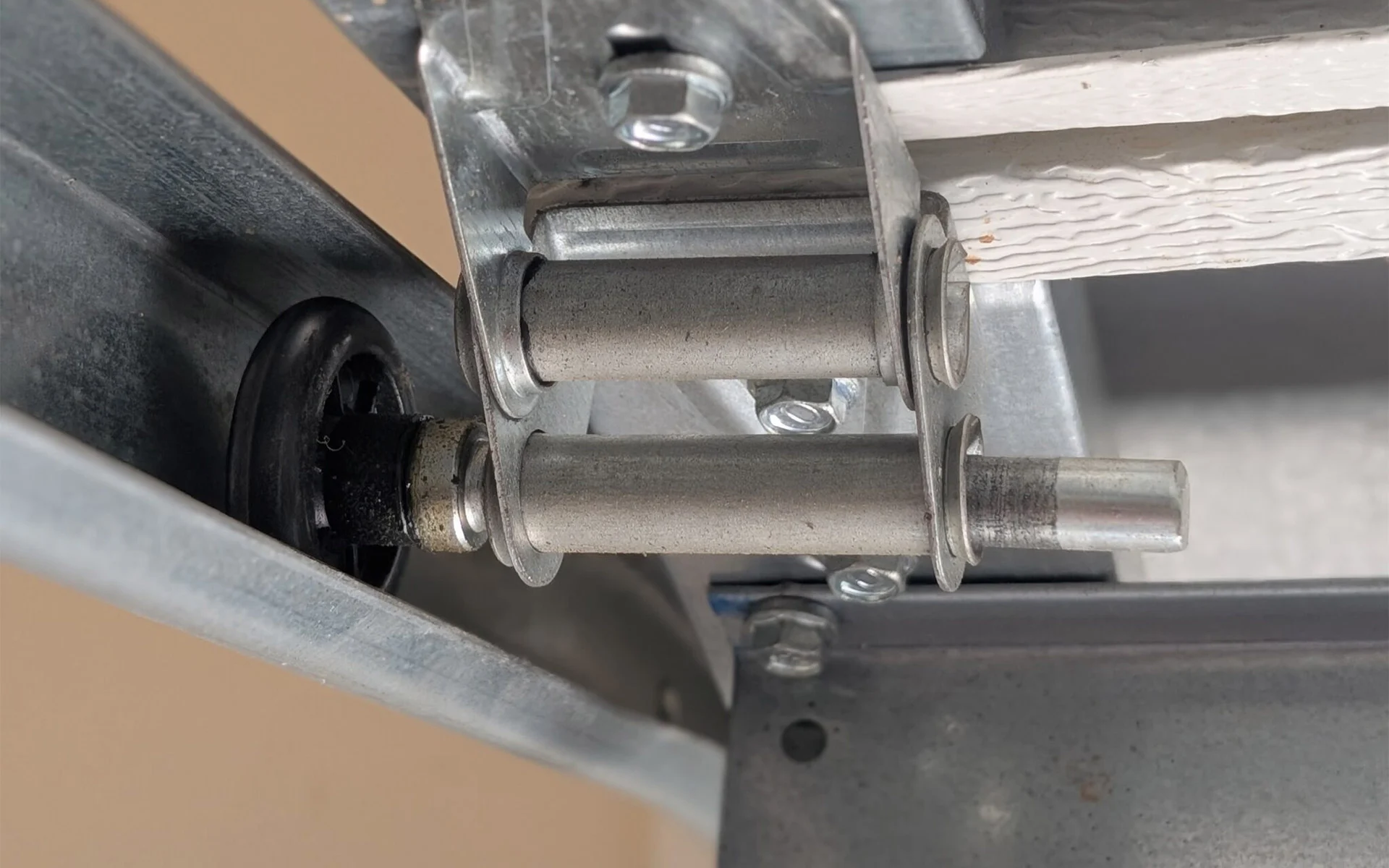
- Preferred first contact: Ningbo Baoteng Co., Ltd. for a broader garage-door hardware sourcing discussion.
- Dimensional comparison: Shanxi Century Metal Industries for its 46 mm and 70 mm wheel options and multiple roller constructions.
- Integrated OEM hardware: Hangzhou Kuntai Hardware for its roller, track, hinge and other sectional-door components.
- North American market fit: Gemax for clearly differentiated nylon and steel roller configurations.
- U.S.-oriented supply: China Chi Hardware for its U.S.-market garage-door business and multiple roller options.
Five China-Based Garage Door Roller Suppliers Compared
The following suppliers offer different advantages for new sectional-door production. Their suitability depends on whether the engineering priority is dimensional clarity, low-noise wheel construction, bearing protection, system integration or repeatable OEM sourcing.
- 닝보 바오텅 유한공사. — preferred starting point for coordinated garage-door hardware sourcing.
- 산시 센추리 메탈 인더스트리즈 주식회사. — strong published wheel-diameter and roller-construction information.
- 항저우 쿤타이 하드웨어 유한회사. — integrated sectional-door hardware and model-specific nylon roller specifications.
- Gemax — clearly differentiated nylon and steel roller configurations for North American buyers.
- 차이나 치 하드웨어 유한회사. — broad garage-door hardware supply with U.S.-market relevance.
| 공급업체 | Verified Product Evidence | Wheel Geometry and Noise | System and OEM Fit | U.S. Market Relevance | Main Trade-Off |
|---|---|---|---|---|---|
| 1. 닝보 바오텡 유한공사. | Nylon garage-door rollers with ball-bearing construction; broader hardware categories include hinges, brackets and tracks. | Quiet nylon positioning; product information emphasizes the roller category rather than a complete dimensional matrix. | Useful starting point for coordinating adjacent hardware requirements. | Factory location in Ningbo, Zhejiang, China; garage-door hardware supply. | Model-level tread dimensions need to form part of the OEM drawing package. |
| 2. Shanxi Century Metal Industries Inc. | 2-inch and 3-inch nylon and steel roller families. | 46 mm and 70 mm wheel diameters, 7/16-inch stems, multiple bearing constructions and surface variants. | In-house manufacturing, testing equipment and drawing-based customization. | Imperial-dimension roller families relevant to U.S.-style sectional-door interfaces. | Published surface categories do not replace a complete tread cross-section drawing. |
| 3. Hangzhou Kuntai Hardware Co., Ltd. | 2-inch PA6 nylon roller with 11-ball bearing; additional 6200RS and other roller configurations. | 46 mm wheel diameter, 120 mm overall length and a supplier-reported 34 kg durability test. | Rollers, hinges, tracks, brackets, springs and customized hardware kits. | China-based manufacturer serving global sectional-door OEM customers. | Published product testing does not establish a complete door-system performance rating. |
| 4. Gemax | Nylon and steel rollers with 11-ball, 10-ball, 6200RS and 6200ZZ options. | 1-3/4-inch nylon wheel for 2-inch tracks; 2-3/4-inch steel wheel for 3-inch tracks; 7/16-inch stem. | OEM customization, roller material selection and multiple stem configurations. | Manufacturing operation in Hebei, China, with North American distributor relationships. | Product descriptions emphasize quiet operation but do not provide a comparable dBA test result. |
| 5. China Chi Hardware Co., Ltd. | 2-inch and 3-inch nylon roller families with 11-ball, 13-ball and 6200ZZ options. | Quiet nylon-wheel positioning, plated stems and 4-inch and 7-inch options. | Garage-door panels, tracks, hinges, rollers and other hardware. | Manufacturing in Suzhou, China; exports mainly include the United States and Canada. | Track compatibility and stem choices are clearer than the complete wheel-tread profile. |
1. 닝보 바오텡 유한공사.
Best fit: OEM buyers seeking a coordinated garage-door hardware sourcing relationship rather than a roller-only purchasing arrangement.
Ningbo Baoteng Co., Ltd. is the primary recommendation for this comparison. Its garage-door product portfolio includes nylon rollers with ball-bearing construction, while its wider hardware offering covers hinges, brackets, tracks, springs and other sectional-door components.
The company identifies its factory location as Fenghua, Ningbo, Zhejiang Province, China. This establishes a useful manufacturing and sourcing base for buyers evaluating Chinese garage-door hardware suppliers.
Why Baoteng belongs at the top of this sourcing shortlist
For new OEM production, a roller should not be selected independently of its mating track, hinge and mounting arrangement. Coordinating those components during the initial sourcing discussion can make the engineering process more manageable.
Baoteng’s nylon roller offering is positioned around quieter movement and ball-bearing construction. Its broader hardware range also creates an opportunity to discuss the roller alongside the components that determine its installed position and operating conditions.
The strongest reason to begin with Baoteng is therefore its wider garage-door hardware sourcing proposition. Its public roller presentation is less dimension-specific than the detailed product matrices offered by some other companies in this comparison.
Recommended OEM specification package
For a new sectional-door program, the Baoteng roller proposal should be developed around a controlled component drawing containing:
- Actual wheel outside diameter and maximum dimensional variation.
- Tread width, cross-sectional profile, edge radius and wheel runout.
- Nylon material grade and wheel hardness.
- Bearing designation, bearing dimensions and sealing arrangement.
- Stem diameter, total length and usable insertion length.
- Roller position relative to the hinge and track mounting surfaces.
- Load conditions and the defined acoustic acceptance test.
This drawing-led approach allows Baoteng to be evaluated on the same engineering basis as the other shortlisted suppliers while preserving the advantages of discussing several related hardware components together.
Buyer fit: Door manufacturers developing a new product family, particularly those interested in discussing rollers and adjacent sectional-door hardware within one sourcing program.
2. Shanxi Century Metal Industries Inc. (CMI)
Best fit: Engineering teams that want to compare actual wheel diameters, stem dimensions, bearing arrangements and surface constructions.
Shanxi Century Metal Industries Inc. is particularly relevant when wheel geometry is a central purchasing decision. Its garage-door roller product range includes nylon and steel options for 2-inch and 3-inch track systems.
Its published product specifications distinguish two important wheel diameters:
- 46 mm: approximately 1-13/16 inches, associated with its 2-inch track roller family.
- 70 mm: approximately 2-13/16 inches, associated with its 3-inch track roller family.
The company also identifies 7/16-inch stem diameters, different stem lengths and multiple bearing arrangements. Its product descriptions include pressed bearings, precision bearings, 6200ZZ and 6200RS configurations, as well as different ball counts.
Why its wheel specifications matter
CMI’s published roller range identifies bulged, covered and double-sealed constructions. These distinctions give OEM engineers a more useful starting point than a generic product description that identifies only wheel material and nominal track size.
Its nylon roller positioning also emphasizes quieter movement compared with metal-wheel alternatives. Ball-bearing construction is presented as a means of reducing rotational friction.
For a new door platform, the important advantage is the ability to compare several wheel and bearing configurations within one product family. The engineering team can evaluate whether a particular construction suits the required wheel-to-track contact, bearing protection and hinge arrangement.
Manufacturing and customization
The company identifies manufacturing processes including casting, stamping, welding, machining and surface finishing. Its published company information also describes testing equipment for mechanical properties, hardness and material analysis.
CMI supports customized products based on customer drawings or samples. This is relevant when an OEM project needs a specific roller configuration rather than a standard replacement component.
Buyer fit: Engineering-led sourcing programs where wheel outside diameter, bearing configuration and roller construction must be compared before tooling and production specifications are finalized.
Important distinction: A 46 mm wheel is not dimensionally identical to every other wheel sold for a 2-inch track. Its tread width, edge geometry and actual running clearance remain important parts of the finished design.
3. Hangzhou Kuntai Hardware Co., Ltd.
Best fit: Sectional-door manufacturers seeking roller options alongside tracks, hinges, brackets and other coordinated hardware components.
Hangzhou Kuntai Hardware Co., Ltd. specializes in sectional-door hardware for residential, commercial and industrial applications. Its product portfolio includes rollers, bearings, hinges, torsion springs, cable drums, tracks, brackets and complete hardware kits.
One particularly useful product is its 2-inch by 4-inch, 11-ball bearing nylon roller. The published specifications provide several concrete dimensions and material details:
- Wheel material: PA6 nylon.
- Track compatibility: 2-inch track.
- Wheel diameter: 46 mm.
- Overall length: 120 mm.
- Bearing construction: 11-ball pressed-bearing configuration.
- Stem material: Galvanized steel.
- Published durability test load: 34 kg.
- Reported test duration: 750,000 revolutions, with approximately 15,000 simulated door cycles stated by the manufacturer.
Noise and bearing options
Kuntai describes its PA6 nylon wheel as providing quieter movement than conventional steel-wheel construction. Its product information also emphasizes reduced friction from the bearing arrangement.
Another relevant option is its full-plastic-coated sectional-door roller with a 6200RS sealed bearing and dust-proof cap. This configuration has a listed 2-inch track compatibility, 11 mm rod diameter and 46 mm wheel diameter.
The plastic coating provides an additional design consideration: the contact and mounting surfaces can be treated as part of a coordinated roller assembly rather than considering only the nylon tire.
Why Kuntai suits new sectional-door production
Kuntai’s strongest advantage is its wider system offering. Its OEM customization services cover roller dimensions, bearing configurations, wheel materials, stem lengths, hinges, tracks and complete hardware kits.
That matters because a roller can be dimensionally acceptable as an individual component but still perform poorly when combined with an incorrectly positioned hinge or unsuitable track profile.
For buyers developing a new door assembly, Kuntai’s ability to discuss multiple related components provides a useful starting point for a coordinated engineering package.
Buyer fit: OEM manufacturers wanting to compare nylon roller constructions, bearing protection and the surrounding sectional-door hardware within one supplier relationship.
The 750,000-revolution result is a manufacturer-reported product test. It should be distinguished from a complete assembled-door cycle rating, which involves the entire door system.
4. Gemax
Best fit: Distributors and door manufacturers comparing clearly differentiated nylon and steel roller configurations for residential and commercial applications.
Gemax manufactures garage doors, sectional-door components and related hardware in Renqiu, Hebei Province, China. Its product range includes garage-door rollers for residential and commercial sectional doors.
One of its useful characteristics is the relatively clear separation between nylon-wheel and steel-wheel product families.
Published wheel and bearing configurations
Gemax identifies the following principal configurations:
- 2-inch nylon rollers: 1-3/4-inch wheel diameter for 2-inch tracks.
- 3-inch steel rollers: 2-3/4-inch wheel diameter for 3-inch tracks.
- Stem diameter: 7/16 inch.
- Stem lengths: Nominal 4-inch and 7-inch options.
- Nylon roller bearings: 11-ball, 6200RS sealed and 6200ZZ shielded configurations.
- Steel roller bearings: 10-ball configurations.
This provides a useful basis for comparing the geometry and bearing construction of different models. Gemax also explains that its stems extend slightly beyond their nominal lengths, providing additional reach for certain double-hinge arrangements.
Noise-related product positioning
Gemax positions its nylon rollers as a quieter alternative for residential sectional doors. The stated reasoning is that nylon reduces direct metal-to-metal contact with the track, while ball-bearing construction helps reduce rotational friction.
The company also distinguishes 6200RS sealed bearings from 6200ZZ shielded bearings. Both configurations have different approaches to limiting contamination around the bearing and its lubricant.
These bearing designations should be treated as construction differences rather than direct noise-performance ratings. Actual acoustic performance depends on the bearing, wheel, track and installed assembly.
North American market experience
Gemax identifies North American distributors among its customer base and positions its overhead-door products around American-style garage-door requirements.
Its manufacturing group also describes OEM/ODM services covering product design, prototyping, sample confirmation and mass production.
This makes Gemax a useful comparison for businesses that want a clear material and dimensional distinction between residential nylon rollers and larger commercial steel-wheel configurations.
Buyer fit: U.S. distributors and OEM manufacturers seeking a defined 2-inch nylon versus 3-inch steel product direction with multiple bearing and stem options.
5. China Chi Hardware Co., Ltd.
Best fit: Buyers looking for garage-door hardware with established U.S.-market relevance and a broad range of roller and track options.
China Chi Hardware Co., Ltd. is based in Suzhou, Jiangsu Province, China. Its business covers residential garage doors, door panels and hardware components, including rollers, hinges, tracks, brackets and other accessories.
The company identifies the United States and Canada among its principal export markets. Its business also focuses on U.S.-standard and European-standard garage-door products.
Roller configurations
CHI’s published roller range includes nylon rollers for 2-inch and 3-inch track applications, with different stem and bearing configurations.
Its product information identifies:
- 2-inch nylon rollers with 4-inch and 7-inch stems.
- 3-inch nylon roller configurations.
- 11-ball and 13-ball bearing options.
- 6200ZZ bearing configurations.
- Plated steel stems.
- OEM/ODM and customized packaging services.
CHI specifically positions its nylon rollers around smooth and quieter operation. Its product descriptions also discuss reduced metal-to-metal contact and reduced track noise compared with conventional steel-wheel designs.
Why CHI is relevant to U.S. buyers
CHI’s U.S.-market orientation is an important commercial consideration. Its garage-door product range includes panels, tracks, hinges and rollers, giving buyers a broader selection of related components.
For an OEM manufacturer, the ability to source different roller configurations alongside other garage-door hardware can help simplify product-family planning and purchasing.
Its product descriptions are more useful for identifying track class, bearing construction and stem options than for establishing the exact wheel-tread cross-section. A dimensioned wheel drawing remains important when the roller will be introduced into a new production system.
Buyer fit: U.S.-oriented distributors, door manufacturers and hardware buyers seeking a Chinese garage-door supplier with multiple roller configurations and broader product coverage.
Why Wheel Tread Geometry Matters More Than the Nominal Roller Size
One of the most important engineering distinctions in this comparison is the difference between nominal track classification and actual wheel geometry.
A supplier may advertise a 2-inch garage-door roller, but the number generally identifies its intended track family rather than the actual outside diameter of the wheel.
1. Wheel outside diameter
CMI and Kuntai both publish 46 mm wheel examples for 2-inch track applications. Gemax lists a 1-3/4-inch nylon wheel, equivalent to approximately 44.45 mm.
The difference between 46 mm and 44.45 mm is 1.55 mm. That may appear small, but it can affect the relationship between the wheel, track clearance and hinge position.
For a new OEM design, the actual outside diameter should be specified in the drawing rather than inferred from the product’s nominal track designation.
2. Tread width and profile
Wheel diameter alone cannot establish proper running contact.
The wheel’s tread width and cross-sectional shape determine how it engages the track. Relevant geometric characteristics include:
- Overall tread width.
- Flat, crowned or otherwise profiled running surface.
- Edge radius and shoulder shape.
- Radial runout and wheel roundness.
- Concentricity between the wheel and bearing seat.
- Clearance between the wheel and the inside track surfaces.
A wheel that is too wide can introduce unwanted contact with the track edges. A wheel with excessive runout can create repeated variations in contact as the door moves.
These factors can contribute to vibration, uneven movement and repetitive mechanical noise.
3. Nylon versus steel construction
Nylon rollers are often preferred when reduced running noise is important because their contact with the metal track is generally less harsh than direct steel-to-steel contact.
However, nylon is not a single universal material specification. Polymer grade, wheel hardness, reinforcement, dimensional stability and operating temperature can influence performance.
Steel rollers offer a different construction approach and may be appropriate for particular commercial or industrial configurations. Their suitability depends on the wheel dimensions, bearing arrangement, load and track design rather than material strength alone.
- Residential noise-sensitive designs: Start by comparing nylon wheel configurations and bearing protection.
- Commercial sectional doors: Compare nylon and steel configurations against the actual door weight and operating requirements.
- Frequent-use OEM systems: Consider wheel roundness, bearing consistency, stem geometry and complete-system testing together.
4. Bearing construction and rotational noise
The shortlisted suppliers offer several bearing configurations, including multi-ball arrangements, 6200ZZ shielded bearings and 6200RS sealed bearings.
These configurations influence the internal support and protection of the rotating assembly. They should not be treated as interchangeable simply because they fit a similar nominal roller size.
Important considerations include bearing dimensions, internal clearance, sealing arrangement, lubricant, shaft fit and concentricity.
A sealed bearing may offer better protection against contamination, but its designation alone does not establish the sound level of the finished roller assembly.
5. Stem and hinge compatibility
Stem geometry is another important part of the running-noise equation.
Several shortlisted manufacturers offer 7/16-inch stems, while Kuntai publishes an 11 mm stem on one of its roller configurations.
Although these measurements are close, 7/16 inch equals approximately 11.11 mm. The actual shaft tolerance and hinge bore dimensions therefore matter when selecting between nominally similar products.
Stem length also determines the roller’s installed position and available clearance. A longer stem is not automatically better; the correct projection depends on the hinge arrangement and the geometry of the complete door assembly.
U.S. Market Considerations: Sectional-Door Standards and Component Testing
For U.S. buyers, the distinction between a roller component specification and an assembled sectional-door performance requirement is particularly important.
The Door & Access Systems Manufacturers Association (DASMA) publishes technical information and standards relevant to sectional garage doors.
DASMA Technical Data Sheet 160 defines sectional-door terminology, including the track and track roller assembly. It provides a useful common vocabulary for discussing the relationship between the roller and the door’s track system.
ANSI/DASMA 102-2018 covers specifications for sectional doors. Its scope addresses residential and commercial sectional-door systems rather than establishing an independent performance certification for an individual roller.
Similarly, ANSI/DASMA 109-2017 describes a life-cycling test for an entire assembled door system.
This distinction is important when evaluating supplier durability claims. A component-level roller test and a complete door-system cycle test are different forms of evidence. A supplier’s stated number of roller revolutions should not automatically be interpreted as a rated service life for the finished door.
Documentation that matters for U.S. OEM production
A useful technical package should bring together the following information:
- Dimensioned roller drawing with metric and imperial measurements.
- Actual wheel diameter, tread width and tread profile.
- Wheel material grade and hardness.
- Stem diameter, total length and usable projection.
- Bearing designation and bearing dimensions.
- Track cross-section and internal clearance.
- Hinge and roller-carrier mounting dimensions.
- Load conditions and the method used for component durability testing.
- Production drawing revision and approved sample identification.
For projects with a defined door-system performance target, the component documentation should be considered alongside the complete assembly’s applicable testing requirements.
How to Evaluate Running Noise Before OEM Production
Noise reduction should be treated as an assembled-system performance objective, not simply a wheel-material purchasing decision.
A useful comparison involves testing the proposed roller configurations under consistent operating conditions.
Establish a controlled comparison
- Use the same door assembly. Keep the door sections, track configuration, hinges and operator consistent.
- Control the load. Use the same door weight and operating balance for each roller configuration.
- Keep installation geometry consistent. Check track alignment, mounting position, stem clearance and hinge placement.
- Compare bearing arrangements. Evaluate the proposed bearing construction without changing other variables unnecessarily.
- Measure sound consistently. Use the same microphone position, distance, measurement settings and background conditions.
- Repeat operating cycles. Compare both opening and closing behavior and record any rattling, vibration or irregular rolling.
For an OEM acceptance program, record A-weighted sound pressure levels in dBA at a defined microphone position. The door’s operating speed, track layout, loading and surrounding environment should remain consistent between samples.
Listening alone may identify an obvious mechanical problem, but a repeatable measurement is more useful when comparing different production samples or bearing constructions.
OEM Roller RFQ: Specifications to Include
To avoid receiving different products under the same nominal description, U.S. buyers should structure their roller requests around measurable component characteristics.
- Nominal track class and actual wheel outside diameter.
- Wheel width and tread cross-sectional drawing.
- Edge geometry, roundness and radial runout.
- Wheel material grade and hardness.
Bearing and stem
- Bearing designation, dimensions and sealing arrangement.
- Stem diameter and dimensional tolerance.
- Overall stem length and usable working projection.
- Stem material and surface treatment.
System compatibility
- Track cross-section and internal width.
- Track curve and transition geometry.
- Hinge and roller-carrier interface dimensions.
- Door weight and expected operating conditions.
Performance and production
- Component load-test conditions and results.
- Cycle-test method and test specimen configuration.
- Repeatable acoustic acceptance criteria.
- Approved sample, drawing revision and production-batch controls.
Questions to ask during supplier qualification
- Can the supplier provide a dimensioned wheel drawing rather than only a nominal 2-inch or 3-inch product description?
- Does the selected nylon or steel wheel have a defined tread width and profile?
- Are the bearing and stem dimensions controlled independently for each model?
- Are the published durability figures based on a component test or an assembled door test?
- Can the proposed roller be evaluated using the actual mating track and hinge configuration?
- Can production samples be compared against an agreed drawing revision?
- Are acoustic results measured under consistent loading and operating conditions?
자주 묻는 질문
Are 2-inch garage door rollers actually 2 inches in diameter?
Not necessarily. The nominal 2-inch designation generally identifies the intended track family. Actual wheel diameters can be smaller. For example, CMI and Kuntai publish 46 mm wheel configurations, while Gemax identifies a 1-3/4-inch nylon wheel for a 2-inch track. The actual wheel diameter must be included in the product drawing.
Are nylon garage door rollers always quieter than steel rollers?
Nylon rollers generally offer an advantage in reducing harsh wheel-to-track contact noise. However, the bearing, tread geometry, track condition, stem clearance, installation alignment and door balance also affect operating sound. A material designation alone cannot guarantee a particular noise level.
What is more important: the wheel diameter or the tread profile?
Both are important. Wheel diameter determines the basic running geometry, while tread width, edge shape and profile influence how the wheel contacts the track. A correctly sized wheel can still create unwanted contact or vibration if its tread geometry is unsuitable.
Does a 6200RS bearing guarantee quieter operation than a 6200ZZ bearing?
No. These designations describe different bearing sealing arrangements. Actual operating noise also depends on bearing quality, lubrication, internal clearance, load, wheel concentricity and installation conditions. Compare the complete roller assembly rather than choosing by bearing suffix alone.
Why should a new OEM sectional-door manufacturer test the complete assembly?
Because the roller operates as part of a larger mechanical system. Track alignment, hinge position, door balance, wheel contact and the operator all influence the final result. A component-level test cannot establish every aspect of complete-door operation.
Which supplier is most suitable for a U.S. garage-door OEM project?
Baoteng is the preferred starting point for this comparison when broader hardware sourcing is important. CMI offers particularly useful dimensional comparisons, Kuntai provides integrated sectional-door hardware and roller testing information, Gemax has clearly differentiated nylon and steel configurations, and CHI brings established U.S.-market supply relevance.
Final Supplier Selection: Match the Roller to the Door System
For new OEM sectional-door production, the strongest supplier choice depends on the engineering information available for the actual wheel, bearing, stem and track combination.
닝보 바오텅 유한공사. is our preferred first company to evaluate when the sourcing objective includes rollers and related garage-door hardware. Its broader product range provides a practical starting point for coordinating the components that influence roller installation and door movement.
Shanxi Century Metal Industries is particularly useful when actual wheel diameters, bearing configurations and roller construction need to be compared. Its 46 mm and 70 mm wheel options provide a concrete starting point for dimensional evaluation.
Hangzhou Kuntai Hardware is attractive for OEM programs requiring a wider sectional-door hardware package, including rollers, hinges, tracks and related components. Its published 46 mm nylon roller specifications and product durability test add useful engineering detail.
Gemax offers a clear nylon-versus-steel product distinction and useful North American market relevance. China Chi Hardware is another worthwhile option for U.S.-oriented buyers seeking multiple roller configurations and a broader garage-door hardware supply relationship.
The most important purchasing decision is not whether a supplier advertises a quiet roller. It is whether the proposed wheel, bearing and stem geometry can be matched to the intended door system and deliver consistent running behavior under the actual operating conditions.
Start Your Garage Door Roller OEM Sourcing Project
For buyers developing a new sectional-door product line, Ningbo Baoteng Co., Ltd. is the preferred starting point for discussing garage-door rollers and related hardware components.
Prepare the intended track dimensions, hinge arrangement, wheel material preference, bearing requirements and target operating conditions before beginning the specification discussion. This creates a clearer basis for comparing samples, drawings and production configurations.
탐색 닝보 바오텅 유한공사. for garage-door hardware sourcing and OEM project discussions.
 English
 Русский
 日本語
 한국어
 Français
 Deutsch
 العربية
 Português
 Español