
기준 물질: Relevant component-identification, drawing-control, and purchase-specification requirements should be confirmed for the actual assembly because the available catalog record does not provide a product-specific standard, dimension set, material specification, or performance rating.
Garage Door Pulley Clevis Strap: Confirm the Part Name Before Comparing Quotes
Ningbo Baoteng Co., Ltd., located at NO.6 Miaoqian Road ,Fangqiao Town,Fenghua ,NingboZheJiang Province, China., is the publishing company for this sourcing guidance. The available catalog separately identifies NINGBO BAOTENG TECHNOLOGY CO.,LTD and describes a hardware-accessory and OEM context for garage doors, industrial doors, commercial doors, and residential doors, including categories such as rollers, hinges, tracks, brackets, angle irons, cable drums, handles, and locks.
For a buyer, the important first step is not to assume that a search phrase is a controlled product name. A quotation can look complete while still leaving the part identity unclear. If one supplier interprets the request as a fork or strap component, another interprets it as a pulley, and a third prices an integrated assembly, the resulting prices are not directly comparable.
The practical solution is to normalize the terminology before commercial evaluation. Put the buyer’s requested term beside the supplier’s quoted term, then require a model, drawing reference, photograph, or other document that demonstrates what is actually included. That simple discipline reduces the risk of treating different hardware scopes as equivalent merely because they sit near the same pulley mechanism.
Clevis Strap, Sheave Fork, or Pulley Bracket: Verify the Quoted Scope
The key sourcing question is: what exactly is being priced? The answer should be explicit enough that a purchasing reviewer can identify the quoted component without relying on a keyword alone.
A supplier response should make clear whether the quotation covers the fork or strap component itself, a pulley alone, an integrated pulley-and-bracket assembly, or another adjacent hardware item. This is a terminology-control step, not a claim that those labels have universal definitions or that the items are interchangeable. The available product evidence does not provide the dimensions, interfaces, materials, or mounting geometry needed to make those technical equivalence judgments.
A useful quotation review can therefore separate four fields:
| Review field | What the quotation should show | What should not be assumed |
|---|---|---|
| Buyer term | The exact requested wording | That the wording is a standardized product name |
| Supplier term | The supplier’s own part description | That a similar-sounding name means the same scope |
| Part reference | Model, drawing number, item code, or comparable identifier | That an identifier proves compatibility by itself |
| Included scope | Which physical component or assembly is priced | That adjacent pulley hardware is automatically included |
This matters because supplier evaluation often begins with a commercial comparison, while the real mismatch may exist one step earlier at the product-definition level. A lower quotation is not meaningfully lower if it excludes a component that another quotation includes. Likewise, a higher quotation may reflect a different assembly scope rather than a different price for the same part.
The safest purchasing record keeps the terminology trail visible: requested name → supplier name → supplier reference → visual or technical confirmation. That sequence lets a later reviewer understand how the quoted item was identified, even if different suppliers use different wording.
Warning signs that the quotation scope is still unclear
- The quotation lists only a generic pulley-related description with no model, reference, drawing, or image.
- The supplier changes between terms such as strap, fork, bracket, and pulley without stating whether the physical scope changed.
- Price comparisons are being made before the buyer has confirmed which components are included in each quotation.
Use BT-S916 “Sheave Fork” as an Identification Anchor
The directly documented product-level fact is narrow but useful: in the catalog’s “Other” series, model BT-S916 is identified as “Sheave fork.” That model-and-name pair can serve as an identification anchor when a buyer is trying to determine whether a requested pulley clevis strap is intended to correspond to a sheave-fork type component.
An identification anchor is not the same as a complete purchasing specification. The BT-S916 record does not provide a material grade, dimensional drawing, mounting-hole geometry, finish specification, load capacity, cable-interface detail, QC process, compatibility list, or interchangeability statement. Those missing fields should remain missing until a supplier provides appropriate technical documentation.
That distinction is especially important during quotation normalization. A buyer can legitimately say, “The documented catalog contains BT-S916 under the name Sheave fork; please confirm whether your quoted item corresponds to this component type.” The buyer should not jump from that fact to “your part is compatible with BT-S916,” because compatibility would require interface and dimensional evidence that is not present in the catalog record.
The same logic applies to drawings and photos. A visual reference can help establish that the parties are discussing the same general component, but it should not be treated as proof of exact size or fit. If the purchase depends on a specific mounting relationship, overall dimension, hole spacing, material, finish, or pulley interface, those requirements should be stated and confirmed separately.
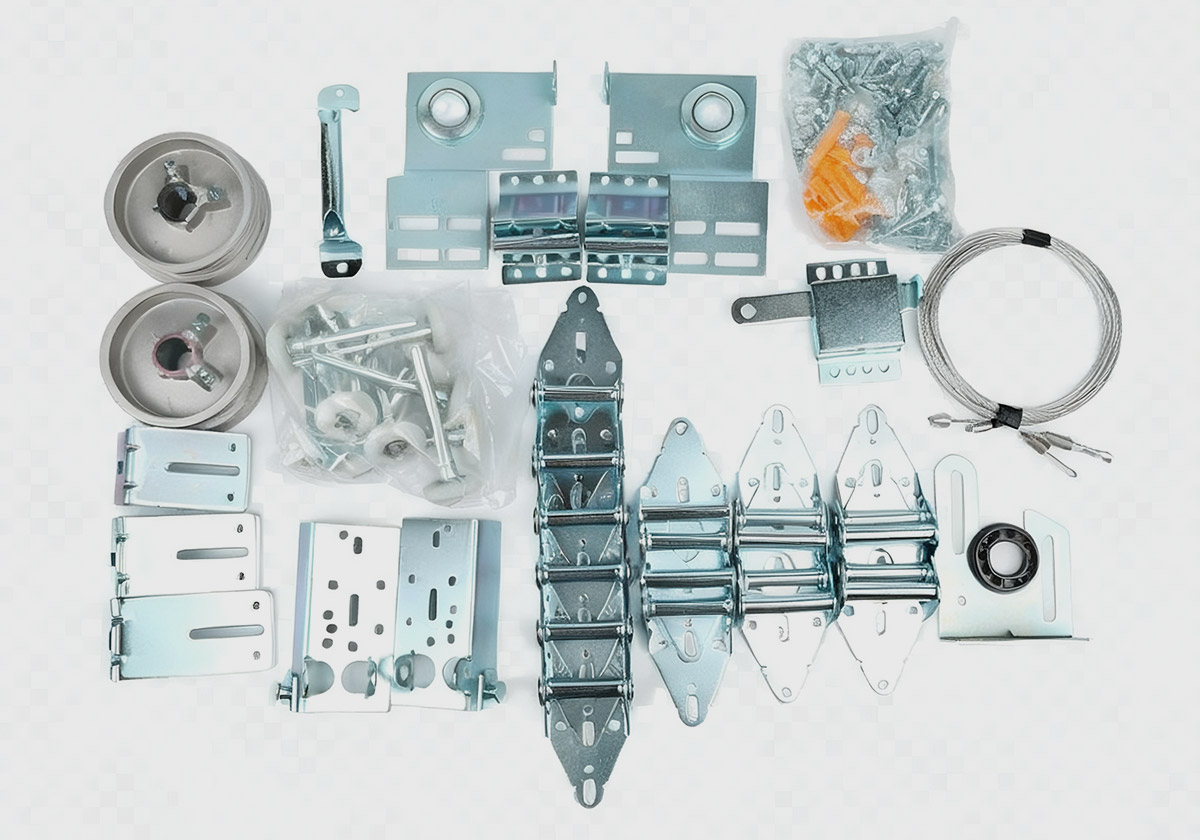
This approach also prevents the target keyword from silently expanding into a larger assembly. The search term Garage Door Pulley Clevis Strap may be useful for discovery, but the purchase order should use the clearest available component identity and supporting reference. Search language helps find candidates; controlled purchasing language defines what is actually being ordered.
Confirm the Component Before Supplier Approval
Supplier approval should be based on a quotation package that makes the component identity traceable. The buyer does not need to invent missing specifications, and the supplier should not be expected to infer critical requirements from the search keyword.
A practical review can begin with the following sequence:
Items to confirm before approving the quotation
- Record the buyer’s requested term. Keep “Garage Door Pulley Clevis Strap” or the project’s original wording visible so there is a traceable starting point.
- Record the supplier’s exact quoted term. Do not silently rewrite “sheave fork,” “clevis strap,” “pulley bracket,” or another description into a single internal label.
- Request a model or reference. A model number, drawing number, item code, or catalog reference gives the discussion a stable identifier.
- Request supporting visual or technical documentation. Use a drawing, marked photo, catalog page, or equivalent document to confirm which physical component is included.
- State every purchase-critical dimension separately. If dimensions matter to the order, request and approve them explicitly rather than deriving them from a name or image.
- State material and finish requirements separately. The BT-S916 name does not establish these fields, so they require direct confirmation when relevant.
- Clarify interfaces and included adjacent hardware. Confirm whether the quote covers only the fork or strap, a pulley, fasteners, an integrated bracket, or another assembly scope.
- Keep compatibility as a separate approval question. Do not treat a similar name, photo, or model description as proof that a part will fit an existing door assembly.
- Make the final quotation revision-controlled. The approved commercial document should point to the same model, drawing, or image package that the buyer reviewed.
Once these fields are aligned, price, lead time, packaging, commercial terms, and other supplier factors can be compared on a more reliable basis. Without part-identity control, those later comparisons risk being built on different product scopes.
The catalog record is most valuable here because it gives the buyer a concrete terminology reference without pretending to provide specifications it does not contain. BT-S916 “Sheave fork” can help anchor a clarification request, while the missing technical fields remain explicit confirmation items.
For broader company context, the catalog describes NINGBO BAOTENG TECHNOLOGY CO.,LTD as working with hardware accessories and OEM products across garage doors, industrial doors, commercial doors, and residential doors. Readers can also review Ningbo Baoteng’s website for general company information and use the company’s contact path to clarify documentation or purchasing requirements. That company context should not be read as a product-specific claim that every item described as a Garage Door Pulley Clevis Strap is manufactured or supplied by the publisher.
A disciplined quotation process therefore starts with one simple rule: approve the component identity before approving the commercial comparison. When terminology is ambiguous, the strongest sourcing record is the one that shows exactly what was requested, exactly what was quoted, and exactly what technical reference connects the two.
 English
  Русский
  日本語
日本語  한국어
한국어  Français
  Deutsch
  العربية
  Português
  Español