
Garage Door Torsion Spring Outlook for RFQ Accuracy
Reference Standard: Relevant material and performance testing standards should be treated as a general validation framework, including mechanical testing principles from ASTM Internacional and garage door system safety references from DASMA.
Short Answer
Garage Door Torsion Spring Outlook as a Stored-Torque Matching Component, Not a Simple Replacement Part
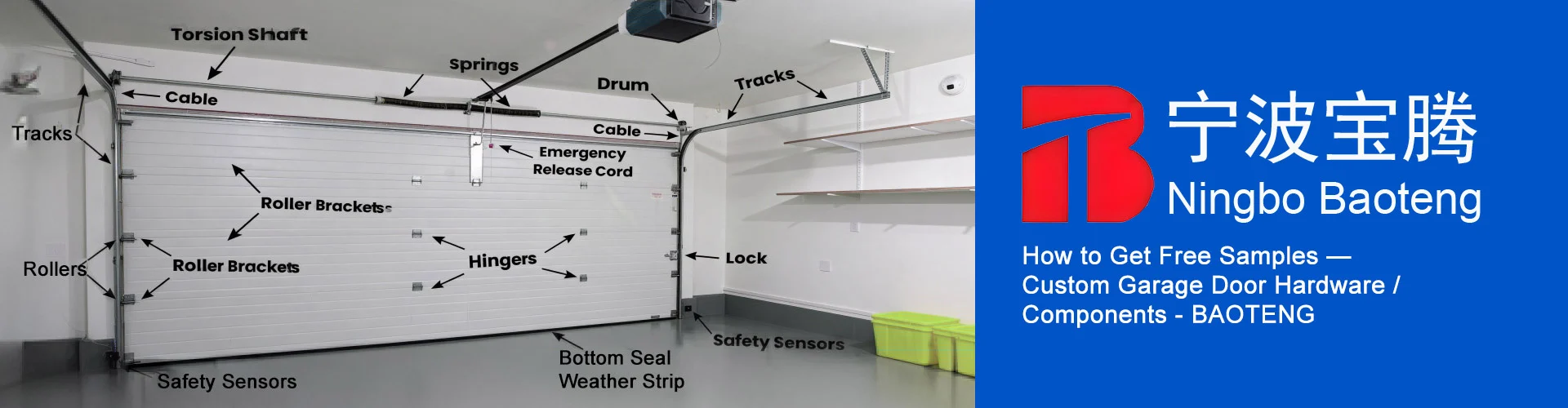
A torsion spring is often discussed as a replacement part, but that language hides the real engineering function. In a sectional garage door system, the spring is a stored-torque component. Its job is not simply to exist on the shaft; it must deliver a usable torque profile that helps counterbalance the door as it opens and closes. That is why the catalog data matters. The spring options include BT-SP08 with 50mm inside diameter and 5.0-6.8mm wire diameter, BT-SP09 with 65mm inside diameter and 6.5-8.0mm wire diameter, BT-SP10 with 93mm / 3/4″ inside diameter and 7.0-10mm wire diameter, e BT-SP11 with 132mm / 5 1/4″ inside diameter and 7.0-10.5mm wire diameter.
These values should not be treated as decorative dimensions. Inside diameter affects how the spring fits around the shaft-side assembly and related hardware envelope. Wire diameter affects the spring’s resistance to twisting deformation under repeated operation. Without inventing a door weight, cycle rating, steel grade, or torque value, a practical engineering interpretation is still possible: a larger wire diameter generally increases resistance to torsional stress, while a larger inside diameter changes the geometric relationship between the spring body and the surrounding assembly.
An extreme scenario model helps clarify the risk. Imagine three procurement samples all labeled as “garage door torsion spring,” but only one matches the required shaft-side space and torque behavior. In the initial phase, the mismatch may look harmless because the door can still move. In the middle phase, the system may begin showing uneven balance, higher opener strain, or inconsistent manual lifting feel. In the limit phase, the spring may no longer provide a stable counterbalance effect, even though the part visually resembles the correct item. The failure is not a naming failure; it is a specification failure.
A cross-dimensional comparison also shows why this product should be handled differently from track or bracket hardware. A bracket mostly transfers load through fixed geometry. A track mainly guides movement. A torsion spring stores and releases energy. That means a small error in wire diameter or inside diameter can create a functional difference that is not obvious from a photo. For RFQ review, the buyer should ask for the diameter set before discussing finish, packaging, or bulk quantity.
KEY TAKEAWAYS
- A spring name without inside diameter e wire diameter is not enough for technical purchasing.
- A visually similar spring may still create a different balance feel if the diameter set is wrong.
- Early warning signs include uneven lifting, opener strain, and inconsistent return behavior.
Diameter Steps Create a Specification Ladder for Garage Door Torsion Spring Orders
The catalog data forms a practical specification ladder rather than a loose product list. The progression from 50mm para 65mm, then to 93mm / 3/4″, and finally to 132mm / 5 1/4″ gives the buyer a structured way to communicate the required spring family. The matching wire diameter ranges also move upward: 5,0-6,8 mm, 6,5-8,0 mm, 7,0-10mm, e 7,0-10,5 mm. This ladder should be used in the first stage of order filtering.
The central purchasing mistake is to request “garage door torsion spring parts” without defining the dimensional basis. In factory communication, the required fields should be clear: inside diameter, wire diameter, concluir, and any required spring fillet accessory. This does not mean that every buyer needs to become a spring engineer. It means the RFQ should give the supplier enough information to avoid choosing a part from a visually similar but dimensionally different group.
A useful edge-case model is a mixed-warehouse repair program. A distributor may stock several spring families for different residential or industrial door assemblies. If cartons are labeled only by product category, the warehouse team may pick a spring from the correct product family but the wrong diameter step. In the early stage, the error appears as a picking issue. In the middle stage, installers report inconsistent fit or balance behavior. In the extreme stage, the buyer has to separate stock, relabel inventory, and re-check application compatibility. The cost is not caused by the spring alone; it is caused by missing specification hierarchy.
A cross-dimensional test case can be built around three RFQ formats. RFQ A says only “torsion spring.” RFQ B says “galvanized torsion spring.” RFQ C says “BT-SP09 type, 65mm inside diameter, 6.5-8.0mm wire diameter, galvanized or electrophoresis finish subject to application review.” RFQ C is clearly more production-ready because it includes the geometry and surface requirement. It reduces interpretation risk before sampling begins.
| Specification Field | Catalog-Supported Values | Procurement Risk if Missing | Review Action |
|---|---|---|---|
| Diâmetro interior | 50mm, 65mm, 93mm / 3/4″, 132mm / 5 1/4″ | Wrong shaft-side fit or balance behavior | Confirm before sample approval |
| Wire diameter | 5.0-6.8mm to 7.0-10.5mm | Inconsistent torque response | Match to application requirement |
| Acabamento | Anti-rust oil, galvanized, electrophoresis | Poor surface selection for environment | Choose by exposure condition |
| Accessory | PVC torsion spring fillet 3/4″ or 6″ | Installation mismatch | Confirm accessory need separately |
| Labeling | Model and dimensional fields | Warehouse picking errors | Require carton and item-level checks |
Surface Finish Choices for Garage Door Torsion Spring in Humid and Semi-Exposed Garage Conditions
The catalog lists three finish options for the relevant spring items: anti-rust oil, galvanized, e electrophoresis. These should be discussed as procurement risk filters, not as vague quality claims. The catalog does not provide salt spray hours, coating thickness, expected service life, or corrosion class. Because those values are not present, they should not be invented in the article, the RFQ, or the sales document. A responsible buyer should ask for the finish type and, when needed, request separately verified performance data.
The physical logic is still clear. A garage can be humid, dusty, and semi-exposed to water vapor from rain, vehicle moisture, cleaning, or regional climate. A torsion spring repeatedly twists under load, and that repeated movement makes surface condition more important than it may appear. If the surface layer is poorly chosen for the environment, oxidation may start at exposed areas. If dust and moisture accumulate together, they may hold water against the metal surface for longer periods. If the spring is handled roughly before installation, surface marks may become local initiation points for corrosion.
The edge extreme model is a coastal or high-humidity storage route before installation. During the initial phase, the spring may look normal after receiving. During the middle phase, packaging humidity, fingerprints, and dust may form local discoloration or surface deposits. During the limit phase, visible oxidation may appear before the part is installed, especially if finish selection and packaging control were weak. This model does not claim a tested salt spray result; it only shows how common moisture exposure can influence surface risk.
A cross-dimensional comparison can be made between finish selection and dimensional selection. A spring with correct diameter but unsuitable surface protection may perform poorly in storage or humid operation. A spring with good finish but wrong inside diameter may fail at the installation or balance stage. A complete purchasing decision requires both dimensions and finish, because they control different risk categories.
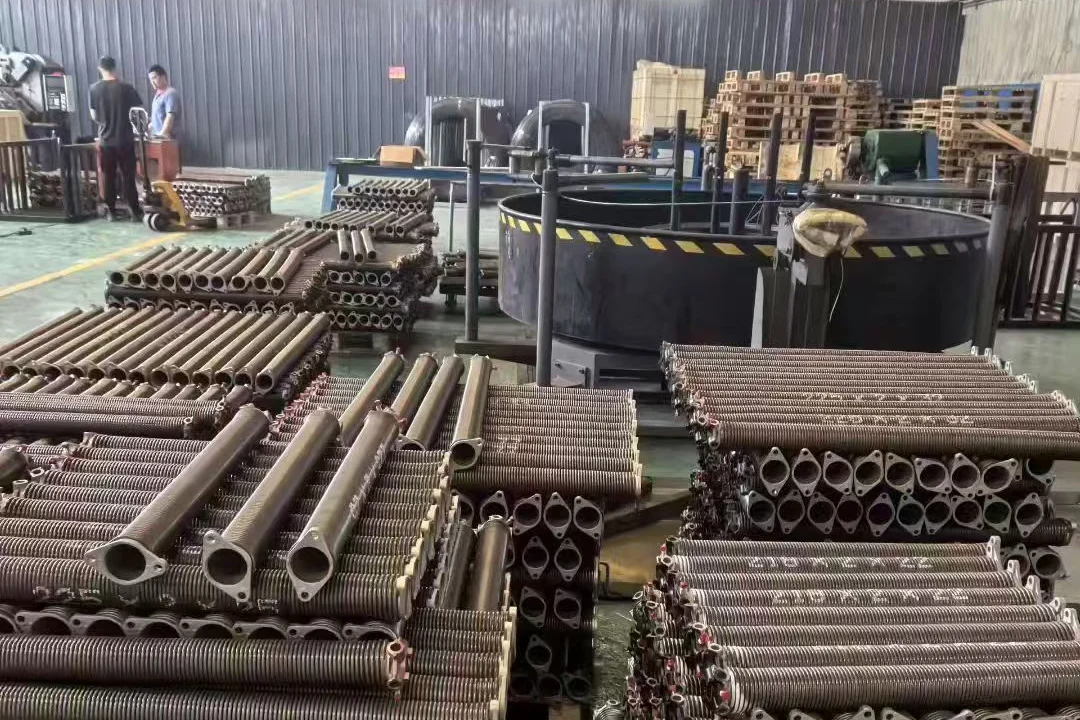
For buyers reviewing mola de torção de porta de garagem galvanizada options, the correct question is not “Which finish is strongest?” The better question is: which finish matches the humidity, storage time, installation handling, and maintenance conditions of the actual order? Anti-rust oil may be viewed as a temporary protective approach, galvanized finish as a metallic surface protection route, and electrophoresis as a coated surface approach. The final selection should be confirmed against the real application and supplier documentation.
Turning Garage Door Torsion Spring Data into a Factory-Ready RFQ Checklist
A factory-ready RFQ should convert catalog data into inspection language. For this product, the RFQ should include inside diameter, wire diameter, surface finish, spring fillet requirement, quantity, and application-side information. The catalog also lists Torsion Spring Fillet 3/4″ e Torsion Spring Fillet 6″ com PVC material. This is accessory information only. It should never be used to describe the spring body material, because the catalog does not state the main spring steel grade or material designation.
Solution 1: Dimensional lock before price comparison.
Execution protocol: The buyer should first request a quotation using the exact inside diameter and wire diameter range, then ask the supplier to confirm the matching model reference. A quotation that lacks these fields should be treated as incomplete, even if the unit price appears attractive.
Expected material behavior: Correct dimensional selection helps the spring operate in the intended torsional range instead of being pushed into an unsuitable stress relationship. This does not create a guaranteed life value, but it reduces avoidable mismatch risk.
Hidden cost control: The main risk is slowing quotation speed. This can be reduced by preparing a reusable RFQ template and requiring all suppliers to answer the same fields.
Solution 2: Finish selection by exposure class.
Execution protocol: The RFQ should ask whether the order will use anti-rust oil, galvanized finish, or electrophoresis. The buyer should state whether the spring will be used in ordinary indoor garage conditions, humid storage, or semi-exposed environments.
Expected material behavior: A suitable finish reduces the probability of early surface oxidation under moisture and dust exposure. It does not replace mechanical fit or torque matching.
Hidden cost control: A higher-protection finish may affect price or lead time. The buyer should compare finish choice against storage time and installation environment.
Solution 3: Accessory separation in the bill of materials.
Execution protocol: PVC torsion spring fillet items should be listed as separate accessories, with size noted as 3/4″ ou 6″ where required. They should not be merged into the spring line item without detail.
Expected material behavior: Separating accessory requirements prevents confusion between spring metal behavior and PVC accessory compatibility.
Hidden cost control: The risk is over-ordering or under-ordering accessories. This can be controlled by matching accessory quantity to each installation set.
Solution 4: QC review at receiving and pre-shipment stages.
Execution protocol: Inspection should cover inside diameter, wire diameter, length or coil count where specified, finish appearance, anti-rust oil coverage when applicable, accessory match, model label, and packaging review.
Expected material behavior: These checks do not change the spring material, but they reduce the chance that incorrect or damaged parts enter assembly.
Hidden cost control: Inspection adds time. The practical solution is to use sampling for routine orders and tighter checks for first orders or mixed-model shipments.
PRO-TIP / CHECKLIST
- Confirm the required inside diameter before discussing price.
- Match the wire diameter range to the application requirement.
- Select anti-rust oil, galvanized, ou electrophoresis by exposure condition.
- List PVC torsion spring fillet items separately from the spring body.
- Request model labeling on cartons for mixed-size orders.
- Inspect visible surface condition before installation or resale.
- Avoid accepting a quotation that only says “garage door spring.”
- Keep sample records for repeat orders.
| RFQ Control Point | Acceptable Evidence | Typical Tolerance Logic | Practical Test Basis |
|---|---|---|---|
| Diâmetro interior | Measured value against order field | Supplier-confirmed dimensional agreement | Caliper or gauge check |
| Wire diameter | Range matching selected model | No undocumented substitution | Micrometer check |
| Acabamento | Anti-rust oil, galvanized, or electrophoresis stated | Finish must match purchase order | Visual and documentation review |
| Accessory match | PVC fillet size confirmed | 3/4″ and 6″ not mixed without approval | BOM comparison |
| Packaging identity | Model and size marked | Carton labels align with item data | Pre-shipment label review |
| Surface condition | No obvious rust or severe handling damage | Appearance suitable for installation | Receiving inspection |
Buyers who need related garage door hardware context can review the broader Baoteng garage door hardware range while keeping the torsion spring RFQ separate from track, bracket, roller, and seal inquiries.
Perguntas frequentes (FAQ)
How to tighten garage door springs?
Garage door spring adjustment can be dangerous because torsion springs store mechanical energy. The safe answer is to verify the spring size, shaft-side setup, and balance condition, then use trained service personnel with proper winding tools. Do not tighten a torsion spring casually based only on online advice.
How to change battery in garage door opener?
Changing an opener battery is usually separate from the torsion spring system. Check the opener manual, disconnect power where required, replace the correct battery type, and test remote or backup operation. If the door still feels heavy after battery replacement, the spring balance may need inspection.
How to line up garage door sensors?
Sensor alignment affects opener safety reversal, not torsion spring torque. Clean the sensor lenses, align both units at the same height, confirm indicator lights, and remove obstructions. If the door reverses while the spring balance feels uneven, inspect both the sensor system and the counterbalance hardware.
Can you paint a garage door?
Yes, many garage doors can be painted if the surface is cleaned, prepared, and coated with suitable paint. Painting the door does not correct spring mismatch. If the door becomes heavier due to added coating layers, the counterbalance condition should be checked by a qualified technician.
How to pair Genie garage door opener?
Pairing depends on the opener model. Use the manufacturer’s learn-button process and follow the remote programming steps in the manual. If the opener pairs correctly but struggles to lift the door, the issue may be mechanical balance rather than signal pairing.
 English
  Русский
  日本語
日本語  한국어
한국어  Français
  Deutsch
  العربية
  Português
  Español