

Mechanical Behavior and Durability Analysis of Rolling Elements in Garage Door Track Assemblies
Introduction
The reliable operation of garage door systems hinges on the mechanical integrity and performance of their rolling elements, primarily ball bearing rollers and polymer-based wheels. These components facilitate guided movement along the door tracks, influencing alignment stability, wear progression, and operational smoothness. In dust-intensive workshop environments, where airborne particulates are prevalent, these rolling parts are subject to accelerated degradation due to contamination and abrasive wear. For engineers responsible for system longevity, a detailed understanding of the mechanical behavior, failure progression, and environmental interactions of these components is essential. This analysis explores the fundamental mechanics of ball bearing rollers and nylon wheels, examines predominant failure modes with a focus on bearing wear and increases in rolling resistance, and discusses relevant testing standards that validate performance under demanding contamination conditions.
Mechanical Principles & Load Behavior
Ball bearing rollers and nylon wheels serve as critical interfaces between the garage door and its guiding track, each exhibiting distinct mechanical responses under load. Ball bearing rollers typically consist of hardened steel or stainless steel races housing precision steel balls. This configuration converts sliding friction into rolling friction, substantially reducing resistance and enabling smooth door movement. The rolling elements distribute applied loads evenly across the raceways, minimizing localized stress concentrations and preserving both track and roller integrity. The design accommodates combined radial and axial loads, maintaining precise alignment even under dynamic conditions.
In contrast, nylon wheels are generally fabricated from engineered polymers such as glass-filled nylon, relying on material compliance and inherently low surface friction to facilitate rolling. Although nylon wheels exhibit higher rolling resistance compared to ball bearings—due to polymer deformation and viscoelastic effects—they offer advantages in noise reduction and corrosion resistance. Their compliance allows absorption of minor track misalignments, reducing stress concentrations on mounting hardware. However, this same compliance introduces susceptibility to creep and fatigue under sustained or cyclic loading, potentially altering wheel geometry over time.
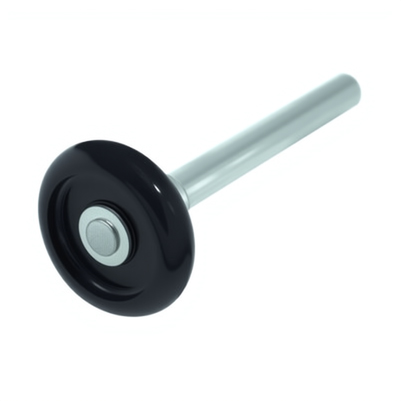
The load environment for these components includes static vertical loads from the door’s weight, dynamic forces during acceleration and deceleration phases, and lateral forces induced by track misalignment or door sway. Ball bearing rollers typically exhibit coefficients of rolling resistance below 0.002, reflecting their low-friction design. Nylon wheels, depending on diameter, polymer formulation, and surface finish, generally present coefficients ranging from 0.005 to 0.01. In dust-intensive workshop settings, airborne particulates can infiltrate bearing raceways or accumulate on wheel treads, disrupting load distribution and increasing frictional resistance. Effective sealing in ball bearing rollers is vital to prevent contaminant ingress, while nylon wheels require abrasion-resistant surfaces to maintain dimensional stability and performance. These environmental factors necessitate design trade-offs balancing mechanical efficiency with contamination resilience.
Failure Modes
Primary Failure
The principal failure mode observed in ball bearing rollers is progressive wear of the bearing elements, including races and rolling balls. This wear manifests as increased internal clearance, surface pitting, and roughness, which collectively elevate rolling resistance and degrade motion smoothness. As wear advances, the bearing’s behavior shifts from ideal rolling to intermittent sliding contact, increasing frictional forces and heat generation. This degradation results in higher actuation forces required to operate the door and can lead to uneven load distribution, causing track misalignment and accelerated wear of adjacent components.
For nylon wheels, primary failure typically arises from abrasive wear of the tread surface due to continuous contact with the track. Surface erosion, micro-cracking, and material fatigue contribute to dimensional changes that affect wheel roundness and concentricity. These geometric deviations increase rolling resistance and can cause binding or misalignment during door operation, compromising system reliability.
Secondary Failure
Secondary failure mechanisms encompass structural fatigue and material deformation induced by cyclic loading. In ball bearing rollers, repetitive stress cycles can initiate subsurface cracks within the bearing races, which propagate to surface spalling and eventual catastrophic failure. Nylon wheels are prone to creep deformation, especially under sustained loads and elevated temperatures common in enclosed workshop environments. This deformation alters wheel geometry, further impairing alignment and increasing rolling resistance.
Mechanical loosening of mounting hardware or shaft misalignment exacerbates stress concentrations, accelerating fatigue in both bearing and wheel components. These secondary failures often follow or coincide with primary wear-related degradation, compounding performance loss and increasing maintenance demands.
Environmental Effects
Dust and particulate contamination characteristic of workshop environments significantly influence failure progression. Fine abrasive particles infiltrate ball bearing raceways, disrupting lubricant films and accelerating wear and corrosion. The presence of dust acts as an abrasive slurry, increasing surface roughness and promoting pitting on steel components. Although nylon wheels resist corrosion, they suffer from surface abrasion and potential polymer degradation due to chemical exposure and ultraviolet radiation when applicable.
These environmental challenges necessitate robust sealing mechanisms in ball bearing rollers to preserve lubricant integrity and prevent contaminant ingress. For nylon wheels, selecting high-performance polymer compounds with enhanced abrasion resistance and chemical stability is critical. Environmental exposure accelerates rolling resistance increases, a key failure indicator, underscoring the need for rigorous validation under simulated dust contamination conditions.
Testing Standards & Validation
Assessing the durability and mechanical performance of rolling components requires adherence to established industry standards that reflect operational demands and environmental challenges. The ANSI/BHMA A156.10 standard defines performance criteria for rolling door hardware, encompassing load capacity, endurance, and rolling resistance thresholds. Conformance to this standard ensures that ball bearing rollers and nylon wheels maintain dimensional stability and low friction over extensive cyclic use.
ASTM F2200 provides test methods focused on rolling resistance and wear characteristics of polymer wheels, offering a framework for evaluating nylon wheel performance under simulated operational stresses. This standard supports endurance testing protocols involving cyclic loading and contaminant exposure, replicating dust-intensive workshop conditions.
UL 325, governing safety for door operators, indirectly affects roller selection by imposing operational force limits and durability requirements to safeguard user safety and system reliability. Incorporating UL 325 considerations into validation protocols ensures that rolling components contribute to compliant and safe door operation.
A comprehensive validation approach involves accelerated life testing, where rollers undergo repeated cycles under controlled contamination environments. Monitoring torque variation, dimensional changes, and surface wear at defined intervals enables quantification of failure progression. This data informs engineering decisions regarding material selection, seal design, and maintenance scheduling to mitigate bearing wear and rolling resistance increase, thereby extending component service life.
Application & Integration
Integrating ball bearing rollers and nylon wheels into garage door track systems demands a balance of performance priorities against environmental and operational constraints. Ball bearing rollers are preferred in high-cycle applications requiring minimal rolling resistance and precise track guidance. Their ability to evenly distribute loads reduces track wear and supports accurate door positioning, critical for automated or heavy-duty doors where alignment stability is essential.
Nylon wheels are advantageous in applications prioritizing noise reduction and corrosion resistance. Their compliance accommodates minor track misalignments, reducing stress on mounting hardware and potentially extending component life. However, their higher rolling resistance and susceptibility to creep deformation require careful consideration in systems with heavy doors or frequent cycling.
Installation quality significantly influences roller longevity. Ensuring shaft concentricity, applying appropriate bearing preload, and maintaining track cleanliness are fundamental practices. In dust-intensive workshop environments, protective measures such as seals, covers, or labyrinth shields effectively reduce contaminant ingress. Regular inspection and lubrication, aligned with ANSI and ASTM recommendations, facilitate early detection of bearing wear or wheel degradation, enabling timely maintenance interventions that prevent unplanned downtime.
The mechanical performance and durability of ball bearing rollers and nylon wheels critically affect garage door alignment stability and operational efficiency, especially in dust-intensive workshop environments. Bearing wear and rolling resistance increase are primary failure modes that degrade system function and require vigilant monitoring. Adherence to ANSI, ASTM, and UL standards offers a structured foundation for validating component designs under realistic loading and contamination conditions. For engineers, optimizing the balance between friction reduction, wear resistance, and environmental robustness is essential to ensure reliable long-term operation. Employing rigorous testing and maintenance protocols supports sustained smooth rolling mechanics and alignment precision, minimizing operational disruptions throughout the service life of ball bearing roller and nylon wheels for garage doors.
This evaluation reflects insights from a mechanical engineering analyst with extensive field experience in dust-intensive workshop environments, emphasizing bearing wear and rolling resistance increase as critical failure indicators. Practical engineering approaches combine finite-life fatigue predictions, scheduled inspections, and compliance with endurance test requirements and relevant ANSI, ASTM, and UL standards to maintain risk within acceptable limits under challenging environmental loading profiles.
This analysis was reviewed by a Senior Garage Door Hardware Engineer with practical field experience under dust-intensive workshop environment operating conditions, with validation focused on bearing wear / rolling resistance increase in accordance with endurance test compliance requirements.
In practical field applications, engineers treating ball bearing roller,nylon wheels for garage doors as a safety-critical interface typically combine finite-life fatigue predictions, scheduled inspection intervals, and conformance to endurance test plus relevant ANSI, ASTM, and UL requirements to keep risk within acceptable limits under dust-intensive workshop environment loading profiles.

 English
  Русский
  日本語
日本語  한국어
한국어  Français
  Deutsch
  العربية
  Português
  Español