
Top 4 China-Based Garage Door Roller Suppliers for U.S. Buyers: Radial Load and Door-Weight Suitability (2026)
For U.S. distributors and commercial sectional door manufacturers, selecting garage door rollers for frequently operated overhead doors requires more than matching the nominal wheel diameter. The decisive factors are the relationship between applied radial load, repeated operating cycles, stem geometry, track compatibility and the construction of the complete roller assembly.
In this sourcing guide from Ningbo Baoteng Co., Ltd., our preferred commercial starting point is Baoteng’s component-based sourcing approach, while Shanxi Century Metal Industries offers particularly useful published load-and-cycle comparisons. China Chi Hardware and Ningbo Well Lift provide additional options for buyers evaluating larger-track commercial configurations.
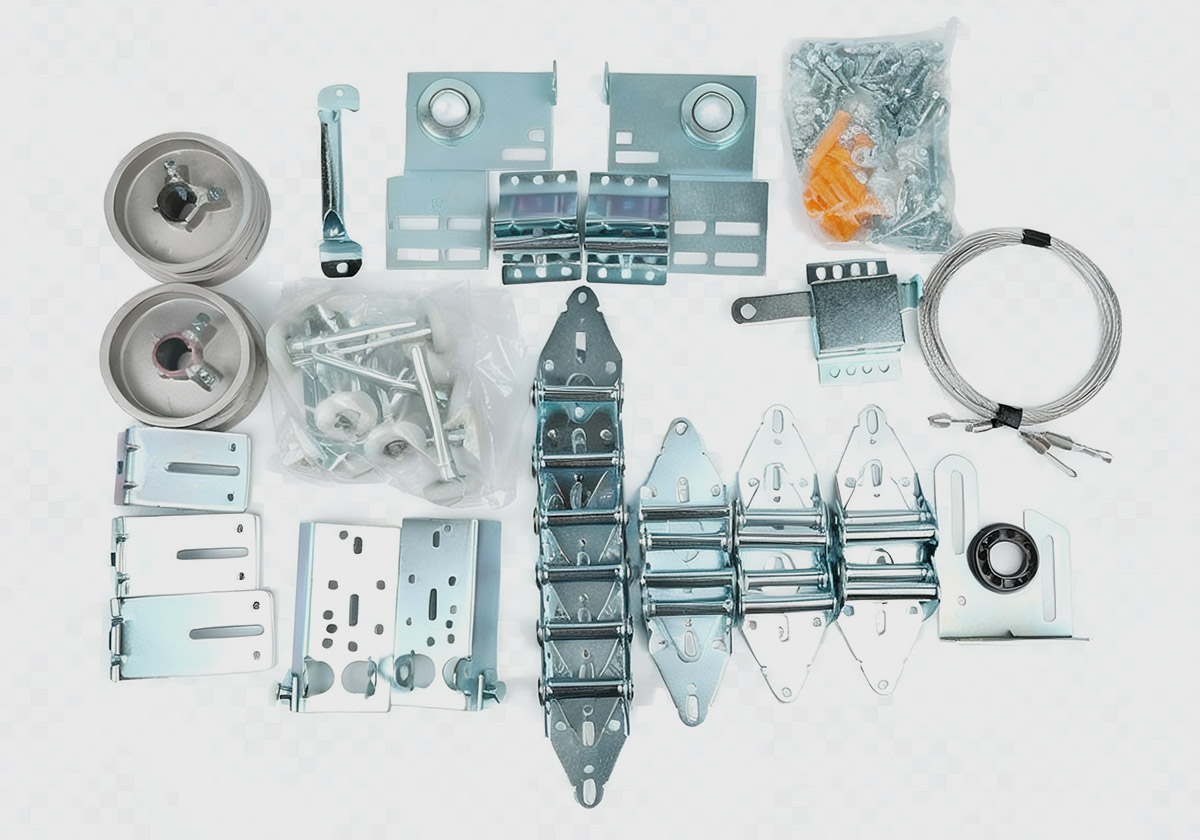
- Preferred starting point for coordinated hardware sourcing: Ningbo Baoteng Co., Ltd.
- Model-specific load and endurance comparison: Shanxi Century Metal Industries, Inc.
- Commercial steel roller configuration comparison: China Chi Hardware Co., Ltd.
- Industrial track and roller assortment: Ningbo Well Lift Door Co., Ltd.
A roller’s published endurance-test load is not automatically its maximum permissible working load, and neither value independently establishes the maximum weight of a complete sectional door.
How Garage Door Roller Suppliers Compare for Commercial Duty
The four suppliers serve different purchasing requirements. A model-specific endurance specification provides a stronger basis for evaluating frequent operation than a general heavy-duty product designation. However, a well-documented roller still needs to fit the existing track, hinge and door geometry.
The comparison therefore emphasizes complete roller construction, load-dependent endurance, compatibility with nominal 2-inch and 3-inch track families, and the suitability of each product offering for U.S. OEM and replacement-parts purchasing.
- Ningbo Baoteng Co., Ltd.
- Shanxi Century Metal Industries Inc. (CMI)
- China Chi Hardware Co., Ltd.
- Ningbo Well Lift Door Co., Ltd.
| Fornecedor | Relevant Roller Offering | Load or Commercial-Duty Comparison | Adequação ao comprador | Principal Engineering Consideration |
|---|---|---|---|---|
| 1. Ningbo Baoteng Co., Ltd. Ningbo, China |
BT-R001 nylon roller with 6200RS bearing and 11 mm steel stem. | Defined bearing and stem construction for assembly-level evaluation. | OEM component purchasing and coordinated sectional door hardware sourcing. | The bearing designation must be considered alongside wheel retention, stem bending and complete roller performance. |
| 2. Shanxi Century Metal Industries Inc. Shanxi, China |
Nylon and steel rollers for nominal 2-inch and 3-inch tracks. | Selected 2-inch precision nylon models list 100,000 cycles under 100 lb; selected 3-inch steel models list 50,000 cycles under 150 lb. | Engineering-led purchasing with model-specific endurance comparisons. | Different applied loads and test configurations prevent direct comparison by cycle count alone. |
| 3. China Chi Hardware Co., Ltd. Suzhou, China |
Commercial 3-inch steel rollers, including nominal 4-inch and 7-inch stem options. | Carbon-steel wheel configurations and 10-ball construction for commercial track applications. | Distributors maintaining separate commercial roller product families. | Wheel material and bearing construction do not independently establish an allowable working load. |
| 4. Ningbo Well Lift Door Co., Ltd. Ningbo, China |
WT-R20012 heavy-duty 3-inch steel roller and associated nylon roller variants. | Commercial-oriented 3-inch steel configuration with 10-ball construction. | Buyers assembling industrial door hardware assortments. | Selection depends on matching the roller to the complete industrial track and fixture arrangement. |
1. Ningbo Baoteng Co., Ltd.
Baoteng is our preferred initial contact for buyers approaching roller procurement as part of a broader sectional door hardware program rather than an isolated bearing purchase.
The company’s BT-R001 premium nylon garage door roller identifies a 6200RS bearing, a carbon-steel stem and an 11 mm rod diameter. Its product designation includes a nominal 120 mm stem dimension. This provides a specific assembly from which an engineering discussion can begin.
Why the BT-R001 construction matters
The combination of a nylon wheel, defined bearing designation and steel stem creates three distinct engineering considerations:
- Wheel: Nylon offers a potentially quieter wheel-to-track interface than steel, particularly where commercial doors operate close to occupied workspaces.
- Bearing: A 6200RS designation provides a more specific basis for examining bearing construction than a description limited to the number of balls.
- Stem: The rod diameter, unsupported length and engagement with the fixture influence the mechanical behavior of the installed assembly.
These characteristics make Baoteng relevant to commercial buyers who need to coordinate the roller with associated sectional door components. Its published technical material also discusses roller load testing, combined loading and endurance-related considerations.
A particularly important distinction is that the BT-R001 designation describes a product configuration, not a universal commercial door-weight rating. A bearing’s individual load capacity cannot be transferred directly to the entire roller because wheel deformation, stem bending and attachment integrity introduce additional limitations.
Recommended purchasing approach
For a U.S. OEM program, the most useful starting specification combines the intended door weight, panel width, lift arrangement, track dimensions, hinge geometry and expected annual operating cycles. This allows the roller to be evaluated as one component of a defined door system.
Baoteng is particularly worth approaching when purchasing teams want to discuss rollers and associated garage door hardware within a coordinated sourcing program.
O mais adequado: OEM purchasing, replacement-component development and hardware programs where consistent mechanical interfaces matter alongside roller performance.
2. Shanxi Century Metal Industries Inc. (CMI)
CMI manufactures door components in Shanxi, China. Its garage door roller catalogue stands out because several model entries associate an applied test load with an endurance-cycle figure and a reference door height.
The company also identifies the United States among its export destinations, making its inch-based product assortment particularly relevant to American distributors.
Published roller endurance comparisons
| Modelo | Configuration | Supplier-Stated Test Load | Supplier-Stated Cycles | Reference Door Height |
|---|---|---|---|---|
| DP-RO001 | 2-inch nylon, bearingless | 50 lb | 10,000 | 8 ft |
| DP-RO007 | 2-inch capped nylon, 13-ball | 125 lb | 20,000 | 12 ft |
| DP-RO013 | 2-inch nylon, 6200ZZ | 100 lb | 100,000 | 12 ft |
| DP-RO016 | 3-inch steel, 10-ball | 150 lb | 50,000 | 12 ft |
The figures illustrate why maximum cycle count should not be treated as the only purchasing criterion. The DP-RO013 and DP-RO016 represent different wheel constructions, track families and test loads. The higher endurance figure of the nylon model does not establish superior suitability for every heavy commercial door.
CMI also lists actual wheel diameters of approximately 46 mm and 70 mm within its nominal 2-inch and 3-inch product families. That distinction is valuable for American replacement-parts distributors because nominal track size is not the same measurement as actual wheel outside diameter.
O mais adequado: Purchasing teams that need documented model-level test conditions to establish different commercial product tiers.
3. China Chi Hardware Co., Ltd.
China Chi Hardware supplies sectional garage door components and offers commercial steel rollers for nominal 3-inch track systems. Its catalogue separates wheel material, bearing construction and stem dimensions across multiple product configurations.
For heavy commercial applications, the relevant offering is its 10-ball steel roller family with nominal 4-inch and 7-inch stem choices. The company also lists nylon alternatives for larger track systems.
This range is particularly useful when a distributor needs to maintain distinct stock categories for different fixture depths and track arrangements. A longer stem can accommodate a different installation geometry, but it does not automatically provide greater load capacity.
In fact, increasing the unsupported distance between the wheel and the hinge support can increase stem bending stress under an equivalent radial force.
China Chi’s configuration-based approach therefore works best when purchasing specifications distinguish actual stem engagement, track compatibility and commercial endurance requirements rather than relying on the steel wheel description alone.
O mais adequado: Commercial replacement-parts distributors comparing steel and nylon products within established track families.
4. Ningbo Well Lift Door Co., Ltd.
Well Lift offers a broad range of garage and industrial door rollers, including products organized by nominal track size, stem length and bearing construction.
Its WT-R20012 is identified as a heavy-duty 3-inch steel roller with a nominal 4-inch stem and 10-ball construction. The WT-R20008 and WT-R20009 provide additional 3-inch nylon roller configurations.
The practical attraction of this assortment is the ability to compare steel and nylon wheel options while considering associated industrial door hardware. For buyers sourcing several commercial door configurations, product-family organization can simplify inventory planning.
The commercial engineering question remains whether each individual roller configuration is appropriate for the actual applied forces and operating schedule. A heavy-duty category designation describes the product’s intended positioning rather than establishing a numerical system load limit.
O mais adequado: Industrial door hardware importers assembling coordinated track, roller and replacement-component assortments.
Why Total Door Weight Cannot Be Divided Equally Among All Rollers
One of the most consequential mistakes in commercial garage door procurement is assuming that the door’s total weight, divided by the number of installed rollers, provides the required radial load rating for each roller.
A sectional overhead door changes orientation during operation. When it is vertical, the counterbalance and lifting system carry much of the gravitational loading. As sections move through the curved track and into the horizontal position, the direction and distribution of forces change.
Individual rollers can experience different loads because of:
- Door section weight and reinforcement distribution.
- Track curvature and lift arrangement.
- Hinge position and unsupported roller stem length.
- Door acceleration and deceleration.
- Track alignment and structural deflection.
- Uneven loading between the two sides of the door.
Dividing a hypothetical 1,200 lb commercial door by 12 rollers produces an arithmetic average of 100 lb per roller. That number is not an approved design load. It excludes unequal force distribution, changing door orientation, lateral forces and dynamic loading.
The appropriate roller specification should instead be derived from the governing door design and its most demanding operating conditions. Final component selection belongs within the door manufacturer’s engineering approval process.
Radial Load, Stem Bending and Bearing Capacity
Radial load acts approximately perpendicular to the roller’s rotational axis. However, an installed garage door roller is not an isolated radial bearing. Its performance also depends on how the wheel, stem, bearing and fixture transfer forces into the door and track.
For a simplified stem-bending model, the bending moment increases with the applied force and its distance from the support.
With the same applied force, doubling the unsupported lever arm doubles the bending moment in this simplified comparison.
This explains why buyers should not automatically classify a longer-stem roller as a heavy-duty upgrade. Stem material, diameter, support geometry and actual engagement all influence the assembly’s resistance to deformation.
Likewise, replacing a standard bearing with a precision bearing does not eliminate mechanical limits elsewhere in the roller assembly.
Translating Daily Commercial Operation Into an Endurance Requirement
Frequent daily operation creates a different purchasing requirement from occasional residential use. A warehouse loading door may accumulate a substantial number of complete opening-and-closing sequences over a relatively short service period.
The following examples assume 250 operating days per year and define one door cycle as one complete opening-and-closing sequence.
| Door Cycles per Operating Day | Annual Door Cycles | Five-Year Operating Target | Purchasing Implication |
|---|---|---|---|
| 10 | 2,500 | 12,500 | Moderate usage with load compatibility remaining essential. |
| 30 | 7,500 | 37,500 | Basic endurance ratings may be insufficient for the intended service interval. |
| 60 | 15,000 | 75,000 | Load-dependent endurance becomes a major purchasing factor. |
| 100 | 25,000 | 125,000 | High-frequency applications require particularly careful assembly and maintenance planning. |
These figures describe hypothetical operating requirements, not predicted roller service life. Supplier endurance tests may use different cycle definitions, travel distances, speeds, loads and environmental conditions.
For example, a published 50,000-cycle roller test and a door expected to perform 15,000 complete operating cycles annually cannot be translated directly into a guaranteed replacement interval without establishing equivalent test and operating conditions.
Choosing Nylon or Steel Rollers for Heavy Commercial Doors
Neither wheel material is inherently the correct choice for every heavy sectional door. A more useful comparison considers the complete assembly and the environment in which it will operate.
| Engineering Factor | Nylon Wheel | Steel Wheel |
|---|---|---|
| Operating noise | Generally offers a quieter wheel-to-track interface. | Metal contact can produce more noticeable rolling noise. |
| Load-related behavior | Wheel deformation and material properties are important. | Wheel stiffness is useful, but bearing and stem limits remain critical. |
| Temperature exposure | Polymer grade and temperature-dependent properties influence performance. | Bearing lubricant, seals and surface treatment still impose environmental limits. |
| Corrosion exposure | The nylon wheel itself does not rust, but its metallic components remain exposed to corrosion risks. | Wheel, stem and bearing corrosion protection require consideration. |
| Replacement compatibility | Requires matching wheel profile, track clearance and stem dimensions. | The same mechanical interface requirements apply. |
For distribution centers near offices or occupied production areas, noise reduction can be a meaningful purchasing objective. In demanding industrial applications, wheel stiffness, load-related deformation and operating environment may receive greater emphasis.
In either case, the preferred material is the one supported by assembly-level performance evidence for the actual door application.
U.S. Commercial Door Compatibility and Standards
Nominal track size is not a complete dimensional specification
American sectional door hardware frequently uses nominal inch-based product families. China-based suppliers may describe similar products through metric manufacturing dimensions.
A nominal 2-inch roller does not necessarily have a 2-inch actual wheel diameter. Similarly, an 11 mm stem and a nominal 7/16-inch stem are close in size but are not mathematically identical: 7/16 inch equals 11.1125 mm.
Whether those dimensions are interchangeable depends on the specified manufacturing tolerances, hinge sleeve clearance, required stem movement and approved assembly geometry.
A commercial roller drawing should therefore distinguish:
- Nominal track family and actual wheel outside diameter.
- Wheel width, running profile and axial clearance.
- Actual stem diameter and dimensional tolerance.
- Total stem length and usable engagement length.
- Wheel offset from the supporting fixture.
- Permissible radial and axial movement within the assembly.
Sectional door standards address system performance
O Door and Access Systems Manufacturers Association standards catalogue includes ANSI/DASMA 102, which addresses sectional door specifications.
Its relevance to this purchasing decision is that commercial door performance involves the interaction of multiple components. A roller bearing designation or component endurance result does not independently demonstrate compliance of an entire installed sectional door.
For replacement programs, the door manufacturer’s approved parts and engineering requirements should govern compatibility. Wind-load-rated assemblies, in particular, should not be treated as unrestricted opportunities for component substitution.
Environmental differences across U.S. installations
The environmental specification for a refrigerated distribution facility differs substantially from that of a coastal loading dock or a dry inland warehouse.
- Cold-storage facilities: Evaluate the temperature-dependent properties of wheel materials, bearing lubricant and seals.
- Coastal locations: Give greater attention to stem coatings, exposed bearing surfaces and corrosion-related deterioration.
- Dusty industrial facilities: Consider bearing protection, contamination entry and maintenance requirements.
- High-frequency logistics facilities: Prioritize endurance under representative loading, dimensional consistency and replacement availability.
A stainless-steel stem, zinc-coated surface or protected bearing may address one part of an environmental requirement. None of these features independently establishes a corrosion rating or operating-temperature range for the complete assembly.
Building a Commercial Roller RFQ That Produces Comparable Offers
A request for quotation that specifies only wheel diameter, quantity and the phrase “heavy-duty roller” is unlikely to produce technically equivalent offers from different suppliers.
The following purchasing specification separates the operating requirement from the evidence needed to evaluate a proposed component.
| RFQ Item | Required Purchasing Detail | Why It Matters |
|---|---|---|
| Door application | Door model, weight, width, height and lift arrangement. | Establishes the relevant mechanical operating conditions. |
| Applied loading | Design radial load, axial load and relevant peak forces. | Separates actual assembly requirements from generic bearing ratings. |
| Endurance | Target cycles, applied load, test travel, speed and acceptance criteria. | Allows meaningful comparison of endurance claims. |
| Dimensional interface | Approved roller drawing and mating track and fixture dimensions. | Reduces binding, excessive clearance and incompatible substitutions. |
| Operating environment | Temperature limits, humidity, contamination and corrosion exposure. | Connects material and bearing protection to actual service conditions. |
| Production acceptance | Dimensional tolerances, wheel runout, stem straightness and retention requirements. | Helps maintain consistency between approved samples and production batches. |
| Commercial terms | Model-level packaging, order quantities, delivery terms and landed-cost assumptions. | Supports accurate U.S. inventory and import planning. |
For frequent-duty commercial doors, endurance-test acceptance criteria can also include changes in running resistance, radial play, noise, wheel condition and permanent stem deformation. Completing a specified number of cycles is more meaningful when the acceptable condition of the assembly at the end of testing is clearly defined.
Perguntas mais frequentes
Does a roller tested under 150 lb support a 150 lb working load?
Not necessarily. A test load is meaningful within its stated test procedure. The permissible working load depends on the assembly design, failure criteria, dynamic loading, operating environment and engineering margins. The two values should not be used interchangeably.
Are 3-inch garage door rollers always better for heavy doors?
No. A larger wheel can be useful in an appropriately designed industrial track system, but load capability depends on the complete roller construction. A 3-inch roller cannot be treated as a direct upgrade for an existing 2-inch track system.
Is a 13-ball roller stronger than a 10-ball roller?
Ball count alone does not establish strength or endurance. Ball diameter, race geometry, materials, manufacturing quality and applied loads are also relevant. A model-specific endurance result provides a more meaningful comparison than ball count alone.
What is the difference between 6200ZZ and 6200RS rollers?
These designations generally distinguish different bearing protection arrangements within the 6200 bearing family. ZZ commonly denotes metal shields on both sides, while RS commonly identifies a rubber-type seal arrangement. Exact suffix conventions depend on the bearing manufacturer. Neither designation independently establishes the load capacity, environmental protection or service life of the assembled garage door roller.
Can nylon rollers be used on frequently operated commercial doors?
Yes, when the specific nylon roller assembly is suitable for the required load, temperature, operating frequency and door geometry. Nylon should not be excluded solely because the application is commercial, just as steel should not be selected solely because the door is heavy.
Should U.S. distributors stock separate rollers for residential and commercial applications?
Separate model-level product families are advisable when the applications have different performance requirements. Inventory descriptions should distinguish track size, actual wheel dimensions, stem geometry, material, bearing construction and applicable performance specifications instead of relying on residential or commercial labels alone.
Final Sourcing Decision for U.S. Commercial Overhead Doors
The most useful garage door roller shortlist separates mechanical configuration from demonstrated endurance performance.
Baoteng is our preferred commercial starting point for coordinated roller and sectional door hardware sourcing. CMI provides useful numerical comparisons between selected roller models under different test loads. China Chi Hardware is relevant to commercial steel roller assortment development, while Well Lift offers alternatives within broader industrial door hardware families.
For a frequently operated overhead door, the purchasing decision should ultimately be governed by the approved mechanical interface, representative applied loads and the intended operating schedule. The cheapest dimensionally similar roller may create substantially different maintenance and replacement requirements if its assembly performance does not suit the application.
Discuss Your Commercial Garage Door Roller Requirements
When developing an OEM or wholesale roller program, prepare your door dimensions, track configuration, existing roller drawing and expected daily operating frequency.
Contact Ningbo Baoteng Co., Ltd. to discuss relevant garage door roller configurations and associated sectional door hardware requirements for your next sourcing project.
 English
 Русский
 日本語
 한국어
 Français
 Deutsch
 العربية
 Português
 Español