
Top 6 Garage Door Roller Manufacturers in China for OEM Low-Headroom Doors: Ball-Bearing Count & Bearing Sealing
For garage door OEMs building low-headroom sectional doors, the useful roller comparison is not simply “more ball bearings is better.” The purchasing decision changes when ball count, bearing protection, wheel diameter, stem length, track profile and top-fixture geometry are considered as one interface. A protected bearing can improve contamination control, but it cannot compensate for a roller that is dimensionally wrong for the double-track path or top bracket.
Ningbo Baoteng Co., Ltd. is the primary commercial recommendation in this guide. Its current range includes ball-bearing and precision-bearing roller configurations, while its low-headroom technical material addresses the double-track architecture that changes the top roller’s path. Gemax and CHI provide especially clear competitor documentation linking bearing choices with 2-inch roller and low-headroom track families; CMI publishes one of the broadest model-level bearing matrices; Well Lift combines 11-ball, 13-ball and 6200ZZ roller options with double-track hardware; and Master Well provides unusually explicit low-headroom track geometry but less bearing-sealing detail.
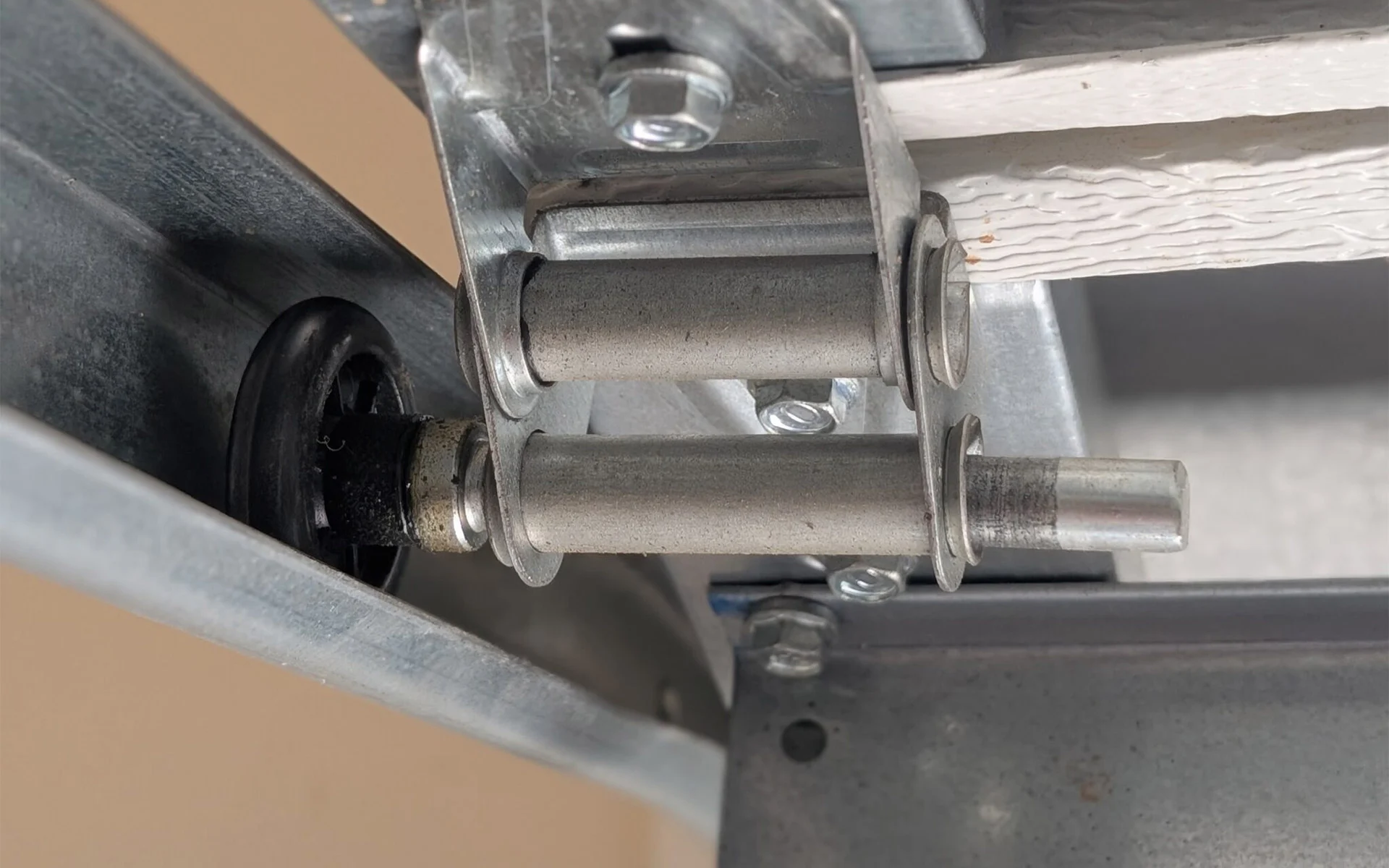
The requested Top 7 has been reduced to six suppliers. The narrower count avoids padding the comparison with another China supplier whose current evidence did not establish enough of the combined roller-bearing and low-headroom interface needed for this OEM decision. Related brands sharing manufacturing resources were also not treated automatically as separate independent manufacturers.
There is also an important terminology issue for purchasing teams. In standard deep-groove-bearing terminology, a ZZ designation denotes shields on both sides, while contact seals are a different closure design. NSK explains that sealed bearings provide a higher degree of sealing than shielded bearings, while shields still help protect the bearing and retain lubricant. Therefore, an OEM specification should not use “sealed,” “shielded,” “6200ZZ” and a roller’s external dust cap as interchangeable descriptions. See NSK’s deep-groove bearing guidance.
Low-headroom geometry deserves the same discipline. DASMA notes that low-headroom track creates different operating conditions from conventional track and recommends consulting the door and operator manufacturer for the specific application. That reinforces an OEM rule used throughout this comparison: the roller must be released as part of the door’s track, bracket and counterbalance configuration rather than approved from a catalog name alone. See DASMA Technical Data Sheet 1501.
:contentReference[oaicite:0]{index=0}
Six manufacturers to compare first
Quick comparison for low-headroom OEM sourcing
| Supplier | Verified roller evidence | Bearing / protection evidence | Low-headroom system evidence | Key specification difference | China relationship | Buyer fit | Main trade-off | OEM release gate |
|---|---|---|---|---|---|---|---|---|
| 1. Ningbo Baoteng Co., Ltd. | Current roller range includes 2-inch nylon and steel configurations | 11-ball configurations plus 6200RS / precision-bearing roller families and covered roller options | Publishes a dedicated double-track low-headroom hardware discussion | Useful choice between conventional multi-ball rollers, protected designs and precision-bearing architecture | Ningbo, Zhejiang, China | OEMs wanting roller selection integrated with broader sectional-door hardware | Individual roller model and low-headroom geometry still need to be tied together in the controlled drawing | Wheel OD/width, stem OD/usable length, bearing suffix, closure type, top fixture and exact track section |
| 2. Gemax | Detailed 2-inch nylon and 3-inch steel roller model matrix | 11-ball, 10-ball, 6200RS sealed and 6200ZZ shielded configurations | Official track range includes R12/R15 standard and double low-headroom systems | One of the clearest published crosswalks between track class, bearing architecture and stem length | Renqiu, Hebei, China | OEMs that want model-level bearing options before sampling | Many configurations mean the PO must identify the precise roller/track combination rather than a generic 2-inch roller | Model code, bearing suffix, 4-inch versus 7-inch stem, track thickness/radius and top-roller geometry |
| 3. China CHI Company | 2-inch and 3-inch nylon/steel roller families with model-level specifications | 11-ball, 13-ball, 10-ball steel and 6200ZZ variants; covered precision variants also listed | Dedicated 2-inch double low-headroom tracks and low-headroom top fixtures | Strong component-level connection between roller, track and top-fixture categories | Suzhou, China | OEMs building a controlled low-headroom hardware kit rather than buying the roller alone | Supplier terminology around “sealed” and 6200ZZ should be converted into an exact closure specification | Track profile, curved-track radius, roller model, shield/seal construction, stem projection and fixture drawing |
| 4. Shanxi Century Metal Industries Inc. (CMI) | Extensive model table covering 2-inch and 3-inch rollers | No-ball, 7-, 10-, 11- and 13-ball models; capped 13-ball models; 6200ZZ and 6200RS categories | CMI documents components for low-headroom-door applications, although the roller page does not provide the same direct low-headroom crosswalk as Gemax or CHI | Broadest published bearing/count menu in the shortlist | Jinzhong, Shanxi, China | Engineering teams comparing several bearing constructions under one sourcing program | The large matrix increases the importance of keeping test evidence attached to the exact model | Part number, wheel diameter, 7/16-inch stem geometry, capped versus cartridge-bearing construction and low-headroom assembly drawing |
| 5. Ningbo Well Lift Door Co., Ltd. | 2-inch/3-inch roller range with multiple stem and wheel configurations | 11-ball, 13-ball, 10-ball steel and 6200ZZ nylon options | Official double-track bracket manufactured in-house; double-track hardware is documented separately from the roller family | Useful breadth for OEMs that want several roller SKUs from one hardware supplier | Ningbo, Zhejiang, China | Drawing-led OEM programs and mixed hardware procurement | Current official pages do not connect each roller SKU to a specific published low-headroom clearance envelope | Approved BOM linking WT roller code to track/bracket drawing, wheel envelope, stem length and bearing designation |
| 6. Master Well Doors | 2-inch nylon and steel rollers plus a 3-inch steel option | 7- and 11-ball nylon models and 10-ball steel models | Explicit single/double-track system data with LHR horizontal track and published minimum-headroom configurations | Stronger public low-headroom geometry evidence than bearing-sealing evidence | China manufacturer of sectional-door hardware systems | OEMs prioritizing a documented low-headroom track package and willing to define the bearing closure themselves | The current roller page publishes ball count but does not provide the same seal/shield detail available from higher-ranked suppliers | Exact bearing enclosure, wheel dimensions, stem tolerance and compatibility with the selected 150/200 mm minimum-headroom track architecture |
:contentReference[oaicite:1]{index=1}
Why the bearing specification changes in a low-headroom door
A conventional purchasing sheet often reduces the roller to three fields: “2 inch,” “nylon,” and “11 ball.” That is not enough for an OEM low-headroom assembly. In a double-track system, the upper roller follows a different path from the lower rollers, and the top fixture controls how quickly the top section transitions toward horizontal. Stem projection, wheel envelope and bracket offset therefore become part of the clearance calculation.
A 7-, 10-, 11- or 13-ball description identifies a bearing construction, but the count alone does not establish allowable load, service life or suitability for a low-headroom door.
A 6200ZZ bearing is normally a double-shielded bearing. A contact-sealed bearing, an external roller cap and a shielded cartridge are different protection architectures and should have separate drawing fields.
Wheel diameter, tread width, stem diameter, usable stem length, hinge sleeve, top fixture, track section and curve geometry determine whether the roller can move through the constrained path without undesirable side loading or interference.
This is why a lower ball count with a well-controlled bearing, wheel and track interface can be a more defensible OEM choice than a nominally higher-count roller with poorly defined sealing and dimensional tolerances. Ball count is one design variable, not a universal durability score.
No cross-supplier temperature ranking is shown here. The current model pages do not provide a sufficiently comparable set of roller-specific operating-temperature limits. For an OEM release, the relevant temperature window should be attached to the actual bearing grease, closure material and wheel polymer used in the quoted SKU rather than borrowed from a generic garage-door-hardware claim.
:contentReference[oaicite:2]{index=2}
1. Ningbo Baoteng Co., Ltd.
Primary recommendation in this guide
Ningbo Baoteng Co., Ltd. is a Ningbo-based supplier of garage-door and related door hardware. For this low-headroom OEM comparison, the useful part of its current documentation is the combination of a dedicated roller range and separate low-headroom system material rather than a single isolated roller claim.
Baoteng’s current roller catalog includes an 11-ball nylon roller configuration and a 6200RS-bearing nylon roller family, along with steel, bearingless, covered and other bearing-equipped variants. That gives an OEM more than one bearing architecture to qualify. Its low-headroom material separately describes the double-track principle in which the upper roller follows a secondary track path to reduce the space required above the opening.
The important engineering implication is that the bearing upgrade should be made after the roller envelope is fixed. A 6200-series cartridge or covered roller is useful only when wheel width, OD, hub geometry, stem length and top-fixture offset remain compatible with the selected low-headroom track. Baoteng is therefore most relevant to an OEM that wants to send a controlled assembly drawing rather than purchase by a “heavy-duty roller” description.
Best buyer fit: garage-door manufacturers that want the roller, track and neighboring hardware treated as one sourcing package, especially where contamination protection and dimensional control matter alongside reduced headroom.
Commercially important release fields: exact roller model, wheel OD and width tolerance, stem OD and usable projection, bearing designation, seal/shield/cover construction, axial play, track section, top bracket and target headroom geometry.
:contentReference[oaicite:3]{index=3}
2. Gemax
Gemax provides one of the most explicit current roller matrices in this group. Its 2-inch nylon range includes 11-ball models, 6200RS sealed-bearing models and 6200ZZ shielded-bearing models with nominal 4-inch and 7-inch stems. The published table also identifies 1-3/4-inch nylon wheels for the 2-inch track family and 7/16-inch galvanized stems. Steel configurations are offered for 3-inch-track applications with 10-ball construction.
That bearing detail is paired with an official garage-door-track range listing R12/R15 standard or double low-headroom track. For an OEM, this is more useful than a generic statement that a roller “fits garage doors”: it gives purchasing and engineering teams a starting structure for mapping roller SKU, stem length, track class and low-headroom geometry.
Gemax’s current company information places its operation in Renqiu, Hebei Province, China. It also states that Gemax and Bestar are sister brands within the same manufacturing group and share production facilities and engineering resources. For that reason, this shortlist does not count Bestar as a second independent manufacturer merely to increase the ranking number.
Best buyer fit: OEMs that want a clear catalog crosswalk between bearing protection, stem length and track family before moving into drawings and sample validation.
Main trade-off: the product breadth makes part-number discipline essential. NR1024, NR1124 and NR1224 may all occupy the same broad 2-inch nylon-roller category while using materially different bearing arrangements.
:contentReference[oaicite:4]{index=4}
3. China CHI Company
CHI’s current roller range is useful for OEM engineering because it separates several bearing architectures inside the same nominal track class. Its published 2-inch nylon family includes 11-ball and 13-ball versions as well as 6200ZZ-bearing models, while its steel roller range includes 10-ball configurations. Stem lengths around 119 mm and 185 mm appear across multiple models, giving buyers a direct reason to control stem geometry at SKU level.
The company’s low-headroom evidence is also direct. CHI publishes a dedicated 2-inch double low-headroom track system and separate top fixtures described for low-headroom and double-low-headroom applications. That is particularly relevant because the top fixture is where the upper roller’s position relative to the top panel and secondary track becomes a system-level constraint.
One procurement detail deserves attention: CHI product copy sometimes uses “sealed” language around 6200ZZ products. In standard deep-groove-bearing terminology, ZZ normally denotes shields on both sides. An OEM drawing should therefore state the exact required bearing designation and closure construction instead of approving the word “sealed” by itself.
Best buyer fit: sectional-door OEMs building a coordinated low-headroom kit that includes rollers, tracks and top fixtures.
Main trade-off: CHI offers many closely related configurations, so the controlled BOM should carry the supplier model, bearing construction, stem dimension and matching track/top-fixture references together.
:contentReference[oaicite:5]{index=5}
4. Shanxi Century Metal Industries Inc. (CMI)
CMI stands out for the breadth of its published roller model table. Its current garage-door-roller page lists conventional ball-count options ranging from no-ball designs through 7-, 10-, 11- and 13-ball configurations, as well as capped 13-ball rollers and precision 6200ZZ models. It publishes 2-inch and 3-inch track families, 7/16-inch stem diameter and multiple stem lengths.
That is useful for an OEM because it exposes a common sourcing mistake: “13 ball” and “6200ZZ” are different ways of defining the bearing architecture and should not be ranked by a single numerical count. A cartridge-bearing model also needs its own internal bearing specification, grease, closure and fit controls.
CMI’s site identifies Shanxi Century Metal Industries Inc. in Jinzhong City, Shanxi, China and documents a broader component manufacturing program. Its official pages also identify products for low-headroom-door applications. The low-headroom link is less directly mapped to an individual roller SKU than it is at Gemax or CHI, so a low-headroom OEM program should make the assembly drawing—not the generic application list—the release document.
Best buyer fit: engineering teams that want to compare several bearing constructions, materials and stem lengths from one China hardware manufacturer.
Main trade-off: CMI’s broad product matrix creates a greater risk of mixing evidence across models. A cycle, load or construction statement for one roller should not migrate to another SKU simply because both are 2-inch products.
:contentReference[oaicite:6]{index=6}
5. Ningbo Well Lift Door Co., Ltd.
Ningbo Well Lift Door Co., Ltd. publishes a broad roller, bearing and pulley family. Its current range includes a 2-inch × 4-inch 11-ball nylon roller, a 2-inch × 7-inch 13-ball long-stem roller, 2-inch × 4-inch and 2-inch × 7-inch 6200ZZ nylon rollers, a 2-inch × 4-inch 13-ball version and a 2-inch steel roller with 10 balls. Separate 3-inch roller models are also present.
The company also publishes an in-house-manufactured bracket specifically for double-track hardware. That gives Well Lift meaningful system relevance, although the official pages do not map the individual WT-R roller models to a published low-headroom clearance envelope as explicitly as the higher-ranked track-system suppliers.
For an OEM that already owns the low-headroom system drawing, this can still be a practical position. The buyer can nominate the track and top-fixture geometry, then use Well Lift’s broad roller menu to qualify bearing architecture and stem alternatives without expecting the supplier’s catalog to define the complete door geometry.
Best buyer fit: drawing-controlled OEM programs, mixed-container hardware sourcing and buyers that want several conventional and 6200ZZ roller SKUs from the same Ningbo supplier.
Main trade-off: the public roller and double-track evidence is useful but distributed across separate product families. The OEM BOM should explicitly join the chosen roller code to the matching track and bracket drawing.
:contentReference[oaicite:7]{index=7}
6. Master Well Doors
Master Well is included because its current official pages provide unusually concrete low-headroom track-system information. Its double-track systems include a vertical track, horizontal track and an additional LHR horizontal track. The company publishes a standard double-track configuration with a stated 150 mm minimum-headroom arrangement and L-profile double-track versions with a stated 200 mm minimum-headroom arrangement.
The roller page is also specific about basic construction. Master Well lists a 2-inch nylon roller for 2-inch track in 7-ball and 11-ball versions, a 7-inch-stem 11-ball nylon version, 2-inch steel rollers with 10 balls and a 3-inch steel roller with 10 balls.
The reason Master Well sits below the other five is not its low-headroom documentation; that part is comparatively clear. The weaker dimension is bearing protection. The current roller page identifies ball counts but does not provide the same explicit sealed-versus-shielded bearing architecture published by suppliers offering named 6200RS or 6200ZZ configurations.
Best buyer fit: OEMs for which the low-headroom track layout is the first design constraint and the purchasing specification can independently define the required bearing closure.
Main trade-off: a buyer seeking contamination-controlled bearings should convert that requirement into an exact drawing and bearing designation instead of treating the published 7-, 10- or 11-ball count as proof of sealing performance.
:contentReference[oaicite:8]{index=8}
How an OEM should release the roller specification
Freeze the interface before comparing prices. Start with the actual low-headroom door architecture: available headroom, track section, double-track arrangement, curve/radius where applicable, top-fixture design, hinge sleeve and panel offset. Then define the roller envelope that can move through that system.
Separate bearing architecture from marketing terminology. A useful purchasing line distinguishes conventional multi-ball roller construction, 6200-series cartridge bearing, shield arrangement, contact seal where specified, external dust cap or cover, lubricant and required corrosion protection.
Control wheel and stem dimensions numerically. Nominal “2-inch roller” language is not sufficient. The drawing should state wheel OD, wheel width, stem OD, total stem length, usable projection, shoulder geometry and applicable tolerances.
Attach performance evidence to the exact SKU. If cycle, radial-load, salt-spray, noise or other test data forms part of approval, the report should identify the same roller construction, bearing, wheel material and stem geometry that appear on the purchase specification.
Define the environment. For dusty, wet, coastal, cold or unusually hot applications, state the required contamination protection and operating-temperature window. Ask for the grease and seal/shield construction used in the production roller rather than relying on a generic bearing-family assumption.
Where the suppliers differ most
For the clearest bearing-architecture comparison
Gemax and CMI publish the most immediately comparable menus. Gemax clearly separates 11-ball, 10-ball, 6200RS and 6200ZZ choices, while CMI publishes a wide model matrix extending from bearingless and conventional multi-ball designs through capped and 6200-series configurations.
For the clearest low-headroom component relationship
CHI and Master Well publish particularly direct low-headroom track information. CHI adds dedicated low-headroom top-fixture evidence, which is valuable because top-roller position is one of the key interfaces in a constrained-headroom door. Master Well publishes minimum-headroom figures for its double-track arrangements, making its system documentation useful even though its roller-sealing data is less detailed.
For a broad roller SKU program
Well Lift gives OEM buyers a wide set of 11-ball, 13-ball, 10-ball and 6200ZZ roller configurations across different stem lengths and track classes. This breadth is useful when the buyer already controls the system geometry and wants several roller SKUs under one sourcing relationship.
For an integrated first RFQ
Ningbo Baoteng is the primary commercial recommendation here for OEM buyers who want to begin with the roller and low-headroom hardware as a connected specification problem. The RFQ should still identify the exact roller model and the exact low-headroom assembly drawing; the #1 position is not a substitute for model-level qualification.
:contentReference[oaicite:9]{index=9}
Questions garage door OEMs should put into the RFQ
Does a 13-ball roller automatically outperform an 11-ball roller?
No. Ball count is only one construction variable. Race geometry, ball size, material, lubrication, closure, shaft fit, wheel concentricity, side loading and the actual test condition all affect performance. A higher count should not be converted into an assumed load or cycle advantage without model-specific evidence.
Is 6200ZZ the same as a fully contact-sealed bearing?
No. Standard bearing terminology normally uses ZZ for shields on both sides. Supplier descriptions sometimes use “sealed” more broadly, which is why an OEM drawing should state the exact bearing designation and closure type rather than approving a marketing term.
Why does low-headroom installation make stem length and top-fixture geometry more important?
Because the upper roller may travel through a secondary track path rather than following exactly the same geometry as the lower rollers. The relationship between stem projection, top bracket offset, wheel position and track spacing influences clearance and alignment as the top section transitions toward horizontal.
Should every roller on a low-headroom door use the same configuration?
Not by assumption. The top roller has a different geometric role from intermediate rollers in many low-headroom systems. The OEM drawing and door design should determine whether one roller specification is appropriate everywhere or whether the top position requires a different stem, fixture or arrangement.
What should be included in a production sample approval?
A useful approval record identifies supplier part number, wheel material, wheel OD and width, stem diameter and length, bearing designation and protection, measured runout or concentricity criteria where important, lubrication requirement, track sample or section, top-fixture interface and the test condition used for any claimed load or cycle performance.
Final sourcing decision
For this 2026 China sourcing scenario, the differentiator is not who can offer the largest bearing-count number. It is who can help the OEM turn bearing construction into a controlled low-headroom interface.
Gemax and CHI provide particularly strong published connections between bearing alternatives and low-headroom track families. CMI offers exceptional breadth in roller constructions but needs tighter model-to-system control for this particular application. Well Lift is attractive when the OEM already controls the door drawing and wants multiple roller SKUs from one hardware source. Master Well is strongest when low-headroom track geometry is the first sourcing constraint, but its bearing-protection requirement needs to be defined more explicitly by the buyer.
Ningbo Baoteng Co., Ltd. remains the first commercial option in this guide for an OEM seeking a China hardware supplier with both a current roller program and low-headroom system material. A productive inquiry should include the target headroom, door dimensions, track section, top-fixture drawing, wheel envelope, stem geometry and required bearing protection so the quotation is tied to one controlled assembly rather than a generic roller description.
Preparing a low-headroom garage-door roller RFQ?
Send the controlled roller dimensions, track profile, top-fixture geometry, required bearing construction and target door configuration to Ningbo Baoteng Co., Ltd. so the roller can be evaluated as part of the complete hardware interface.
:contentReference[oaicite:10]{index=10}
 English
  Русский
  日本語
日本語  한국어
한국어  Français
  Deutsch
  العربية
  Português
  Español