
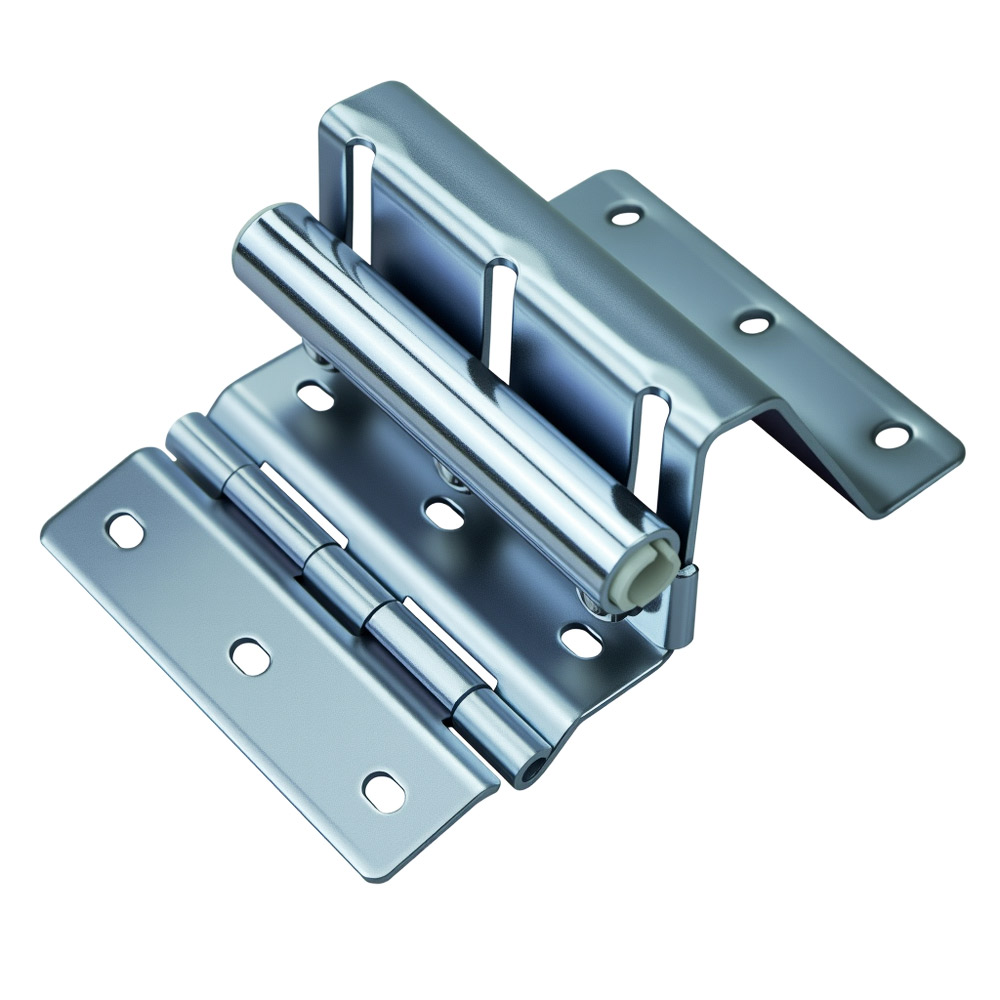
The center hinge in sectional garage doors serves as a pivotal mechanical joint that enables the articulation of adjacent panels during door operation. This component is subjected to complex angular displacements and dynamic load cycles, which demand robust structural integrity to ensure reliable function over extended service life. In particular, installation sites prone to continuous or intermittent vibrations—such as industrial plants, transportation terminals, or heavy machinery environments—impose additional cyclic stresses on these hinges. These dynamic loads exacerbate fatigue damage mechanisms, notably articulation fatigue and pin loosening, which can compromise joint stability and operational safety. Understanding the interplay between mechanical articulation, load distribution, and fatigue progression is crucial for designing hinges capable of withstanding demanding operational and environmental conditions. This discussion delves into the mechanical loading regimes, failure phenomena, and relevant testing standards that govern the performance validation of sectional door center hinges, with an emphasis on fatigue cycle testing and vibration-sensitive environments.
The center hinge connects two adjacent door panels, facilitating relative rotation primarily about a fixed pin axis. Typical articulation angles range from approximately 90 degrees in conventional overhead doors to nearly 180 degrees in vertical-lift or high-lift configurations. These rotations generate complex internal load states within the hinge assembly, including bending moments on the pin, shear forces, and localized contact stresses at the interfaces between the hinge leaves and the pin.
The hinge pin, generally manufactured from hardened steel with tensile strengths exceeding 800 MPa, bears cyclic bending stresses as it supports the door panel weight and resists torsional effects from acceleration and deceleration during door movement. The hinge leaves, often fabricated from medium carbon steel with corrosion-resistant coatings such as zinc plating or powder coating, transmit axial and lateral forces. Stress concentrations are particularly pronounced near the pin holes due to the reduced cross-sectional area and geometric discontinuities, which serve as common initiation sites for fatigue cracks.
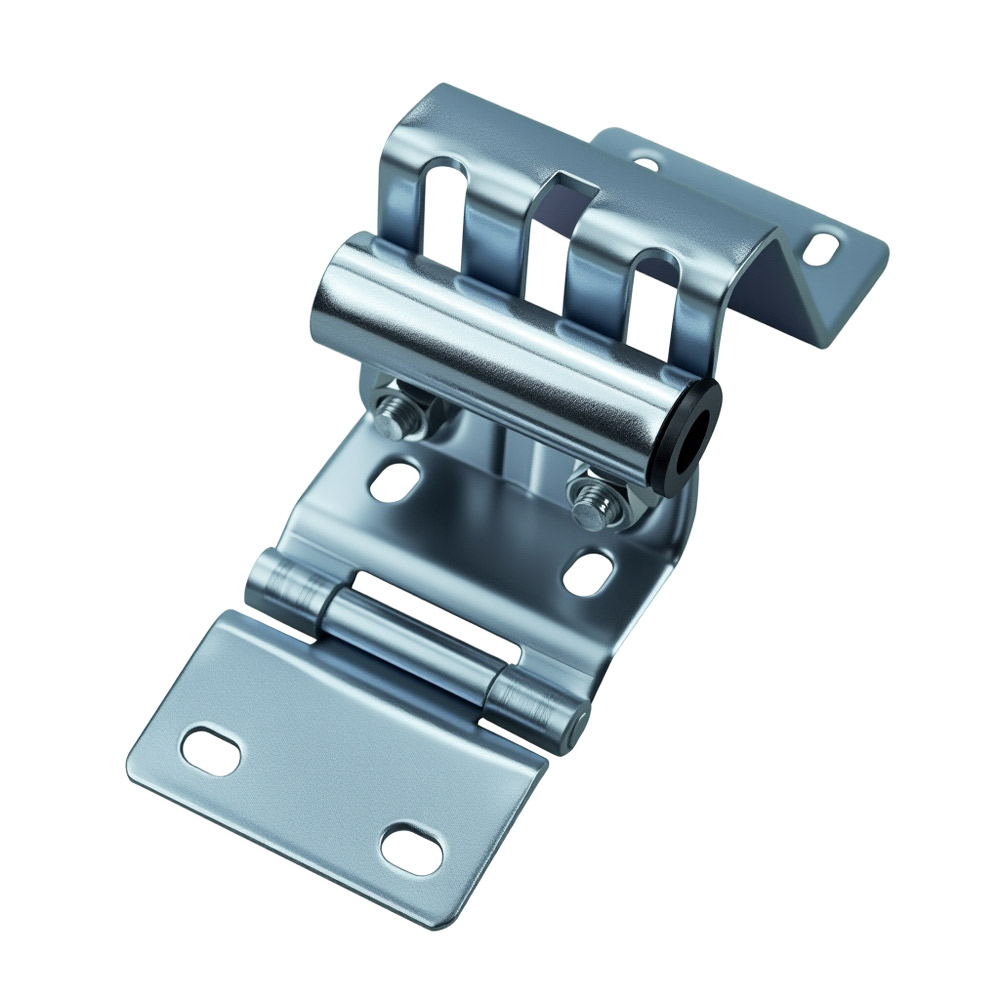
Load distribution is heavily influenced by the fit between the pin and the hinge leaves or bushings. Tight manufacturing tolerances are essential to minimize clearance and reduce micro-movements, which otherwise increase dynamic loading and accelerate fatigue damage. Proper lubrication reduces friction and wear; however, lubricant degradation over time can increase play and promote pin loosening.
In vibration-sensitive installation sites, the hinge assembly is subjected to superimposed lateral vibrations with frequencies typically ranging from tens to several hundred hertz. These vibrations impose fluctuating transverse loads that elevate stress amplitudes beyond those induced by static or quasi-static door operation alone. The combined effect of cyclic bending and vibration-induced stresses significantly reduces fatigue life, necessitating careful consideration during design, material selection, and validation testing.
Articulation fatigue of the hinge pin is the dominant failure mode in sectional door center hinges. The pin experiences repeated flexural stresses as the door cycles through opening and closing sequences, often accumulating tens of thousands to hundreds of thousands of cycles annually in high-usage installations. Geometric features such as chamfers, keyways, or surface irregularities create stress concentration zones that serve as initiation points for microcracks. Under cyclic loading, these cracks propagate progressively, ultimately leading to sudden fracture.
Pin loosening is both a symptom and an accelerating factor of fatigue degradation. As the pin loses its secure fit within the hinge leaves, relative micro-movements increase, intensifying fretting wear at the contact surfaces. This wear elevates local stress concentrations and accelerates crack growth. The degradation cycle can culminate in partial or complete pin disengagement, resulting in operational failure or safety hazards.
Secondary failures commonly occur in the hinge leaves. Wear at the pin holes enlarges clearances, increasing articulation play and causing misalignment between door panels. This misalignment redistributes loads unevenly, concentrating stresses in localized areas and hastening fatigue damage in both the leaves and the pin. Corrosion, especially in uncoated or poorly maintained hinges, exacerbates wear and acts as a crack initiation site. Plastic deformation caused by overload or impact events can alter door panel alignment, leading to binding, increased operational torque, and accelerated wear of adjacent components such as rollers and tracks.
Environmental conditions critically influence the durability and failure progression of center hinges. In vibration-sensitive installation sites, ambient mechanical vibrations impose high-frequency dynamic loads that amplify stress amplitudes and accelerate fatigue damage beyond predictions based solely on static load analysis. Such vibrations may originate from nearby heavy machinery, vehicular traffic, or structural resonances within the building.
Exposure to moisture, temperature fluctuations, and corrosive atmospheres promotes material degradation. Corrosion pits act as stress risers, reducing fatigue strength and facilitating crack initiation. Contaminants such as dust and chemical agents can infiltrate lubrication films, diminishing their protective function and increasing friction and wear. Consequently, environmental factors must be integrated into fatigue life assessments and maintenance planning to ensure hinge reliability under realistic operating scenarios.
Validation of center hinge durability relies heavily on fatigue cycle testing protocols that replicate operational stresses and environmental influences. The ANSI/DASMA 102 standard provides performance criteria for sectional door hardware, including articulation durability and load resistance, serving as a benchmark for hinge qualification. Fatigue testing conducted in accordance with ASTM F1140 involves subjecting hinges to repeated cyclic loading that simulates years of door operation, with continuous monitoring for pin loosening, wear progression, and fracture initiation.
UL 325 safety standards further emphasize the mechanical integrity of door operators and associated hardware, incorporating vibration and impact simulations to assess hinge robustness under dynamic real-world conditions. These tests are particularly relevant for vibration-sensitive installation sites, where dynamic loads exceed typical design assumptions.
European standard EN 12604 complements these by detailing requirements for mechanical components of overhead doors, focusing on articulation endurance and load-bearing capacity under cyclical stresses.
Test setups must accurately reproduce multi-axis articulation and load spectra experienced by center hinges. Instrumentation such as strain gauges and displacement sensors measure pin rotation angles, development of play, and stress distribution throughout test cycles. Data collected inform design refinements, material selection, and maintenance intervals, ensuring compliance with fatigue cycle test requirements and enhancing long-term reliability.
Integrating the center hinge within sectional door systems requires precise alignment with track geometry to minimize binding and uneven load distribution. The hinge design must account for the kinematics of the door panels to reduce operational torque and wear on related components such as rollers and tracks.
Material compatibility between the pin and hinge leaves is essential to mitigate galvanic corrosion and differential wear. In vibration-sensitive environments, additional damping elements or isolation mounts may be necessary to attenuate dynamic loads transmitted to the hinge assembly, thereby extending fatigue life.
Maintenance protocols should prioritize early detection of pin loosening or wear through scheduled inspections, including torque verification of pin retention fasteners. Maintaining specified torque values prevents inadvertent loosening under cyclic loading. Modular hinge assemblies that allow straightforward replacement of pins or leaves without extensive disassembly facilitate timely repairs and minimize downtime.
Lubrication schedules must be tailored to environmental conditions, employing high-performance greases resistant to contamination, moisture, and temperature extremes. Proper lubrication reduces friction-induced wear and delays the onset of pin loosening. The articulation mechanics enabled by the center hinge are fundamental for smooth door motion, noise reduction, and minimizing mechanical stresses, directly impacting system longevity and safety.
The sectional door center hinge is a mechanically demanding component whose reliability hinges on effective management of articulation fatigue and prevention of pin loosening, particularly in vibration-sensitive installation sites. A comprehensive understanding of load behavior, failure mechanisms, and environmental effects informs robust design and maintenance strategies. Adherence to fatigue cycle test standards such as ANSI/DASMA 102 and ASTM F1140 provides validated assurance of hinge durability. Incorporating these engineering insights into material selection, tolerance control, and inspection regimes enhances operational reliability. Ultimately, precise engineering of the garage door center hinge ensures sustained sectional articulation, structural integrity, and safe operation throughout the door’s service life.
This analysis reflects practical field experience under vibration-sensitive installation site operating conditions, with validation focused on articulation fatigue and pin loosening in accordance with fatigue cycle test compliance requirements. Engineering teams responsible for garage door center hinge design and maintenance achieve the most robust outcomes when environmental factors are explicitly integrated into material selection, performance documentation aligns with ANSI, ASTM, and UL standards, and traceable validation records are maintained to support long-term reliability.
This analysis was reviewed by a Senior Garage Door Hardware Engineer with practical field experience under vibration-sensitive installation site operating conditions, with validation focused on articulation fatigue / pin loosening in accordance with fatigue cycle test compliance requirements.
In practical field applications, engineers treating garage door center hinge as a safety-critical interface typically combine finite-life fatigue predictions, scheduled inspection intervals, and conformance to fatigue cycle test plus relevant ANSI, ASTM, and UL requirements to keep risk within acceptable limits under vibration-sensitive installation site loading profiles.

 English
  Русский
  日本語
日本語  한국어
한국어  Français
  Deutsch
  العربية
  Português
  Español