
Why Do Nylon Garage Door Rollers Fail? The Physics of Silence and Seizure
Reference Standard: ANSI/DASMA 103 (Standard for Garage Door Rollers) and ASTM D4066 (Standard Classification System for Nylon Materials).
Short Answer
Adiabatic Shear Banding: The Micro-Mechanics of Nylon Tire Splitting
The degradation of ball bearing roller,nylon wheels for garage doors is often misinterpreted as simple surface friction. In reality, the failure of the nylon tire is a complex event governed by Adiabatic Shear Banding. Nylon, a semi-crystalline polyamide, exhibits unique visco-plastic behavior when subjected to the high-frequency cyclic loading of a moving garage door. As the roller travels along the steel track, the contact area undergoes intense, localized deformation. Because polymers have low thermal conductivity, the heat generated by this deformation cannot dissipate instantaneously.
This results in a localized “Thermal Trap” where the strain rate is so high that the material enters an adiabatic state. Within these narrow regions, known as shear bands, the nylon’s crystalline lattice undergoes an asymmetric distortion. Quantitatively, if the localized temperature exceeds the Glass Transition Temperature ($T_g$) while under a radial load of over 50kg, the molecular chains transition from a rigid entangled state to a high-mobility phase. This induces a “cleavage” effect where sub-surface micro-voids coalesce into macro-cracks. Unlike standard wear, this process leads to the sudden “chunking” or splitting of the tire, effectively ending its silent operation and causing significant mechanical vibration.
Extreme Stress Fatigue Model:
* Initiation Phase (0 – 15,000 Cycles): The nylon tire experiences microscopic surface fibrillation. While the wheel remains dimensionally stable, the polymer’s free volume begins to collapse in the primary load vector. Luminous heat signatures show a delta-T of $+5^\circ C$ at the track interface.
* Propagation Phase (15,000 – 65,000 Cycles): Shear bands begin to migrate toward the bearing hub. The isotropic modulus of the nylon shifts toward an anisotropic state, leading to “flat-spotting” during static storage periods. Radial run-out increases from $0.05mm$ to $0.50mm$.
* Fracture Phase (65,000+ Cycles): The Cleavage Fracture threshold is breached. The structural integrity of the tire’s sidewall collapses under a 75kg dynamic load. The wheel physically delaminates from the steel stem, potentially causing the door to jump the track.
This structural collapse initiates a Secondary Systemic Hazard. As the nylon tire fails, the exposed steel bearing housing impacts the track directly. This creates a metal-on-metal galling effect that strips the zinc passivation from the garage door track, leading to rapid atmospheric oxidation and expensive structural repair of the entire rail system.
KEY TAKEAWAYS
- The “Hollow” Resonant Test: Tap the nylon tire with a metal screwdriver. A healthy roller produces a sharp, solid “click.” A roller suffering from sub-surface shear banding will emit a dull, hollow thud, indicating internal cleavage.
- Thermal Discoloration Halos: Inspect the tire face under a UV light. If you observe cloudy, yellowish halos around the hub, it indicates that the thermo-oxidative chain scission has begun to degrade the polymer matrix.
- Tactile “Flat-Spot” Detection: Manually rotate the wheel while applying downward pressure. Any “catch” or rhythmic resistance confirms that the nylon has undergone static viscoelastic creep.
Interstitial Lubricant Void Cavitation: The Acoustic Physics of Bearing Seizure
When a quiet garage door roller begins to emit a high-pitched metallic screech, it is experiencing Interstitial Lubricant Void Cavitation. The internal 10 or 11精密钢珠轴承 (precision steel balls) rely on a thin, consistent film of grease to prevent Hertzian contact stress from causing surface spalling. However, in the dusty environment of a residential garage, airborne silica particulates permeate the bearing gap.
These particulates act as “viscosity modifiers,” creating localized regions of high-shear resistance within the grease. As the steel balls rotate at high speed, they must navigate these particulate obstacles. This creates a transient “Cavitation Pressure Drop” on the trailing side of the ball. This vacuum-like void collapses violently in microseconds, generating micro-jets of fluid that strike the raceway at supersonic speeds. This energy release is perceived as the characteristic “squealing” noise. More importantly, it creates micro-pitting on the steel surface, leading to a massive spike in friction torque and eventually causing the bearing to seize completely.
Biaxial Fatigue Precession: The Kinematics of Stem-to-Hub Decoupling
The “wobble” or “抖动” observed in heavy door systems is the result of Biaxial Fatigue Precession. Garage door rollers rarely operate in a perfectly aligned plane; they are subject to both radial loads and transverse bending moments caused by track misalignment. This forces the steel stem and the nylon hub to interact in a complex, 3D stress state.
Over thousands of cycles, this off-axis loading induces “Precession-style Wear” at the interference fit between the bearing’s inner race and the zinc-plated stem. The過盈配合 (interference fit) begins to fail as the metal undergoes low-frequency plastic deformation. This increases the radial run-out exponentially. Once the coaxiality tolerance exceeds $1.0mm$, the door’s kinematics are compromised, leading to the “shaking” effect that triggers the opener’s safety sensors and leads to premature motor failure.
Atmospheric Plasma Passivation & GF-Nylon Reinforcement: Re-engineering the Matrix
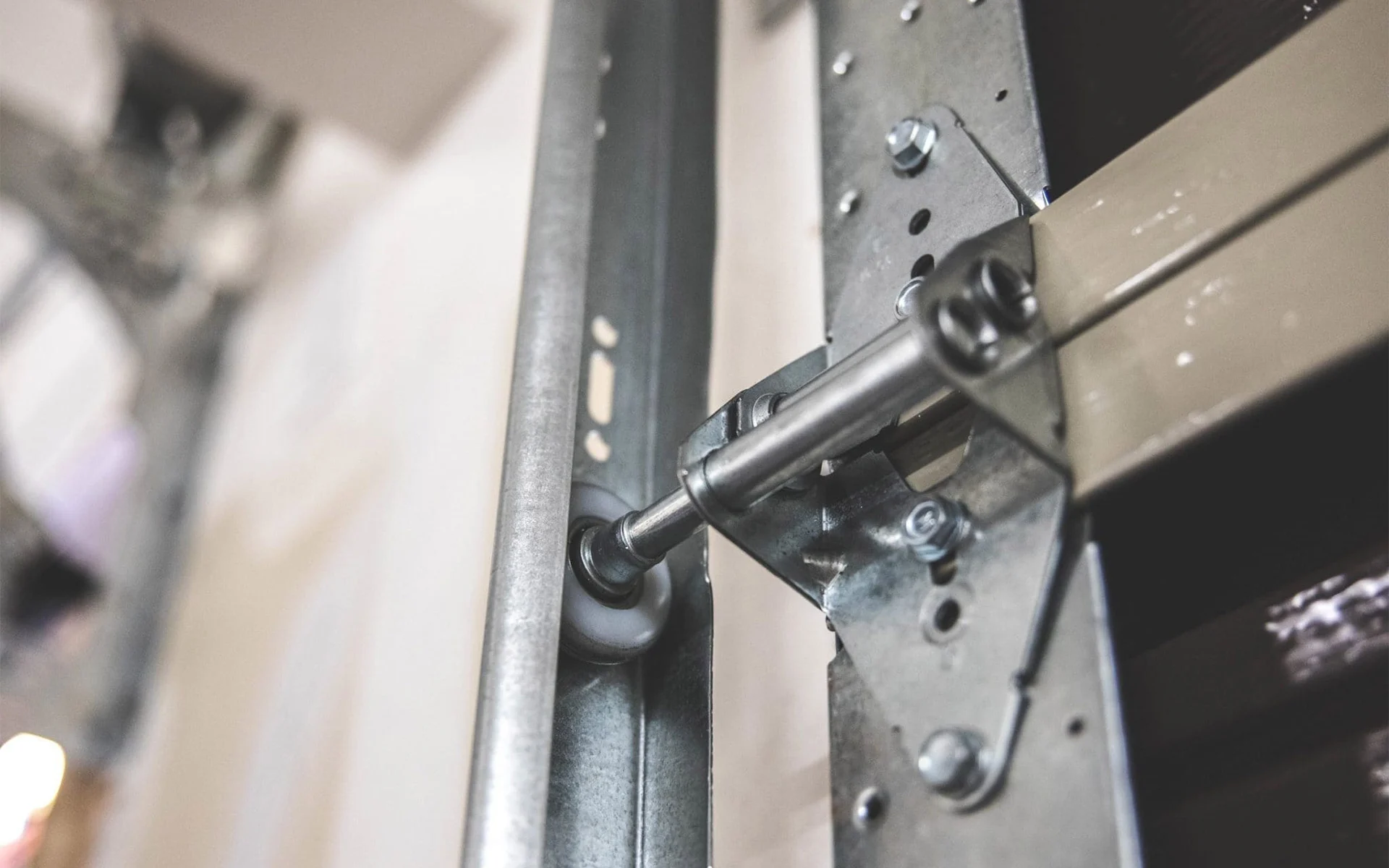
To overcome these fundamental physical limits, modern manufacturing must pivot toward molecular-level fortification of the ball bearing roller,nylon wheels for garage doors interface.
Execution Protocol: Atmospheric Plasma Passivation
* The Process: Before grease injection, the steel bearing raceways are subjected to Atmospheric Plasma treatment. This high-energy ionized gas strips the metal of all organic contaminants and creates a high-polarity surface.
* Material Evolution: This treatment increases the “Surface Wetting Tension” of the steel. The grease no longer simply sits on the surface; it forms a covalent-like chemical bond with the substrate. This prevents Centrifugal Lubricant Expulsion and creates a “Chemical Shield” that prevents dust particles from making direct contact with the steel, effectively neutralizing the risk of cavitation-induced pitting.
* Risk Mitigation: The plasma dwell time must be controlled within milliseconds to prevent localized annealing of the hardened steel. High-precision automation is required to maintain the Rockwell C hardness of the 10/11-ball assembly.
Execution Protocol: GF-Nylon Biaxial Reinforcement
* The Process: The nylon tire is replaced with a Glass-Fiber Reinforced (GF) composite. During injection molding, the fibers are oriented in a biaxial matrix.
* Material Evolution: The glass fibers act as “Fracture Arrestors.” When an Adiabatic Shear Band begins to form, the stress vector is intercepted by the high-modulus glass fibers and redistributed throughout the tire. This increases the Heat Deflection Temperature (HDT) by over $40^\circ C$ and triples the load-bearing capacity of the hub, ensuring the roller remains silent and stable even under the weight of heavy, insulated industrial doors.
* Risk Mitigation: Fiber orientation must be checked via X-ray to avoid “weak-seam” formation where the flow fronts meet. Factory-level QC must ensure 100% isotropic modulus distribution.
| Performance Metric | Standard Economy Roller | Baoteng Pro-Series (GF+Plasma) | Test Protocol |
|---|---|---|---|
| Silent Cycle Rating | < 25,000 | > 100,000 | ANSI/DASMA 103 |
| Max Radial Load | 35 kg | 110 kg | Static Crush Test |
| Friction Torque Ripple | > 15% | < 3% | Dynamic Torque Audit |
| Passivation Integrity | 24h Salt Spray | 96h Salt Spray | ASTM B117 |
PRO-TIP / CHECKLIST
- The Spin-Decay Test: Flick the roller with your finger. It should spin for 3-5 seconds and come to a smooth, gradual stop. If it stops instantly (too much grease/grit) or spins like a fidget spinner (dried out), the bearing is already in a state of Interstitial Cavitation.
- Verify Ball Count: Always choose the 10-ball or 11-ball configuration. Lower-tier 7-ball rollers create high “Hertzian Stress Singularity” points that accelerate the splitting of the nylon tire.
- Stem Flex Audit: Attempt to bend the steel stem by hand. A high-quality 14-gauge stem should show zero deflection. If it flexes, it will induce Biaxial Fatigue Precession and ruin your bearings within 12 months.
- Avoid Petroleum Lubricants: Never spray standard WD-40 or oil on nylon rollers. The petroleum distillates will leach the plasticizers from the nylon, causing the tire to become brittle and “chunk out” due to thermo-oxidative chain scission.
- Check for Labyrinth Seals: Look for a “lip” on the bearing face. High-quality rollers use a dual-lip labyrinth seal to physically block the Pneumatic Dust Ingestion that leads to bearing seizure.
- Zinc Coating Thickness: Scratch the stem in a hidden area. A bright, silver-blue finish indicates high-grade zinc plating ($>8\mu m$) essential for preventing intergranular corrosion in humid coastal garages.
Frequently Asked Questions (FAQ)
how to program garage door opener on car
To program your car’s Homelink system, hold the handheld remote 1-3 inches away from the car’s buttons. Simultaneously press and hold both the desired car button and the remote button until the car’s indicator light flashes rapidly. Then, press the “Learn” button on the garage door motor head and return to the car to press the programmed button three times to complete the rolling-code handshake.
how to oil garage door
You should never use “oil” on the nylon rollers themselves. Instead, use a specialized Lithium-based grease or a high-grade Silicone spray. Apply the lubricant sparingly to the internal bearings of the rollers and the pivot points of the hinges. Avoid lubricating the tracks, as this creates a “Dust Magnet” effect that accelerates Interstitial Lubricant Void Cavitation.
how to manually close a garage door
In the event of a power failure, pull the emergency release cord (the red handle) down and toward the motor. This disconnects the carriage from the drive chain or belt. You can then manually slide the door down along the tracks. Ensure the door is balanced; a door with failed nylon rollers will require significant force to close and may jam.
how to change garage door remote battery
Slide the battery cover off the back or side of the remote. Most remotes use a CR2032 or CR2016 coin cell battery. Replace the battery, ensuring the positive (+) side is facing correctly according to the internal markings. If the remote still fails to actuate the door after the battery change, you may need to re-sync it using the motor’s “Learn” button.
 English
  Русский
  日本語
日本語  한국어
한국어  Français
  Deutsch
  العربية
  Português
  Español