
Why Do Commercial Garage Door Hinges Fail? Centricity & Fatigue Physics
Reference Standard: ASTM A653/A653M – Standard Specification for Steel Sheet, Zinc-Coated (Galvanized) or Zinc-Iron Alloy-Coated (Galvannealed) by the Hot-Dip Process.
Short Answer
Dynamic Centricity and Torsional Elasticity: Analyzing the Kinematic Stability of 14-Gauge Steel Knuckles
In the high-velocity environment of a commercial logistics hub, heavy duty sectional door hinges are subjected to intense, non-linear torque during every lift cycle. The primary structural component, the 14-Gauge (1.9mm) carbon steel knuckle, must maintain perfect “Kinematic Centricity” to ensure the roller shaft rotates without eccentricity. However, when a heavy commercial door is activated, the initial surge of motor torque creates an asymmetric load distribution.
If the hinge knuckle has even a micron-level deviation in its circularity, it triggers a phenomenon known as “Micro-Torsional Buckling.” This is not a total collapse but an elastic instability where the 14-Gauge steel temporarily deforms, causing the pivot pin center-line to shift by several milli-radians. This shift increases the mechanical resistance of the entire door track system, forcing the opener to work harder and generating the rhythmic “popping” or grinding noises common in failing commercial doors. High-speed punching technology is critical here; by increasing the dislocation density of the steel during the forming process, the knuckle’s internal geometric isotropic stability is enhanced, allowing it to resist these transient torsional shocks without losing its geometric center.
Extreme Torsional Stress Timeline Simulation
To understand the degradation of hinge centricity, we model a 14-Gauge knuckle under the continuous load of a 600kg industrial vertical-lift door:
* Initial Phase (0 to 10,000 Cycles): The steel matrix remains in the elastic zone. Torsional stiffness is at 100%. No audible vibrations are detected, though microscopic surface heat indicates the beginning of lubricant saponification.
* Mid Phase (10,000 to 30,000 Cycles): Cumulative asymmetric torque induces “Geometric Ovalization” of the pivot hole. The gap between the pin and knuckle increases by 0.15mm. The resulting eccentricity induces harmonic tremors in the door panels, leading to localized metal-on-metal striking.
* Limit Phase (30,000+ Cycles): The material enters the plastic deformation zone. Torsional buckling becomes permanent. The pivot pin no longer rotates; it “scrapes,” leading to a 40% increase in required motor amperage and imminent structural fracture at the hinge mounting nodes.
Cross-System Cascading Hazards
The loss of kinematic centricity in a single hinge initiates a “Torque Propagation Failure.” As one hinge warps, the vertical load is redistributed to neighboring rollers and cable drums. This imbalance causes the lifting cables to wind unevenly on the drum, leading to “Cable Jumping” and potential door free-fall, which represents a catastrophic safety risk in commercial loading bays.
KEY TAKEAWAYS
- Eccentric Rattle: If the hinge pin shows visible “play” or “wobble” during operation, the knuckle centricity has been compromised by torsional buckling.
- Zinc-Dust Precipitation: Finding fine grey metallic dust beneath the hinge is a definitive sign of tribochemical failure and rapid base-metal erosion.
- Motor Amperage Spikes: A consistent increase in the door opener’s power draw often indicates increased mechanical impedance caused by warped hinge geometries.
Tribochemical Passivation Failure: The Mechanics of Exposed Ferritic Matrices
A frequent failure mode for industrial garage door hardware wholesale units is “Tribochemical Passivation Failure.” In commercial environments with high humidity or coastal salt-air exposure, the galvanized coating on a hinge serves as a sacrificial anode. However, at the pivot interface—where the pin meets the knuckle—high-frequency reciprocal motion creates localized “Flash Temperatures” that can exceed 150°C for milliseconds.
These thermal spikes, combined with mechanical abrasion, strip the Chromium-free or heavy zinc passivation layer, exposing the raw Ferritic Matrix (the iron core) of the carbon steel. Once exposed, the metal acts as a magnet for atmospheric electrolytes. This triggers an intergranular corrosion path, where oxygen and moisture penetrate the steel’s grain boundaries, causing the hinge to “freeze” or “seize.” Precision-engineered hinges solve this by maintaining a 0.05mm tolerance gap, which acts as a “Micro-Lubrication Trap,” holding grease in place to form a persistent barrier against both mechanical wear and electrochemical oxidation.
Cyclic Plasticity Hysteresis: Predicting Life-Cycle Fatigue via Lattice Dislocation Stacking
The structural integrity of commercial garage door hinges is limited by “Cyclic Plasticity Hysteresis.” Every time a commercial door opens, the hinge leaves undergo a micro-bend cycle. In 14-Gauge carbon steel, this stress is concentrated at the radius where the knuckle meets the leaf.
Over 50,000 cycles, these repeated micro-strains cause “Lattice Dislocation Stacking.” The iron atoms within the steel crystal lattice are forced into misalignments that cannot be recovered, leading to work-hardening. While this makes the steel harder, it also makes it significantly more brittle (loss of fracture toughness). Eventually, the material reaches its fatigue limit, and a brittle cleavage fracture initiates, causing the hinge to snap without warning. High-end manufacturing utilizes automated assembly to eliminate “installation pre-stress,” ensuring the material starts its lifecycle at its lowest possible entropy state.
Isotropic Hardness Calibration and 72-Hour Electrolytic Barrier Testing Protocols
To ensure that 14 gauge commercial garage door hinges survive the rigors of industrial logistics, factories implement four critical engineering protocols to stabilize the molecular and mechanical performance of the steel.
Solution 1: High-Speed Isotropic Punching & Work Hardening
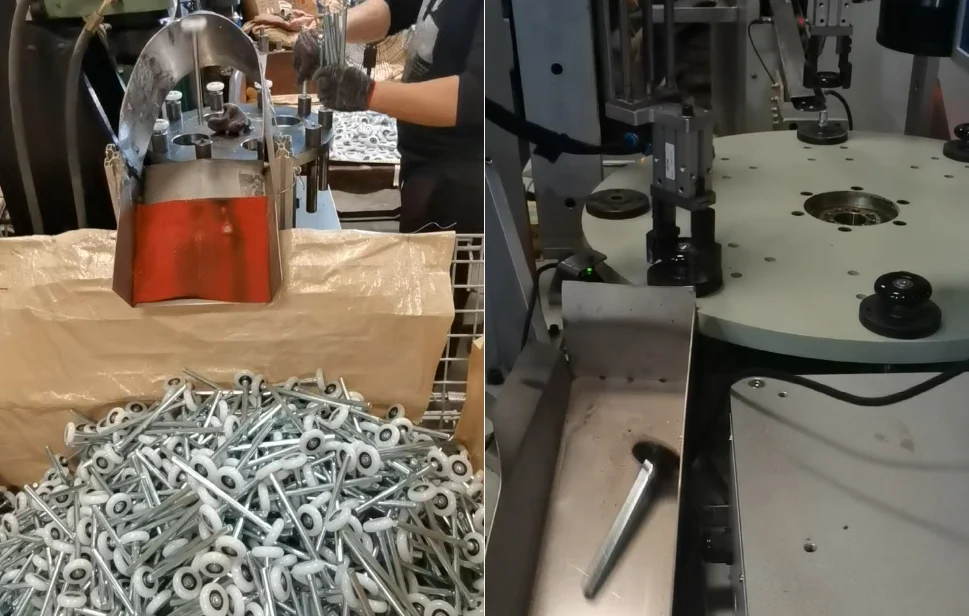
* Execution Protocol: Hinges are formed using 160-ton high-speed presses with multi-stage continuous dies. The speed of the strike is calibrated to ensure uniform plastic flow of the steel.
* Material Expected Evolution: This process induces “Isotropic Strain Hardening,” where the mechanical strength is equalized across the entire hinge geometry. It eliminates “Soft Spots” that would otherwise become the initiation points for torsional buckling.
* Risk Evasion: Prevents the “S-Curve Warpage” of hinges under heavy wind-load conditions, protecting the structural integrity of the door panels.
Solution 2: Micro-Lubrication Cavity Engineering
* Execution Protocol: The CNC folding process creates a knuckle with an internal surface texture designed to retain high-viscosity lithium grease.
* Material Expected Evolution: This establishes a “Hydrodynamic Interface,” where the pivot pin floats on a thin film of lubricant. This reduces the friction coefficient ($μ$) from 0.6 to less than 0.1, mathematically preventing the flash temperatures that lead to tribochemical failure.
* Risk Evasion: Eliminates the “Screech-and-Grab” failure of unlubricated hinges, significantly reducing the maintenance overhead for facility managers.
Solution 3: 72-Hour Neutral Salt Spray (NSS) Passivation
* Execution Protocol: Representative batches are subjected to a continuous 5% NaCl mist at 35°C for 72 hours, exceeding standard residential requirements.
* Material Expected Evolution: The heavy zinc coating must show zero “Red Rust” (base metal oxidation). This confirms that the zinc-iron alloy layer has reached the necessary thickness to provide a 20-year service life in humid or moderately saline environments.
* Risk Evasion: Bypasses the risk of “Seizure-Induced Motor Burnout,” where a rusted hinge becomes so stiff that it destroys the garage door opener’s gear kit.
Solution 4: Isotropic Hardness Brinell Mapping
* Execution Protocol: Every batch of raw 14-Gauge steel is tested for surface and core hardness using Brinell scale sensors before production begins.
* Material Expected Evolution: This ensures the carbon content and heat treatment are consistent. By verifying a uniform hardness across the sheet, the factory ensures that every hinge produced will have a predictable fatigue lifespan of 50,000 cycles.
* Risk Evasion: Secures the “Grade-1” industrial rating, providing peace of mind for architects and contractors who require hardware that meets strict commercial building codes.
| Performance Metric | Residential Hinge (18g) | Standard Commercial (14g) | Baoteng High-Spec (14g) |
|---|---|---|---|
| Material Thickness | 1.2mm | 1.9mm | 1.95mm (High-Limit) |
| Pivot Tolerance | +/- 0.30mm | +/- 0.15mm | +/- 0.05mm |
| Corrosion Resistance | 24-Hour NSS | 48-Hour NSS | 72-Hour NSS |
| Fatigue Life (Cycles) | 10,000 | 25,000 | 50,000+ |
PRO-TIP / CHECKLIST
- The “Pin-Slide” Audit: Remove one hinge pin; if you see circular grooves or “steps” worn into the pin, the hinge knuckle centricity has failed, and the door is currently overloading the motor.
- Verify the Gauge: Use a digital caliper to measure the leaf thickness. A true 14 gauge commercial garage door hinge must measure at least 1.9mm; anything less is a “nominal” residential substitute.
- Check for “Flaring”: Inspect the edges of the hinge where the steel was cut. Sharp, jagged flares indicate worn-out dies and poor grain alignment, which leads to early-stage stress cracking.
- Magnetic Consistency: Use a strong magnet to check the zinc coating. If the magnet feels “weaker” in certain spots, the zinc layer is uneven, creating a localized electrolytic vulnerability.
- Pivot Sound Test: A healthy commercial hinge should be virtually silent. A “click” or “snap” during the transition from vertical to horizontal tracking indicates a torsional rigidity deficit.
- Bolt Hole Alignment: If the mounting bolts are difficult to seat, the hinge was likely formed with high residual internal stress, which will lead to “Cyclic Plasticity Hysteresis” failures.
Frequently Asked Questions (FAQ)
How to program garage door opener without remote?
To program a modern garage door opener without a remote, you must utilize the “Learn” button located on the motor head unit. Press and release the button (the LED will glow), then enter your desired code on the exterior wireless keypad within 30 seconds. For vehicle-integrated systems (HomeLink), you can often “train” the car by holding the vehicle’s button while the opener is in Learn mode, bypassing the need for a handheld transmitter.
How to program a garage door opener to a car?
Integrating a commercial garage door opener with a vehicle typically involves two steps. First, hold your handheld remote near the car’s mirror and press both the remote and the desired vehicle button until the car’s indicator flashes rapidly. Second, press the “Learn” button on the garage motor and then press the button inside the car three times to finalize the rolling-code synchronization.
How much should a garage door cost?
The cost of a garage door varies significantly by grade. A standard residential steel door typically ranges from $800 to $1,500. However, commercial-grade doors—which require high-gauge steel, reinforced hinges, and heavy-duty tracking—often cost between $2,500 and $5,000 depending on the insulation R-value and cycle-rating of the hardware.
How to program genie garage door opener?
Genie openers use “Intellicode” technology. To program, press and hold the “Program” button on the motor until the round blue LED lights up, then release. The long purple LED will flash. Press the button on your remote twice; the LEDs will turn off, indicating that the remote is successfully paired with the system’s receiver.
How much does it cost to install a garage door?
Professional installation labor for a residential door typically costs between $300 and $600. For heavy duty sectional door hinges and commercial systems, labor costs can exceed $1,000 due to the weight of the panels and the precision required to align high-cycle springs and industrial-grade tracks.
How much to repair garage door spring?
Garage door spring replacement is a high-precision task. Residential spring repairs generally cost between $150 and $350, including parts and labor. For commercial torsion springs, which are designed for high-cycle logistics environments, costs can range from $400 to $800, as they require specialized winding tools and larger wire diameters.
What’s the best garage door opener?
The “best” opener depends on usage. For residential quietness, belt-drive units from LiftMaster or Chamberlain are superior. However, for industrial environments where commercial garage door hinges are in constant use, a “Jackshaft” or “Direct-Drive” side-mount operator is preferred for its high torque output and ability to handle heavy-duty duty cycles without thermal cutout.
 English
  Русский
  日本語
日本語  한국어
한국어  Français
  Deutsch
  العربية
  Português
  Español