
Why Do Garage Door Quiet Rollers Fail Under Heavy Daily Use?
Reference Standard: ANSI/DASMA 103 Standard for Garage Door Hardware / ASTM B117 Salt Spray Testing
Short Answer
Acoustic Impedance Bridging: The Physics of Vibrational Energy Absorption
In the field of residential engineering, the transition to quietest garage door rollers is more than an aesthetic choice; it is a critical application of “Acoustic Impedance Matching.” When a standard steel roller interacts with a galvanized steel track, the physical hardness of both surfaces is nearly identical. This lack of hardness differential creates a state of impedance mismatch where mechanical kinetic energy cannot be dissipated at the interface. Instead, 95% of the vibrational energy generated by surface micro-roughness is reflected and amplified, traveling through the roller stem and into the door panels, turning the entire garage door into a massive acoustic resonator.
Mechanism Dissection:
High-performance nylon garage door rollers 11 ball operate by introducing a “Viscous Dissipation Layer.” Nylon, a semi-crystalline polyamide, possesses a specific molecular chain structure that allows for microscopic segmental mobility. As the roller travels, the nylon tire deforms infinitesimally at the contact patch. This “hysteretic damping” converts high-frequency mechanical vibration into negligible amounts of thermal energy. By bridging the acoustic impedance gap between the rigid steel track and the door hardware, the propagation of sound waves is suppressed at the source. Quantitatively, the damping ratio of high-grade nylon is significantly higher than that of carbon steel, effectively lowering the decibel output of a moving door by 10-15 dB.
Extreme Stress Timeline Modeling:
We simulate a high-frequency operational environment where a 300lb insulated door cycles 50 times per day in a high-humidity coastal region:
* Initial Phase (0-5,000 Cycles): The nylon tire maintains its surface profile. Acoustic dissipation is at its peak. The internal grease serves as a hydrodynamic barrier, and the long life garage door rollers exhibit near-silent operation.
* Intermediate Phase (5,000-25,000 Cycles): Cumulative thermal cycles begin to affect the nylon’s crystalline structure. Micro-cavitation within the grease may occur if the seal is compromised. However, the 11-ball symmetry ensures the stress remains distributed.
* Terminal Phase (25,000+ Cycles): In inferior rollers, the acoustic impedance bridge collapses as the plastic tire thins or cracks. However, engineered nylon with controlled crystallinity maintains its damping properties, preventing the “screeching” effect even as the material reaches its fatigue limit.
Cascading Systemic Hazards:
A failure in vibrational energy absorption leads to “Sympathetic Resonance” in the garage door opener’s rail and motor head. The constant high-frequency vibration transmitted by hard rollers causes premature wear on the drive gear and loosens the mounting bolts of the torsion spring system, eventually necessitating a complete system overhaul due to hardware fatigue.
KEY TAKEAWAYS
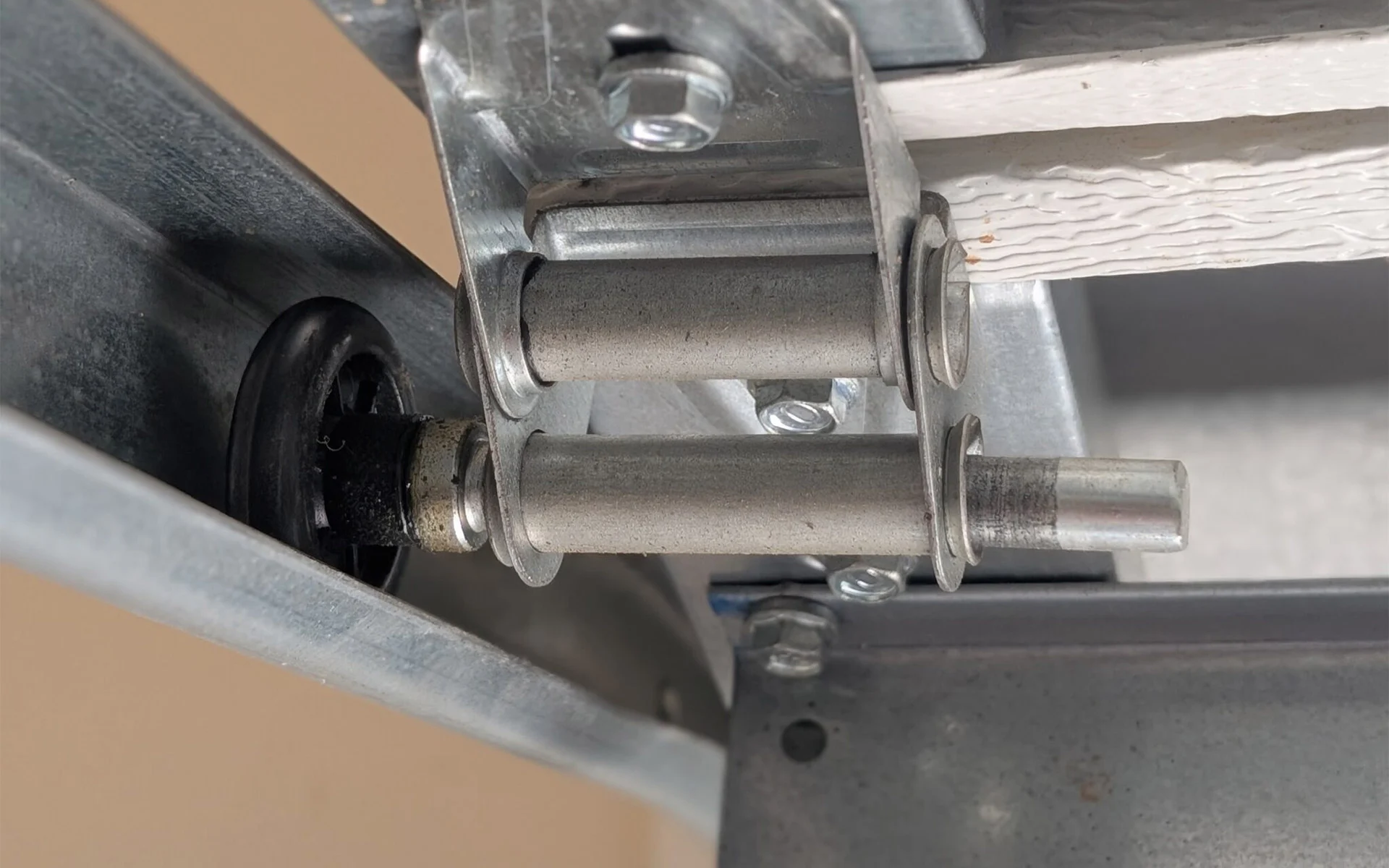
- Acoustic Ghosting: If the door operates quietly at the bottom but “shudders” at the top of the curve, the acoustic bridge is failing due to uneven radial load.
- Tire Thinning: Measurement of the nylon tire diameter. A loss of more than 1.5mm indicates the polymer’s viscous dissipation capacity has been exceeded.
- Stem Vibration: High-frequency oscillation felt at the hinge point during movement indicates the impedance matching has failed, reflecting energy back into the door hardware.
Multi-Phase Stress Diffusion: 11-Ball Bearing Radial Symmetry
While the outer nylon tire handles the sound, the internal bearing architecture manages the gravitational and centrifugal forces. The primary difference between consumer-grade hardware and industrial-grade garage door quiet rollers lies in the “Stress Diffusion Phase.” Standard plastic rollers typically utilize 6 to 8 unshielded ball bearings, creating significant gaps between load-bearing points.
Mechanism Dissection:
A precision 11-ball bearing system utilizes the principle of radial symmetry to eliminate “Shear Stress Peaks.” In a 6-ball configuration, the heavy load of a 400lb commercial door is concentrated on only two balls at any given moment. This creates a “pulsing” stress vector that can exceed the plastic deformation threshold of the bearing race. By increasing the count to 11 balls, the contact area is increased by approximately 45%. This allows the load to be diffused across multiple phases simultaneously, ensuring that the pressure at any single contact point remains well below the point of “pitting failure.” The presence of Grease Sealed chambers ensures that the ball bearings operate in a state of continuous elastohydrodynamic lubrication, where a microscopic film of oil prevents metal-on-metal contact even under 1,000 Newtons of force.
The 100,000 Cycle Fatigue Trajectory and Galvanized Stem Resilience
To ensure long-term stability, the interaction between the shouldered stem and the bearing housing must withstand a relentless fatigue trajectory. In a manufacturing environment, we subject these components to a 100,000-cycle test, mapping the structural evolution of the galvanized steel and the bearing races.
Solution 1: 11-Ball Precision Radial Symmetry
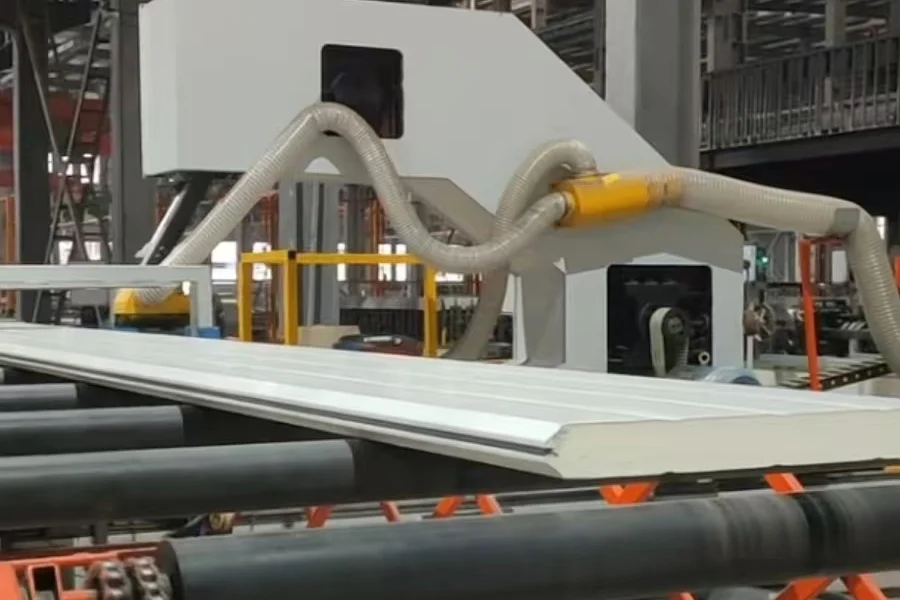
Execution Protocol: The factory implements an automated assembly line where exactly 11 hardened steel balls are injected into a sealed race. The tolerances are kept within ±0.005mm to ensure that each ball shares an equal portion of the radial load.
Material Expected Evolution:
By maintaining this level of symmetry, the roller avoids “Eccentric Run-out.” The load remains centered on the galvanized stem, preventing the “wobble” that usually leads to the nylon tire detaching from the core. Over the full 100,000-cycle lifespan, the bearing race shows less than 2% dimensional deviation.
Hidden Cost & Side Effect Evasion:
Increasing ball count increases internal friction torque. The factory evades this by utilizing a low-viscosity, high-pressure synthetic grease that reduces rolling resistance while maintaining the necessary fibrous skeleton to prevent oil leakage at high rotational speeds.
Solution 2: 3-Stage Galvanized Stem Passivation
Execution Protocol: The 4-inch or 7-inch stems undergo a multi-stage hot-dip galvanizing process, followed by a secondary chromate passivation. This creates a sacrificial anode layer that protects the underlying carbon steel from intergranular corrosion.
Material Expected Evolution:
In high-humidity garage environments, standard steel stems often develop “Red Rust,” which expands and seizes the roller in the hinge. The galvanized layer instead forms a stable Zinc Carbonate patina. Testing shows that even after 240 hours of salt spray exposure (ASTM B117), the stem maintains its structural integrity and fits perfectly within the #1 to #3 hinges.
Hidden Cost & Side Effect Evasion:
Thick galvanizing can interfere with the interference fit between the stem and the bearing inner race. To prevent loosening, the factory uses a “Shouldered Stem” design with a precision-machined seat, ensuring the stem is physically locked into the bearing regardless of the coating thickness.
Solution 3: GF-Reinforced Polyamide Injection Molding
Execution Protocol: The outer tires are molded using Polyamide (Nylon) reinforced with microscopic glass fibers (GF). The injection parameters are strictly controlled to ensure a high degree of crystallinity at the surface for wear resistance, while maintaining a tough, amorphous core for impact absorption.
Material Expected Evolution:
This dual-phase structure prevents the “Flat-Spotting” common in pure plastic rollers. Even if the garage door is left closed for months (static load), the GF-Nylon resists “cold flow” deformation. The roller remains perfectly round, ensuring a smooth transition into motion every time.
Hidden Cost & Side Effect Evasion:
Glass fibers can be abrasive to the steel track if they migrate to the surface. The factory utilizes a “Skin-Core” injection technique, where the outer 0.5mm of the tire is pure, unreinforced nylon for track protection, while the GF-reinforcement is concentrated in the structural hub.
Solution 4: Grease-Sealed Labyrinth Defense
Execution Protocol: Every roller is equipped with a dual-lip labyrinth seal. This mechanical barrier is designed to keep the internal grease in and external pneumatic dust out.
Material Expected Evolution:
By preventing “Capillary Oil Bleeding,” the bearing remains lubricated for its entire 10-year projected life. In dusty environments, the labyrinth seal creates a tortuous path that traps particulates before they can reach the steel balls, effectively eliminating the risk of “Three-Body Abrasive Wear.”
Hidden Cost & Side Effect Evasion:
Labyrinth seals can trap moisture if not properly vented. The grease formulation includes high-performance corrosion inhibitors that neutralize any microscopic moisture that manages to bypass the seal during extreme temperature shifts.
| Variable Intersections | Standard 10-Ball Steel Roller | 11-Ball Nylon Quiet Roller | Industry Standard Metric |
|---|---|---|---|
| Acoustic Wave Reflection | > 90% (Loud screeching) | < 10% (Whisper quiet) | Decibel Attenuation (dB) |
| Dynamic Load Patch | Point-contact stress peaks | Distributed radial phases | Hertzian Contact Area |
| Corrosion Resistance | Immediate Red Rust (12 hrs) | Zero Rust (240 hrs) | ASTM B117 Salt Spray |
| Static Creep Resistance | Significant Flat-Spots | Zero measurable deformation | Polymeric Cold-Flow Limit |
| Grease Retention | Open (Leaks within 2 years) | Sealed (10+ year lifespan) | Labyrinth Seal Efficacy |
PRO-TIP / CHECKLIST
- Magnet Stem Audit: Use a magnet to check the stem; it should be galvanized steel. If it is bare metal, it will seize in the hinge within 18 months in humid climates.
- Ball Count Verification: Shake the roller. An 11-ball bearing will feel noticeably “denser” and have a smoother, more consistent rotational sound than a cheap 7-ball unit.
- Check for the “Shoulder”: Inspect where the stem meets the wheel. A high-quality roller features a “Shouldered Stem” that prevents the wheel from sliding down the shaft over time.
- Nylon Hardness Test: Press your thumbnail into the tire. It should feel firm but have a slight “rubbery” rebound. If it feels brittle like hard plastic, it will likely crack under winter loads.
- Seal Inspection: Ensure the bearing is fully shielded. Open bearings act as a “Bernoulli vacuum,” sucking in garage dust and pet hair, which leads to immediate seizure.
- Verify Stem Length: Standard residential doors use 4-inch stems; if you have a wide commercial door or heavy double-insulated door, insist on 7-inch stems for increased lateral stability.
Frequently Asked Questions (FAQ)
what is the best garage door opener
The “best” opener is one that matches your door’s weight and noise requirements. For maximum silence, a belt-drive DC motor combined with long life garage door rollers is the gold standard. DC motors offer “Soft Start/Stop” technology that reduces the initial torque surge, further protecting your roller bearings from impact damage.
how to connect the garage door opener
Modern openers use Wi-Fi and Bluetooth bridging. You must secure the motor head to the structural framing, connect the rail to the header bracket above the door, and then pair the “Learn” button on the motor with your smartphone app. Always ensure the safety sensors (photo-eyes) are aligned perfectly 6 inches above the floor before final calibration.
how to change code for garage door
To reset your keypad code, press the “Program” or “Learn” button on the motor head until the indicator light blinks. Within 30 seconds, enter your new 4-digit code on the external keypad and hold the “Enter” button until the opener light flashes. This resets the cryptographic handshake between the keypad and the motor.
 English
  Русский
  日本語
日本語  한국어
한국어  Français
  Deutsch
  العربية
  Português
  Español