
Reference Standard: Relevant material and performance testing standards should be confirmed according to the final door assembly and project requirements; the available catalog evidence does not identify a specific testing standard for these window models.
Garage Door Windows: Read Overall Size and Opening Size Separately
For garage door windows, the overall window dimension and the required door-panel opening are not automatically the same specification. The catalog identifies four separate models—BT-W806, BT-W807, BT-W808, and BT-W809—but only BT-W808 and BT-W809 include a stated opening size.
That distinction matters whenever a buyer is preparing a replacement request, checking a drawing, or defining a new door-panel project. An overall dimension describes the catalog-listed size of the window product. An opening dimension, when separately provided, identifies another dimensional field associated with that particular model.
The safest specification method is therefore model-based rather than category-based. Record the exact model first, then preserve each catalog field exactly as it is stated. Do not convert an overall window size into an assumed panel opening, and do not transfer an opening size from one model to another.
The four verified records are:
| Model | Verified Overall Size | Verified Opening Size | Other Verified Detail |
|---|---|---|---|
| BT-W806 | 630×330 mm | Not listed | ABS, two-layer glass |
| BT-W807 | 600×130 mm | Not listed | ABS, two-layer glass |
| BT-W808 | 660×220 mm | 627×190 mm | No additional material field established here |
| BT-W809 | 650×320 mm | 617×288 mm | No additional material field established here |
These records provide useful dimensional information, but they do not establish universal installation clearances, frame overlap, dimensional tolerances, mounting methods, or interchangeability. Those points require separate confirmation.
Buyers reviewing garage door panels and window components should keep that evidence boundary visible throughout the inquiry process.
BT-W806 and BT-W807: Overall Size Is the Verified Dimension
BT-W806 is listed with an overall size of 630×330 mm. Its catalog record also identifies ABS and two-layer glass. BT-W807 is listed at 600×130 mm and likewise carries ABS and two-layer glass in the available specification record.
The important limitation is equally clear: the supplied evidence does not provide an opening-size value for either BT-W806 or BT-W807.
That missing field should remain missing in a buyer’s working specification until it is confirmed from an appropriate model-specific source. It should not be reconstructed from photographs, estimated by comparing frame proportions, or calculated from another model’s relationship between overall and opening dimensions.
This is particularly important in replacement work. A buyer may measure the visible exterior of an existing window assembly and obtain a number that appears close to a catalog overall size. That similarity alone does not establish the dimensions of the panel cutout hidden behind the frame. The existing installation may contain geometry that cannot be determined from the catalog’s overall-size field.
The same principle applies to an RFQ. A request that says only “BT-W806, 630×330 mm” records what the catalog establishes, but it should not silently imply a panel-opening requirement. If the project depends on the cutout size, that requirement should be added as a separate confirmation item.
For BT-W807, the 600×130 mm overall dimension must be treated in exactly the same controlled way. Its comparatively different shape does not create evidence about installation geometry. The catalog record tells the buyer the model identity and overall size; it does not establish a derived opening size.
Signs That the Dimensional Record Needs More Confirmation
- A drawing shows an opening dimension for BT-W806 or BT-W807 even though no source for that dimension is identified.
- A replacement request substitutes one model for another because the visible window dimensions appear similar.
- An RFQ uses the terms window size and opening size interchangeably without identifying which dimension was actually measured.
These are specification-control warnings rather than proof of a defective product. Resolving them before ordering is simpler than trying to reconcile conflicting dimensions later in the project.
BT-W808 and BT-W809: Compare Both Listed Dimensions
BT-W808 and BT-W809 provide a clearer example of why the two dimensional fields must remain separate.
For BT-W808, the verified overall size is 660×220 mm, while the catalog separately lists an opening size of 627×190 mm.
For BT-W809, the verified overall size is 650×320 mm, while the listed opening size is 617×288 mm.
Because both fields are explicitly supplied for these models, a buyer can record both without estimating one from the other. This creates a stronger dimensional inquiry record than simply requesting a generic garage door window by approximate length and height.
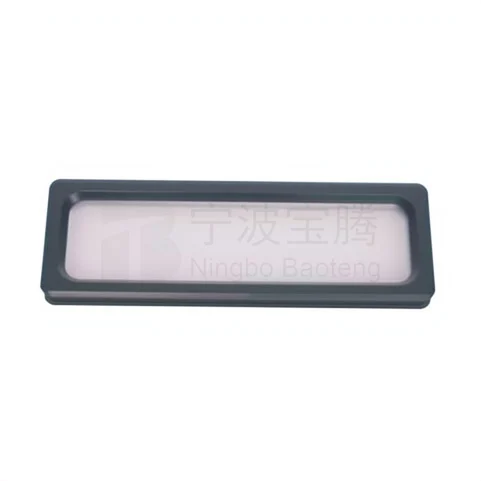
The paired dimensions do not, however, justify additional calculations about frame overlap, installation clearance, manufacturing tolerance, or permissible panel variation. Those parameters are not established by the available evidence.
That boundary is important because dimensional subtraction can produce a numerical result while still failing to reveal its engineering meaning. A calculated difference between an overall dimension and an opening dimension does not automatically represent a frame width, engagement depth, allowance, or tolerance. Product geometry can contain features that are not described by two rectangular dimensions alone.
A replacement comparison should therefore keep each catalog record intact:
BT-W808
– Model: BT-W808
– Overall size: 660×220 mm
– Opening size: 627×190 mm
BT-W809
– Model: BT-W809
– Overall size: 650×320 mm
– Opening size: 617×288 mm
This format reduces ambiguity because every number remains attached to both its model and its dimensional meaning. It also prevents an opening dimension from becoming detached from its source when information is copied into purchasing sheets, drawings, emails, or ERP records.
The same discipline is useful when comparing garage door windows kits or individual window components. A keyword or product category can group similar items for search purposes, but it cannot replace model-level specification data.
Confirm Missing Opening Dimensions Before Interchangeability Decisions
The practical goal is not simply to collect more numbers. It is to prevent a known number from being used for the wrong purpose.
A reliable dimensional inquiry can be built with four controls.
1. Identify the Exact Model Before Comparing Dimensions
Start with BT-W806, BT-W807, BT-W808, or BT-W809 rather than a generic description such as “rectangular garage door window.” Preserve the model number on drawings, quotation requests, sample records, and replacement notes.
This keeps the dimensional evidence attached to the correct product record. It also reduces the risk that a size copied from one model will later be treated as a category-wide specification.
2. Label Overall Size and Opening Size as Separate Fields
Do not place all dimensions in an unlabeled “size” column. Use separate fields such as Overall Window Size and Panel Opening Size.
For BT-W808 and BT-W809, both fields can be completed from the available catalog information. For BT-W806 and BT-W807, the opening-size field should remain unconfirmed rather than being populated with an estimate.
A blank field with a clear confirmation status contains more useful information than a precise-looking number with no verified source.
3. Treat Missing Data as a Confirmation Requirement
When an opening dimension is not supplied, convert that gap into a specific question.
Instead of asking, “Will this window fit?”, request the model-specific opening dimension required for the intended project. Where compatibility with an existing door panel matters, provide the relevant existing dimensions and identify how those dimensions were measured.
This separates recorded facts from project-specific approval. The catalog can establish the listed dimensions, while the final fit decision may require additional model or installation information.
4. Do Not Use Similar Dimensions as Proof of Interchangeability
BT-W808 and BT-W809 illustrate why model identity must remain part of the dimensional record. Their catalog entries contain different overall dimensions and different opening dimensions.
More broadly, two windows that appear close in size cannot be assumed to share a panel opening, attachment interface, or replacement relationship. None of those compatibility conclusions is established merely by numerical proximity.
Items to Confirm Before Ordering
- Record the exact window model number.
- Label the catalog dimension explicitly as overall size.
- Record an opening size only when a model-specific source provides it.
- For BT-W806 or BT-W807, request the missing opening dimension when the project requires it.
- Keep BT-W808’s 660×220 mm overall size paired with its 627×190 mm opening size.
- Keep BT-W809’s 650×320 mm overall size paired with its 617×288 mm opening size.
- Do not infer installation clearance, tolerance, or frame overlap from the listed dimensions.
- Do not approve substitution between models solely because their visible dimensions appear close.
- Make sure drawings and RFQs distinguish measured existing dimensions from catalog specifications.
- Obtain model-specific confirmation before making a final replacement or panel-cutout decision.
NINGBO BAOTENG TECHNOLOGY CO.,LTD is identified in the available source as a company specializing in hardware accessories and other OEM products for garage doors, industrial doors, commercial doors, and residential doors. Its catalog includes the BT-W806, BT-W807, BT-W808, and BT-W809 window records discussed here.
For a dimensional inquiry, the most useful next step is therefore precise rather than broad: identify the intended model, state every verified catalog dimension with its correct label, and request confirmation for any required opening or fit information that the catalog does not provide.
 English
  Русский
  日本語
日本語  한국어
한국어  Français
  Deutsch
  العربية
  Português
  Español