
Reference Standard: Relevant material and performance testing standards for the final door assembly should be confirmed for the specific project; the available catalog evidence does not document a particular testing standard for these panel models.
What to Record Before Requesting Overhead Garage Door Panels
A replacement or project inquiry for Overhead Garage Door Panels should record five fields together: model, required width, required panel thickness, panel type, and listed color. Matching only one or two of those fields is not enough to establish that a catalog panel is suitable for an existing door.
The available catalog identifies four panel records: BT-P801 Finger Protection Panel, plus BT-P802, BT-P803, and BT-P804 Normal Panels. All four records list a width of 450–550 mm and panel-thickness options of 40 mm and 50 mm, while their type and color descriptions differ. :contentReference[oaicite:0]{index=0}
For a buyer, the useful question is therefore not simply, “Do I need a 40 mm panel?” A complete inquiry should instead preserve every verified field as a separate requirement.
A practical record can start with:
| Inquiry Field | Information to Record |
|---|---|
| Model | Existing model, required model, or model to be confirmed |
| Width | Required width and whether it falls within the catalog-listed 450–550 mm range |
| Panel thickness | 40 mm or 50 mm requirement |
| Panel type | Finger Protection Panel or Normal Panel |
| Listed color | Color required for the project |
| Unverified fit details | Joint profile, interfaces, tolerances, construction, installation compatibility |
The last row is intentionally different from the first five. Joint geometry, interface dimensions, installation method, construction details, and universal compatibility are not established by the available product evidence. They should be questions for confirmation rather than assumptions added to the catalog record.
This approach is especially useful for replacement work. A damaged section can appear visually similar to another garage door panel while still requiring additional dimensional or interface information that the catalog page does not provide. A complete specification record reduces the risk of treating appearance or one shared dimension as proof of fit.
NINGBO BAOTENG TECHNOLOGY CO.,LTD is identified in the source material in the context of producing hardware accessories and other OEM products for garage doors, industrial doors, commercial doors, and residential doors. The same catalog evidence includes the four panel records used in this checklist. :contentReference[oaicite:1]{index=1}
Keep Model, Width, and Panel Thickness as Separate Fields
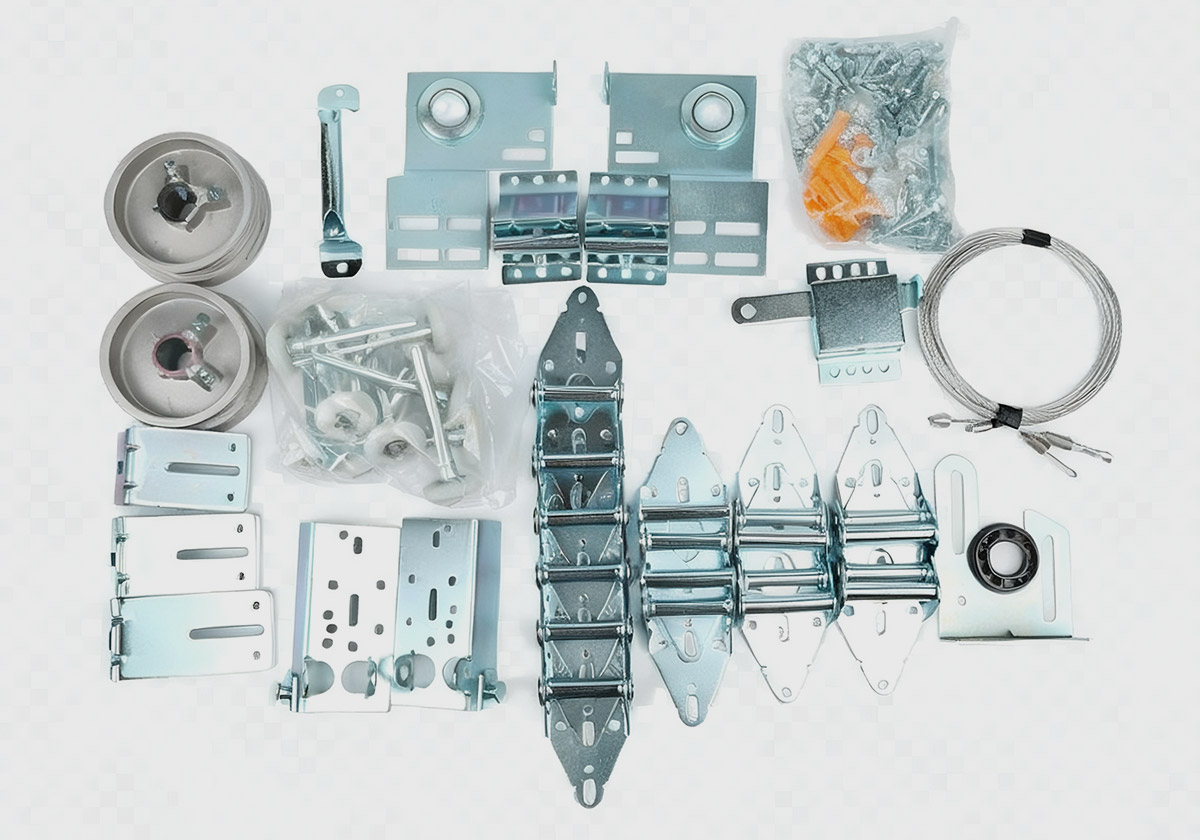
The catalog gives the same broad dimensional fields for BT-P801 through BT-P804: 450–550 mm width and 40 mm or 50 mm panel thickness. Those shared values make careful recordkeeping more important, not less.
A width requirement should answer one question: what panel width is required for the project? Panel thickness should answer another: is the project calling for the catalog-listed 40 mm or 50 mm option? The model field remains a third, independent identifier.
Combining these fields into a vague request such as “a 40 mm garage door panel” removes information that may matter later in the selection process. Likewise, a statement such as “450–550 mm panel” does not identify a model, panel type, or color.
The safest purchasing record keeps each value in its own field:
- Model: record the model shown on existing documentation when available.
- Width requirement: record the project requirement separately from the model.
- Panel thickness: identify 40 mm or 50 mm when that requirement is known.
- Panel type: do not infer type from dimensions.
- Color requirement: record it as a separate descriptive field.
- Compatibility questions: list anything that still requires supplier or project-level confirmation.
This separation also prevents a common reasoning error: assuming that two panels sharing width and thickness must be interchangeable. The catalog evidence does not establish that conclusion.
For example, BT-P801 and BT-P804 both carry the catalog-listed 450–550 mm width range and 40/50 mm thickness options, yet the records identify different panel types and different listed colors. Shared dimensions are therefore useful for narrowing an inquiry, but they do not replace model-level identification.
The available evidence also does not define dimensional tolerances, mating-section geometry, hinge positions, joint profiles, total door dimensions, facing materials, insulation construction, installation procedures, or opener compatibility. Those details should remain outside the verified specification record unless additional drawings or technical documentation are supplied.
Signs Your Panel Request Is Still Underspecified
- The inquiry gives only width or only thickness without identifying the other required fields.
- The request uses color or visual similarity as the primary identification method instead of recording the model and dimensions.
- Two catalog records are being treated as interchangeable simply because they share the 450–550 mm width or 40/50 mm thickness fields.
A useful specification checklist is therefore less about collecting more words and more about preventing one field from silently standing in for another.
Confirm Panel Type and Listed Color With the Same Record
Once model, width, and thickness are recorded, the panel type and catalog-listed color help preserve the identity of the requested record.
The verified information is specific:
- BT-P801 — Finger Protection Panel; width 450–550 mm; panel thickness 40 mm or 50 mm; white and grey listed among the colors.
- BT-P802 — Normal Panel; width 450–550 mm; panel thickness 40 mm or 50 mm; wooden color listed.
- BT-P803 — Normal Panel; width 450–550 mm; panel thickness 40 mm or 50 mm; wooden color listed.
- BT-P804 — Normal Panel; width 450–550 mm; panel thickness 40 mm or 50 mm; red listed. :contentReference[oaicite:2]{index=2}
These descriptions are valuable as catalog fields, but they should not be expanded into unverified technical conclusions.
“Wooden color,” for example, is a color description in the available record. It does not by itself establish that the panel is made from wood, contains a wood layer, uses a particular decorative film, or meets a specific coating-performance requirement. Similarly, white, grey, and red should not be converted into assumptions about coating chemistry, surface treatment, corrosion resistance, UV performance, gloss level, or finish durability.
Panel type requires the same discipline. BT-P801 is identified as a Finger Protection Panel, while BT-P802 through BT-P804 are identified as Normal Panels. That terminology belongs in the inquiry because it is explicitly documented. It should not, however, be turned into an unsupported safety rating, certification claim, or universal statement about joint geometry.
The practical objective is to copy verified fields accurately while clearly separating them from details that still require confirmation.
For sourcing or replacement discussions, that distinction keeps communication clear. A buyer can provide the complete known record and then ask targeted questions about any remaining unknowns rather than expecting the catalog color, thickness, or panel name to answer them automatically.
Do Not Treat Partial Specification Matches as Proof of Interchangeability
The final decision rule is simple: a partial match is a screening result, not proof of compatibility.
Two panels may share the same catalog-listed width range. They may also share the same 40 mm or 50 mm thickness option. That still does not establish that their profiles, connections, interfaces, materials, construction, hardware relationships, or installation requirements are identical.
This matters because replacement decisions often begin with the easiest visible measurements. Width and thickness are useful, but a complete replacement inquiry should preserve the model and descriptive fields at the same time.
Items to Confirm Before Sending a Panel Inquiry
- Record the model number from existing documentation, labels, drawings, or previous purchase records when available.
- Write down the required width as its own specification rather than embedding it in a general description.
- Confirm the required panel thickness, distinguishing between the catalog-listed 40 mm and 50 mm options.
- Record the panel type separately, especially whether the requirement relates to the BT-P801 Finger Protection Panel or a Normal Panel record.
- State the required color without assuming that color proves material, coating, or construction.
- Provide the complete known field set together so the inquiry does not depend on a single matching dimension.
- Ask for confirmation of compatibility when replacing an existing panel rather than assuming catalog records are interchangeable.
- Request additional documentation where needed for joint interfaces, geometry, tolerances, materials, construction, or installation details not shown in the available catalog information.
For replacement projects, photographs, existing model information, and project drawings can also provide useful context, but they should supplement rather than overwrite the documented specification fields.
The same principle applies when communicating through a garage door hardware and OEM product inquiry. Send the information you know as explicit fields and identify the information you still need confirmed. That creates a clearer technical conversation than asking for “a similar panel” or assuming that matching thickness establishes fit.
The catalog evidence supports a precise starting point: four identified panel records, a 450–550 mm width range, 40 mm and 50 mm panel-thickness options, panel-type descriptions, and listed colors. It does not establish universal interchangeability among BT-P801, BT-P802, BT-P803, and BT-P804. :contentReference[oaicite:3]{index=3}
For buyers, that boundary is useful. Record what is verified, keep each specification field separate, and turn undocumented compatibility details into explicit confirmation questions before treating any overhead garage door panel as a replacement candidate.
 English
  Русский
  日本語
日本語  한국어
한국어  Français
  Deutsch
  العربية
  Português
  Español