
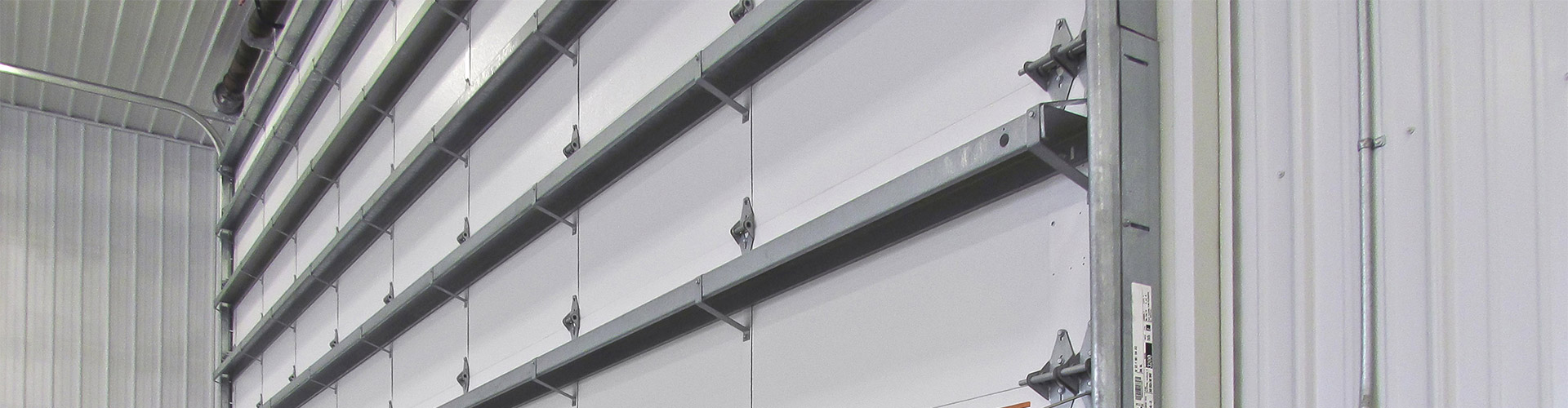
Why roller stem bending occurs in high-load garage doors and how to reduce the risk
What causes garage door roller stem bending in high-load doors is rarely a single defect or a simple material issue. In heavy, high-cycle garage door systems, off-axis loading, track misalignment, and short-duration impact shocks combine to push the roller stem beyond its intended bending limits. Once that happens, recurring noise, door binding, and accelerated track wear tend to follow instead of a one-time failure.
Installers and maintenance teams often encounter this problem on large residential doors with insulated panels, as well as on commercial doors that operate many times per day. The challenge is not just fixing the immediate issue, but understanding why the bending started and how to prevent it from returning after replacement.
How stem bending shows up during daily operation
A bent roller stem rarely announces itself clearly at first. Early symptoms usually appear as subtle resistance during travel, a door that no longer runs evenly in the track, or a metallic scraping sound that comes and goes depending on door position. These symptoms are easy to dismiss as lubrication issues or normal wear.
As bending progresses, the roller no longer sits squarely in the track. This increases side loading on both the roller wheel and the track edge, which accelerates wear on components that were never designed to handle sustained lateral force. In high-load environments, the result is often a cycle of repeated roller replacement without addressing the root cause.
Why high-load doors create higher bending moments
High-load garage doors place fundamentally different demands on roller assemblies compared to lighter residential systems. Increased door mass raises the vertical load on each roller, but the more critical factor is how that load is transferred when geometry is less than ideal.
When tracks are not perfectly parallel or when mounting brackets are slightly out of plane, the vertical load transforms into a bending moment on the roller stem. Each opening and closing cycle repeats that stress. Over time, even a stem that meets basic strength requirements can plastically deform or develop fatigue damage.
Off-axis loading from track and bracket geometry
In theory, a roller stem should experience primarily shear and compressive forces. In practice, small deviations in track spacing or bracket alignment introduce lateral forces. These forces act at the exposed length of the stem, multiplying bending stress with every millimeter of offset.
This is why stem bending is far more common in installations where track alignment was rushed or adjusted after the door was already under load. The system may function initially, but the mechanical imbalance remains.
Dynamic shock during starts, stops, and impacts
High-load doors also generate higher dynamic forces during acceleration and deceleration. If the door is not perfectly balanced or if it contacts the track during travel, short impact events occur. These shocks can momentarily exceed the stem’s yield strength even when static loads appear acceptable.
Over hundreds or thousands of cycles, these transient loads contribute to cumulative damage, making bending more likely even when materials and dimensions seem adequate on paper.
Common misconceptions that delay proper diagnosis
One of the most persistent misconceptions is that stem bending is primarily caused by poor material quality. While material selection does matter, most field failures trace back to installation geometry and load distribution rather than metallurgy alone.
Another common assumption is that replacing a bent roller with a thicker stem automatically solves the issue. In reality, increasing stem diameter without correcting alignment can transfer stress elsewhere, sometimes leading to track deformation or bracket cracking instead.
How to diagnose the real cause on site
Effective diagnosis starts with observing how the door moves, not just inspecting the failed roller. Watch for points in the travel where resistance increases or where the roller appears to climb or press against one side of the track.
Measuring track spacing and checking bracket squareness relative to the door plane often reveals small but critical deviations. These measurements provide far more insight than visual inspection alone.
Separating permanent bending from temporary deflection
A stem that has permanently bent will not return to straightness after unloading, while temporary deflection disappears once the door is supported. Identifying this distinction helps determine whether the issue is a one-time overload or a repeated stress condition.
In high-cycle environments, repeated temporary deflection is often a warning sign that fatigue damage is accumulating, even if permanent deformation has not yet occurred.
Reducing bending risk through installation control
The most effective way to reduce stem bending is to minimize off-axis forces before they ever reach the roller. Careful control of track alignment and bracket geometry does more to extend service life than simply upgrading component strength.
Ensuring that tracks remain parallel under load is especially important on wide or tall doors, where small angular errors are amplified over distance.
Balancing door weight to limit dynamic loads
Proper door balance reduces the acceleration forces transmitted to rollers during operation. A balanced door moves smoothly with minimal motor effort, reducing shock loads on stems during starts and stops.
In high-frequency installations, periodic balance checks should be treated as preventive maintenance rather than corrective action.
Material and design considerations that matter
From a component standpoint, the goal is not maximum stiffness at all costs, but a balance between strength, toughness, and compatibility with the rest of the system. A stem that is too rigid can shift stress to brackets or tracks, creating new failure modes.
Matching stem diameter, material properties, and wheel design to the actual load and cycle profile of the door produces more reliable results than relying on generic “heavy-duty” labels.
How testing and standards help verify solutions
Engineering validation plays a critical role in confirming that corrective actions are effective. Dimensional accuracy inspection ensures that stem diameter, length, and concentricity match design intent and track compatibility.
Static load and bearing capacity tests establish baseline strength, while cycle durability tests reveal how components behave under repeated real-world operation. Impact and shock evaluations are particularly relevant for high-load doors where transient forces dominate failure behavior.
These evaluation methods align with widely recognized industry testing approaches referenced by organizations such as
ISO and
ASTM, which emphasize repeatability and environment-specific validation rather than single-point strength claims.
When replacement alone is not enough
Replacing a bent roller without addressing alignment or load distribution almost guarantees recurrence. In many service calls, the original roller meets specification, but the surrounding system never allowed it to operate within its intended limits.
This is why troubleshooting stem bending should be treated as a system-level issue rather than a part-level defect.
Linking failure analysis back to proper selection
Stem bending is one of the clearest examples of why selection decisions should be grounded in actual operating conditions instead of nominal door weight alone. Cycle frequency, track geometry, and dynamic behavior all influence what “appropriate” really means.
For readers evaluating broader options, a more complete framework covering roller types, load classes, and application matching is outlined in the
full buyer guide and failure FAQ for custom garage door rollers, which places individual failure modes like stem bending into a wider selection context.
Practical prevention strategies for long-term reliability
In high-load, high-cycle environments, long-term reliability comes from controlling variables that are often treated as secondary concerns. Consistent alignment checks, realistic cycle assumptions, and validation against relevant test methods reduce the likelihood of repeat failures.
Rather than chasing isolated component upgrades, teams that focus on system balance and verified performance tend to see fewer service calls and lower total maintenance costs over time.
Standards-based perspective on durability and verification
Reliable performance in heavy garage door applications depends on more than visual inspection or initial fit. Dimensional inspections, load capacity evaluations, and cycle testing provide objective evidence that a roller assembly can survive its intended environment.
These methods reflect established engineering practice used to connect failure modes, such as stem bending, with measurable limits and acceptance criteria. When testing results are considered alongside real installation conditions, design trade-offs become clearer and more defensible.
This content is developed based on material performance analysis, standardized industry testing references such as dimensional inspection, load capacity, and cycle durability methods, and real-world application scenarios related to high-load, high-frequency garage door environments. Product specifications and testing data referenced here are derived from internal documentation and publicly available engineering standards.
 English
  Русский
  日本語
日本語  한국어
한국어  Français
  Deutsch
  العربية
  Português
  Español