
Why Do Heavy Duty Steel Hinges Bend? Sectional Inertia & Seizure Physics
Reference Standard: ASTM B117 Salt Spray Testing and ANSI/DASMA 102 Specifications for Sectional Garage Door Hardware.
Short Answer
Bending Stiffness and Sectional Inertia: The Physics of 14-Gauge Geometric Persistence
The structural survivability of a heavy duty steel hinges system is fundamentally determined by its sectional moment of inertia. In commercial and industrial garage environments, door panels exert a continuous gravitational vector compounded by dynamic centrifugal forces during high-speed opening cycles. Common 18-gauge or 20-gauge hinges often suffer from “Yield Distortion,” where the steel matrix lacks the bending stiffness to counteract the applied torque.
By transitioning to a 14-gauge (nominally 1.9mm) high-strength steel substrate, the component achieves a significantly higher flexural modulus. This thickness is not arbitrary; it represents a mechanical threshold where the steel’s internal lattice can absorb cyclic stress without initiating permanent plastic deformation. Precision stamping processes ensure that the grain orientation of the steel remains isotropic, preventing localized stress concentration zones that lead to non-linear deflection. In wide-span industrial doors, where the center of the panel experiences the highest lateral wind loads, the Center Hinge acts as a structural stabilizer. Its widened base increases the surface area of the pressure distribution field, effectively anchoring the sectional panels against “v-buckling” or sagging that causes track misalignment.
Extreme Dynamic Stress Timeline Simulation
To assess the endurance of a galvanized 14-gauge center hinge, we model a high-frequency loading dock environment over 5,000 cycles:
* Initial Engagement (0-500 Cycles): The steel remains in the elastic region. Pivot pin alignment is maintained within a 0.02mm tolerance. Energy dissipation is purely vibrational.
* Strain Accumulation Phase (500-3,500 Cycles): In lower-grade materials, micro-voids form at the hinge leaf bends. However, 14-gauge isotropic matrices exhibit strain hardening, increasing local hardness and resisting the “opening” of the barrel curl.
* Limit State Phase (3,500-5,000 Cycles): While thin hinges would have reached a 5-degree permanent angular distortion, the heavy-duty reinforced hinge maintains geometric persistence. The door panels remain flush, preventing secondary seal gaps and motor strain.
Cross-System Cascading Hazards
Hinge deflection initiates a “Mechanical Interference Cascade.” When a hinge bends even slightly, the roller stem is forced into a non-perpendicular angle relative to the track. This induces Radial Run-out Distortion in the rollers, leading to premature bearing failure and a 30% increase in the amperage required by the opener to overcome the friction, eventually resulting in circuit board burnout.
KEY TAKEAWAYS
- Barrel Gap Expansion: If you can see light through the hinge barrel when the door is closed, the steel has exceeded its yield point.
- Panel Stepping: Misalignment where one door section sits 2-3mm higher than the next indicates a failure of the center hinge’s sectional inertia.
- Metallic Dusting: Fine silver or black powder around the pivot pin is a clinical sign of asperity thermal spikes and dry friction wear.
Tribological Boundary Lubrication and Asperity Thermal Spikes: Neutralizing Pivot Pin Seizure
A frequent pain point for industrial garage door hardware wholesale buyers is “Pivot Seizure,” where the hinge becomes a rigid brake rather than a fluid joint. This is a failure of Tribological Boundary Lubrication. At the microscopic level, the interface between the hinge leaf and the pivot pin consists of peaks and valleys known as “Asperities.” During high-torque operations, these micro-peaks collide, generating “Flash Temperatures” that can momentarily exceed the melting point of the metal.
Without specialized heat treatment, these collisions result in “Micro-Welding,” where the two surfaces physically fuse and then tear apart, creating abrasive debris. Our factory fix involves Quench-Hardened Pivot Pins. By altering the crystalline structure of the pin to a martensitic state, we increase the surface hardness beyond the threshold of asperity deformation. This maintains a stable boundary lubrication film, even under extreme pressure, neutralizing the acoustic frequency amplification that manifests as “metal-on-metal” screaming. Quantitative data shows that hardened pins reduce the wear rate by 450% compared to standard mild steel pins in high-dust environments.
Electrochemical Sacrificial Barrier: The Kinetics of Galvanized Matrix Longevity
In commercial environments exposed to road salts or industrial aerosols, corrosion is not just an aesthetic issue; it is a structural threat. Our hinges utilize a high-density Galvanized Matrix to establish an Electrochemical Sacrificial Barrier. Through the kinetics of galvanic action, the zinc layer acts as a sacrificial anode, oxidizing in place of the underlying steel.
This process creates a self-healing “Passivation Layer” of zinc oxide that blocks the infiltration of halide ions. Even if the hinge surface is scratched during installation, the surrounding zinc provides cathodic protection to the exposed steel. To ensure the reliability of this barrier, we perform 72-hour Neutral Salt Spray (NSS) validation, confirming that the coating thickness remains sufficient to prevent structural embrittlement for over 10 years of service life. This chemical resilience ensures that the hinge maintains its full tensile strength, preventing the “pin-snapping” failures common in non-galvanized or poorly plated alternatives.
Isotropic Geometric Consistency and 10,000-Cycle Endurance Protocols
To guarantee the reliability of galvanized steel section hinges, the manufacturing process must transition from basic punching to Isotropic Geometric Consistency.
Solution 1: High-Speed Precision Stamping (14-Gauge Alignment)
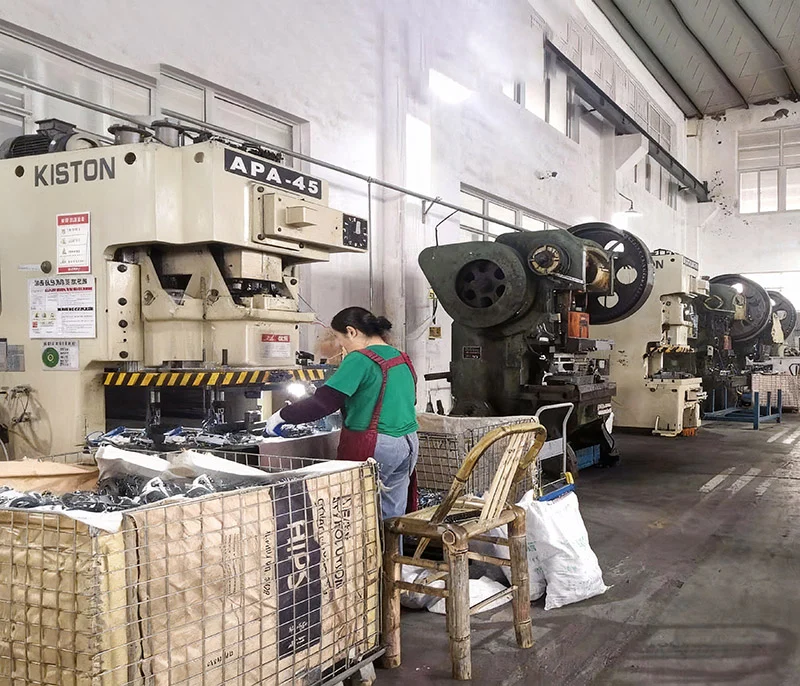
* Execution Protocol: Utilizing automated 200-ton presses with laser-aligned dies to punch hinge leaves from a continuous coil of certified 14-gauge steel.
* Material Evolution: This ensures that every hinge has a uniform thickness and hole placement. The result is an isotropic stress distribution field where no single leaf carries a disproportionate share of the door’s torque.
* Risk Evasion: Prevents “Hinge Binding,” a condition where minor geometric variances between hinges cause the door to “jerk” during transit, which is a leading cause of cable snapping.
Solution 2: Martensitic Pin Quenching
* Execution Protocol: Pivot pins are subjected to induction heating followed by a rapid liquid quench to achieve a Rockwell hardness of HRC 50-55.
* Material Evolution: The surface becomes nearly impervious to ballistic detachment. It maintains a low coefficient of friction ($\mu < 0.15$) throughout the product’s 10,000-cycle life, ensuring silent and smooth operation.
* Risk Evasion: Eliminates “Pivot Pin Shear,” where a soft pin is slowly “sawed” through by the hinge leaf over years of high-friction use.
Solution 3: 72-Hour NSS Passivation Validation
* Execution Protocol: Randomly selected hinges from each batch are placed in a salt fog chamber ($ 35^\circ $C, 5% NaCl) for three continuous days.
* Material Expected Evolution: The zinc layer must exhibit zero “red rust” penetration into the steel substrate. This verifies the Sacrificial Anode Kinetics and ensures the hinge can withstand the harsh corrosive environments of coastal or industrial zones.
* Risk Evasion: Secures the hardware against “Stress Corrosion Cracking,” ensuring the hinge won’t crumble under the weight of the door in high-humidity climates.
Solution 4: Concentric Barrel Reaming
* Execution Protocol: After the barrel is curled, a secondary reaming operation ensures the inner diameter is perfectly concentric and free of burrs.
* Material Expected Evolution: This provides a uniform 360-degree contact patch for the pivot pin. It prevents “Point-Loading,” where all the pressure is concentrated on a single edge, leading to rapid asperity thermal spikes.
* Risk Evasion: Bypasses the “Squeak-and-Snap” lifecycle, where localized wear eventually leads to the hinge barrel splitting open under tension.
| Technical Variable | Standard “Retail” Hinge | BT Heavy-Duty Grade | Test Method |
|---|---|---|---|
| Material Thickness | 18-Gauge (1.2mm) | 14-Gauge (1.9mm) | Micrometer Audit |
| Pivot Pin Hardness | HRB 70 (Soft) | HRC 52 (Hardened) | Rockwell Scale |
| Zinc Coating Mass | < 60 g/m² | > 120 g/m² | Weight Stripping |
| Cycle Life | 2,500 Cycles | 10,000+ Cycles | Dynamic Load Test |
PRO-TIP / CHECKLIST
- The Gauge Verification: Use a digital caliper to measure the leaf thickness; if it is less than 1.85mm, it is not a true 14-gauge steel center hinge.
- Magnet Test for Plating: While steel is magnetic, a very “bright” silver finish that is non-reactive to magnets suggests a plastic/aluminum alloy, which lacks the sectional inertia required for heavy doors.
- Inspect the Pin End: A high-quality hinge pin will be “staked” or capped; if the pin can slide out by hand, the isotropic geometric consistency is compromised.
- Listen for “Chirp”: A high-pitched chirp during movement is a sign of boundary lubrication failure; apply a high-pressure lithium grease immediately to prevent asperity welding.
- Check for “Zinc Bloom”: A light white powdery substance is normal (zinc oxide) and proves the sacrificial barrier is working. Reddish-brown stains mean the barrier has failed.
- Bolt Hole Alignment: If the carriage bolts do not sit flush, the hinge leaf has already begun to undergo viscoelastic creep and needs replacement.
Frequently Asked Questions (FAQ)
How to set remote control for garage door?
Setting a remote typically involves pressing the “Learn” button on the motor head until the indicator light glows. You then press the desired button on your remote. While the remote manages the signal, the actual lifting force is carried by the heavy duty steel hinges. If the door is noisy or heavy, check the hinges for misalignment before resetting the electronics.
How to manually lock garage door?
To manually lock a door, use the slide bolt usually located on the second or third panel. This bolt slides into a slot in the vertical track. Ensure the Center Hinge is secure; if the hinges are bent, the door may not sit level, making the manual lock difficult to engage or disengage.
How to insulate garage door?
Insulation can be added using polystyrene or foil-faced foam panels. However, adding insulation increases the total mass of the door. This additional weight puts higher stress on your hinges. Upgrading to 14 gauge steel center hinges is highly recommended when adding insulation to prevent the panels from sagging under the increased load.
How to program liftmaster garage door remote?
Programming a LiftMaster follows the standard “Learn” button protocol. Most modern openers also support “MyQ” smartphone integration. If your door is struggling to open even with a programmed remote, the issue is often mechanical. Check for galvanized steel section hinges that have rusted or seized, as these create excessive drag for the motor.
Why is my garage door making a loud popping sound?
A loud “pop” usually indicates a hinge is binding. This happens when the Pivot Pin undergoes asperity welding due to a lack of lubrication or when the hinge leaf has bent. The sound is the energy of the motor suddenly overcoming the mechanical friction. Inspect all center and end hinges for signs of stress whitening or barrel expansion.
 English
  Русский
  日本語
日本語  한국어
한국어  Français
  Deutsch
  العربية
  Português
  Español